Troubleshooting Star Hoop Earrings Gold: Care & Fixes
Fix bent points, broken clasps, and tarnish on your star hoop earrings gold. Expert troubleshooting tips for 14k and 18k gold star hoops.

The Structural Vulnerability of Star Shapes
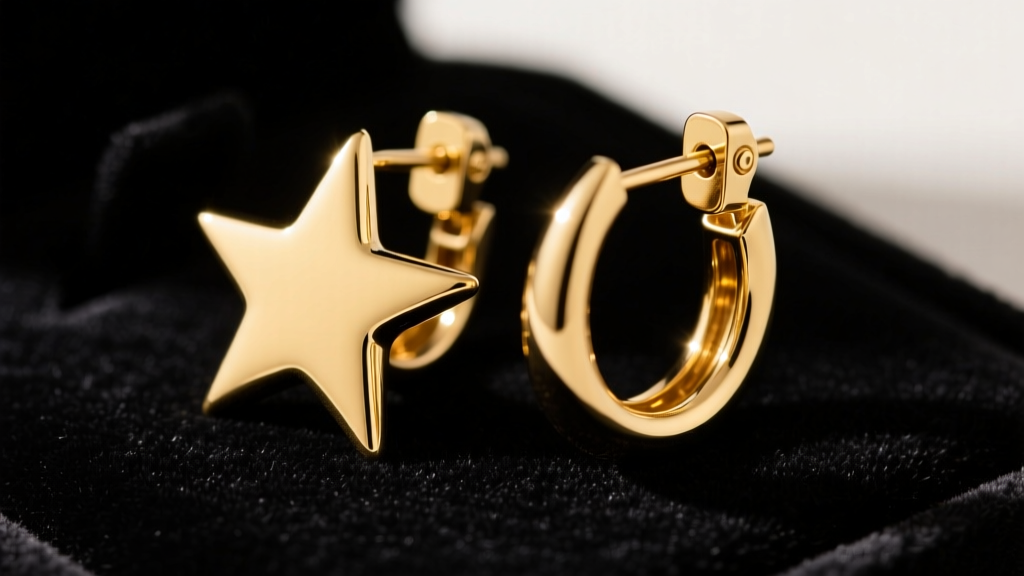
Star hoop earrings gold designs have surged in popularity, but their geometry introduces unique structural vulnerabilities that standard circular hoops do not face. In a traditional continuous hoop, stress is distributed evenly along the curvature of the wire. In a star-shaped hoop, the protruding points act as microscopic levers. When a star point catches on a sweater, hair, or even a towel, the torque is transferred directly to the solder joints or the thinnest sections of the wire, leading to warping, micro-fractures, or complete shearing. Furthermore, many modern star hoop earrings gold designs are CAD-cast rather than die-struck. While casting allows for intricate 3D star facets, it can introduce hidden porosity near the points, making them significantly more brittle. Understanding these failure modes is the first step in effective troubleshooting and long-term care for your gold star hoops.
Troubleshooting Bent and Warped Star Points
The most frequent issue reported with star hoop earrings gold is the bending of the star points. Because 14k and 18k gold alloys possess high malleability, a simple snag can pull a point out of alignment. The instinctual reaction is to push the point back into place with your fingers, but this is a critical error. Gold alloys undergo work hardening—a metallurgical process where the metal becomes harder and more brittle as it is deformed. Repeatedly bending a warped star point back and forth will rapidly induce metal fatigue, resulting in a clean snap.
The Proper Reshaping Technique
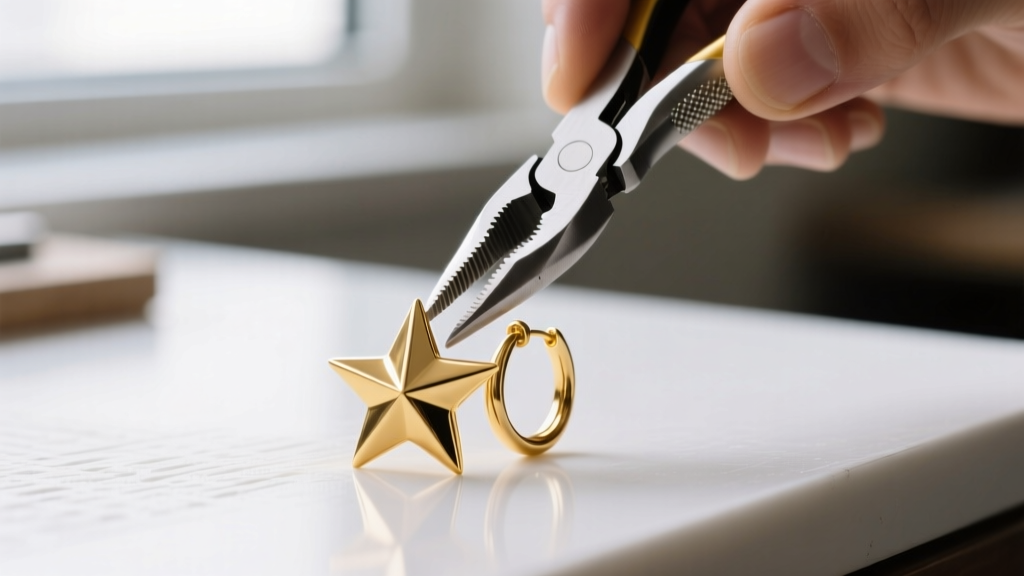
To safely correct a bent star point without inducing work hardening, you must use the correct tools and apply controlled, singular pressure. Never use standard steel jewelry pliers, as the hardened steel teeth will gouge the gold, leaving permanent scratches and creating stress concentrators where future breaks will occur.
- Step 1: Secure the main hoop wire in a padded bench vise or hold it firmly with a brass-jawed clamp to isolate the bent star point.
- Step 2: Use nylon jaw pliers or a rawhide mallet to apply gentle, continuous pressure to the bent point, coaxing it back into its original geometric alignment.
- Step 3: Inspect the solder joint where the star meets the hoop under a 10x jeweler's loupe. Look for hairline cracks or shadowing, which indicate structural compromise.
Resolving Hinge and Latch Clasp Failures
Star hoops are often front-heavy due to the added metal weight of the star motifs. This uneven weight distribution places excessive strain on the hinge and the latch clasp (often an omega back or a V-latch). If your star hoop earrings gold frequently pop open or feel loose, the issue is rarely a broken clasp; it is usually a loss of tension or debris accumulation.
Cleaning the Hinge Pin
Over time, dead skin cells, lotions, and microscopic dust pack into the hinge barrel, preventing the clasp from seating fully into the catch. Submerge the earring in an ultrasonic cleaner filled with a mild, ammonia-free jewelry solution for exactly three minutes. If an ultrasonic cleaner is unavailable, use a soft-bristled baby toothbrush dipped in warm water and a drop of Dawn dish soap to agitate the hinge barrel. Dry thoroughly with compressed air before testing the latch.
Adjusting the V-Latch Tension
If the clasp is clean but still fails to click securely, the V-shaped wire on the post has likely compressed. Using a fine burnisher or a specialized prong pusher, apply extremely light outward pressure to the V-wire to restore its spring tension. Test the closure; it should produce a crisp, audible snap. According to master jewelers at the Jewellers Academy, over-adjusting this wire will cause it to snap off the post entirely, so make micro-adjustments and test repeatedly.
Gold Purity vs. Durability: A Troubleshooting Matrix
When diagnosing why your star hoop earrings gold are failing, you must consider the karat weight. The purity of the gold dictates its Vickers Hardness (HV), which directly correlates to its resistance to bending and snagging. Below is a troubleshooting matrix to help you identify material-based failure modes.
| Gold Karat | Purity | Approx. Hardness (HV) | Primary Failure Mode | Troubleshooting Advice |
|---|---|---|---|---|
| 10k Gold | 41.7% | 130 - 140 HV | Brittle snapping at solder joints | Avoid extreme cold; requires laser welding if broken. |
| 14k Gold | 58.5% | 105 - 115 HV | Moderate bending of star points | Ideal for daily wear; reshape with nylon pliers. |
| 18k Gold | 75.0% | 80 - 90 HV | Severe warping and deep scratching | Reserve for occasional wear; store in individual hard cases. |
| 22k Gold | 91.6% | 55 - 65 HV | Total structural collapse under weight | Not recommended for star hoops; upgrade to 14k or 18k. |
As noted by the Gemological Institute of America (GIA), the alloy metals mixed with pure gold (such as copper, silver, and zinc) are what provide the tensile strength necessary for complex shapes like stars. If you frequently bend your 18k star hoops, consider having a jeweler re-cast them in 14k gold for superior structural integrity.
Preventing Lobe Stretch and Snagging Hazards
The weight of the star motifs, combined with the thickness of the wire, dictates how the earring interacts with your earlobe. Many mass-produced star hoop earrings gold are crafted with 20-gauge (0.81mm) wire to save on material costs. However, a 20-gauge wire bearing the weight of multiple star charms will act like a cheese wire, slowly slicing through and stretching the earlobe piercing over time.
Upgrading the Wire Gauge
For long-term lobe health, star hoops should be crafted with a minimum of 18-gauge (1.02mm) wire, with 16-gauge (1.29mm) being the optimal standard for hoops larger than 25mm in diameter. If your current hoops are causing lobe fatigue, consult a custom jeweler to have the star motifs removed and soldered onto a thicker, 16-gauge continuous wire.

Mitigating the Snag Factor
Sharp star points are notorious for catching on knitwear and hair. If your star hoops feature needle-sharp points, you can safely blunt them at home using a #4 cut needle file. Gently file the very tip of each star point to create a micro-bevel, removing the needle-like catch point. Follow this by polishing the filed area with a rouge cloth to restore the high-shine finish and prevent the raw gold from oxidizing or irritating the skin.
When to Seek Professional Intervention
While minor bends and clasp tension issues can be resolved at home, certain catastrophic failures require professional metallurgical intervention. If a star point has completely sheared off at the solder joint, or if the main hoop wire has fractured, do not attempt to use superglue or standard silver solder. These methods will leave a visible, weak seam that will immediately fail under the lever-action stress of the star shape.
"Laser welding is the only viable repair method for sheared star points on gold hoops. The pinpoint heat of the laser fuses the gold without melting the surrounding intricate facets or damaging the temper of the hinge."
A professional jeweler will use a laser welder to fuse the broken star point back to the hoop, often adding a microscopic amount of matching karat gold wire to reinforce the joint. After welding, the joint is sanded, polished, and rhodium-plated (if white gold) to ensure the repair is entirely invisible and structurally superior to the original factory solder. By understanding the unique physics of star-shaped jewelry, you can effectively troubleshoot issues and ensure your star hoop earrings gold remain a staple in your collection for decades.


