Repair and Clean Turquoise Beaded Hoop Earrings: Expert Guide
Learn how to restring, clean, and repair turquoise beaded hoop earrings. Expert troubleshooting for broken wires, dull stones, and bent hoops.

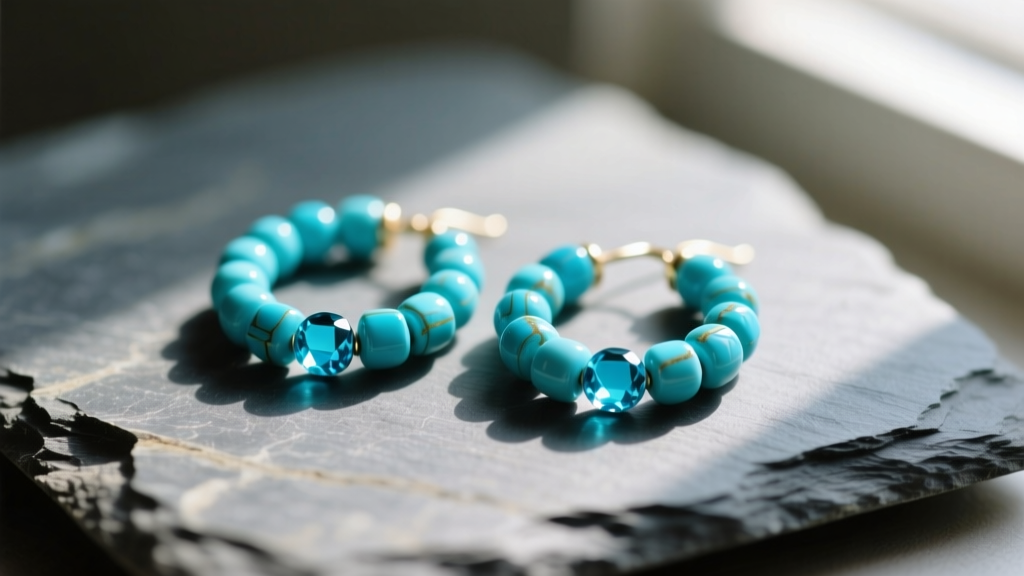
The Unique Vulnerabilities of Turquoise Beaded Hoops
Turquoise beaded hoop earrings are a staple of bohemian and Southwestern jewelry aesthetics, but their construction makes them uniquely prone to specific structural and cosmetic failures. Unlike solid metal hoops or simple stud earrings, beaded hoops rely on a flexible inner wire threaded through rigid gemstones, which is then anchored to a metal clasp system. This creates a complex stress environment where friction, moisture, and tensile weight constantly battle the integrity of the piece.
Turquoise itself is a hydrous phosphate of copper and aluminum, ranking between 5 and 6 on the Mohs hardness scale. This relative softness and high porosity mean the beads can easily chip against one another or absorb skin oils, leading to internal wire degradation and stone discoloration. According to the Gemological Institute of America (GIA), turquoise is highly sensitive to chemicals, heat, and prolonged exposure to water, making standard jewelry cleaning methods potentially destructive. To effectively troubleshoot and repair these earrings, you must first identify whether your stones are natural, stabilized (impregnated with clear resin), or reconstituted, as this dictates your repair and cleaning strategy.
Troubleshooting Broken or Frayed Beading Wire
The most common failure point in turquoise beaded hoop earrings is the snapping or fraying of the inner beading wire. This usually occurs at the crimp point near the clasp or where the wire bends sharply to enter the hoop frame. If your beads are sliding off or the wire has snapped, restringing is mandatory. Do not attempt to simply tie a knot in beading wire; it will fail under the weight of the stones.
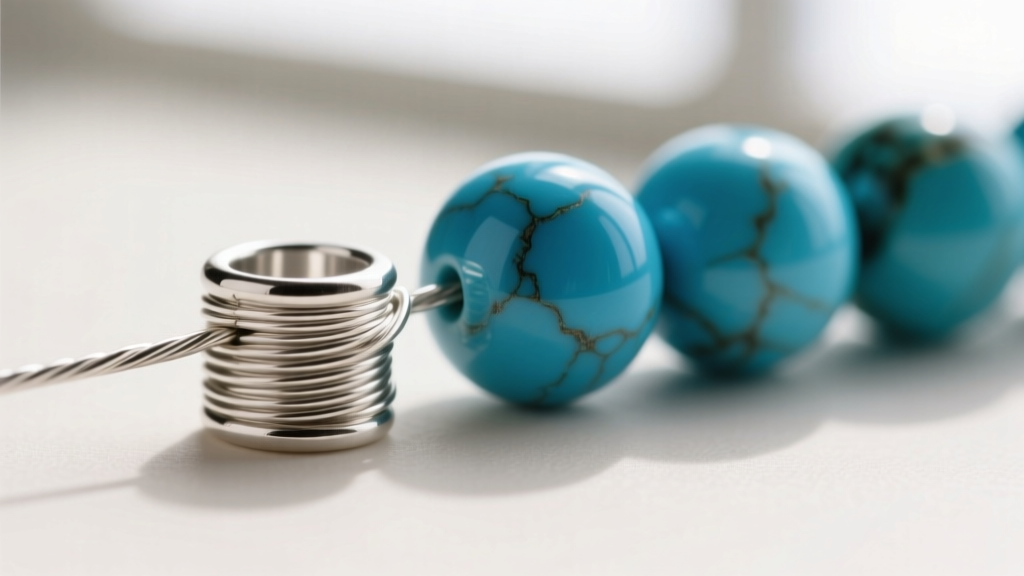
Step-by-Step Restringing Guide
When restringing, material selection is critical. According to Fire Mountain Gems, nylon threads are insufficient for heavy stone beads due to their low abrasion resistance against the sharp inner holes of turquoise.
- Select the Right Wire: Use a 49-strand micro-braided stainless steel beading wire coated in nylon. For standard 4mm to 6mm turquoise beads, a 0.018-inch diameter wire offers the perfect balance of drape and tensile strength. For larger 8mm+ beads, upgrade to a 0.024-inch diameter.
- Use Proper Crimps: Discard round crimp beads. They often slip on braided steel wire. Instead, use 2x2mm sterling silver or gold-filled crimp tubes. The tubular shape provides more surface area for the wire to grip.
- The Micro-Crimp Technique: Thread the wire through the crimp tube, loop it through the clasp ring, and pass it back through the tube. Leave a 2mm tail. Using specialized micro-crimping pliers, compress the tube into a U-shape, then fold the U in half to create a secure, rounded bead-like lock.
- Tension Check: Before final crimping, ensure the beads have a microscopic amount of 'play' (about 1mm of movement). If strung too tightly, the wire will snap the moment the hoop is bent into its circular shape.
Solving Turquoise Discoloration and Dulling
Because natural turquoise is highly porous, it acts like a sponge for environmental contaminants. Sunscreen, perfume, sweat, and even the natural acidity of your skin can cause the vibrant robin's-egg blue to shift to a muddy green or brown over time. Stabilized turquoise, which has been treated with an epoxy resin to harden the stone and lock in color, is far more resistant to this issue.
Cleaning Agents vs. Turquoise Reactions
Never use ultrasonic cleaners, steam cleaners, or harsh chemical dips on turquoise jewelry. The high-frequency vibrations can shatter the stones, and chemicals will strip the natural waxes or resins used in stabilization.
| Cleaning Method | Effect on Natural Turquoise | Effect on Stabilized Turquoise |
|---|---|---|
| Ultrasonic Cleaner | High risk of fracturing; destroys polish | Can cause resin clouding and micro-fractures |
| Mild Dish Soap & Water | Safe for quick wiping; do not soak | Completely safe; best for removing oils |
| Commercial Silver Dip | Will permanently stain and etch the stone | May cause surface pitting if left too long |
| Soft Dry Polishing Cloth | Safe; removes surface dust and light oils | Safe; restores high-gloss resin finish |
If your natural turquoise has already absorbed oils and darkened, the damage is largely permanent. However, you can gently buff the surface with a dry, untreated microfiber cloth to restore some surface luster. For heavy grime, lightly dampen a cotton swab with distilled water and a single drop of pH-neutral baby soap, swab the bead quickly, and immediately dry it with a soft cloth.
Fixing Bent Hoop Frames and Clasp Misalignment
Beaded hoops are frequently subjected to lateral pressure when being removed or stored, leading to warped metal frames and misaligned clasps. If the hoop no longer forms a perfect circle, the tension on the beading wire becomes uneven, accelerating wire fatigue.
Reshaping the Wire Frame
To reshape a bent 20-gauge or 18-gauge sterling silver or gold-filled hoop frame, never use standard metal jewelry pliers, as the steel teeth will permanently gouge the precious metal. Instead, use nylon-jaw pliers. Gently grip the warped section and apply slow, even pressure to bend it back into a circular alignment. Work in small increments, constantly checking the hoop against a flat surface to ensure it lies perfectly flat.
Adjusting Latch-Back Clasps
The weight of turquoise beads often pulls downward on the earring, causing latch-back clasps to pop open or fail to click shut. If the latch won't click, the 'V' shaped catch on the ear wire is likely bent outward. Use flat-nose pliers to gently squeeze the sides of the 'V' catch inward by a fraction of a millimeter. If the hinge pin is loose and causing lateral wobble, a professional jeweler will need to re-peen the pin ends to tighten the tolerance.
Preventing Earlobe Strain from Heavy Beaded Hoops
Turquoise is a dense, relatively heavy gemstone. A fully beaded 2-inch hoop can easily weigh 15 to 25 grams per earring. This concentrated weight on a standard 20-gauge ear wire will cause the earlobe to stretch, droop, and eventually tear over time. Furthermore, the downward pull changes the angle of the hoop, causing the back of the earring to rest awkwardly against the neck.
Structural Support Solutions
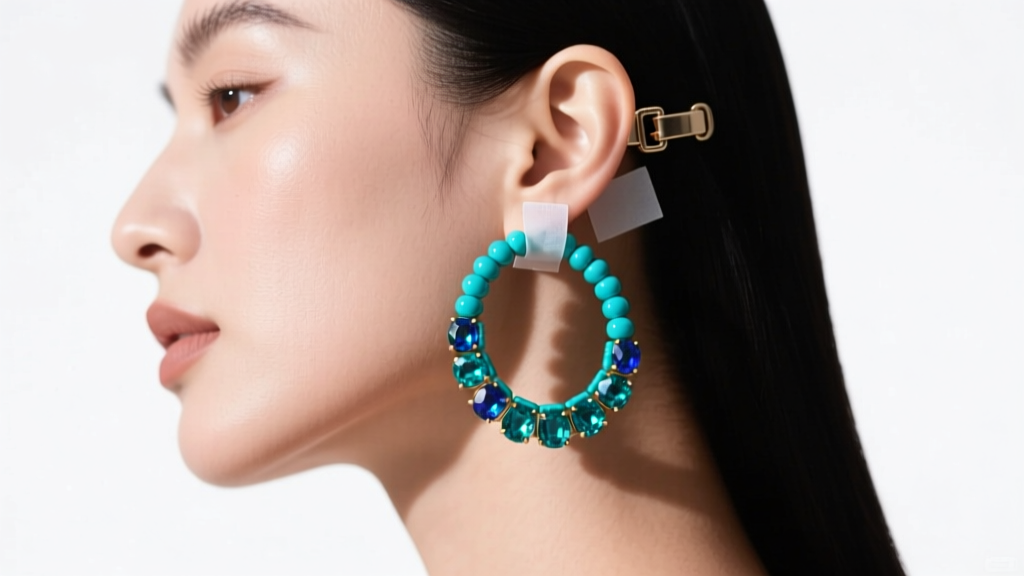
- Silicone O-Ring Backers: Replace standard butterfly friction backs with thick, medical-grade silicone O-rings. These distribute the friction across a wider surface area of the earlobe, reducing the 'cheese-cutter' effect of thin wires.
- Adhesive Lobe Support Patches: Products like BlingDots or generic earlobe support patches are small, clear, adhesive foam discs that stick to the back of the earlobe. The earring wire passes through the patch, which acts as a structural splint, preventing the lobe from bending forward under the weight of the turquoise beads.
- Wire Gauge Upgrades: If you are designing or commissioning custom beaded hoops, insist on an 18-gauge or 16-gauge ear wire. Thicker wire resists bending and distributes weight more evenly across the piercing channel.
Pro Tip: Always store turquoise beaded hoop earrings hanging vertically on a jewelry tree or laid perfectly flat in a lined box. Tossing them into a drawer guarantees the inner beading wire will develop stress fractures at the crimp points, leading to sudden bead loss.
When to Seek Professional Jeweler Intervention
While restringing and basic reshaping can be handled at home with the right tools, certain failures require a bench jeweler. If the actual metal hoop frame has snapped (rather than just bent), soldering is required. Soldering a beaded hoop is highly complex because the intense heat of the torch will instantly destroy the turquoise beads. A professional will need to carefully remove all beads, cut out the damaged wire section, solder the frame, polish the metal, and then restring the stones. Additionally, if your turquoise beads are displaying deep, structural cracking rather than mere surface scratching, a jeweler can assess if the stones can be stabilized with specialized lapidary resins before they crumble entirely.


