Restoring & Repairing Vintage Green Art Deco Earrings
Learn how to troubleshoot, clean, and repair vintage green Art Deco earrings. Expert fixes for chipped enamel, verdigris, and broken screw-backs.

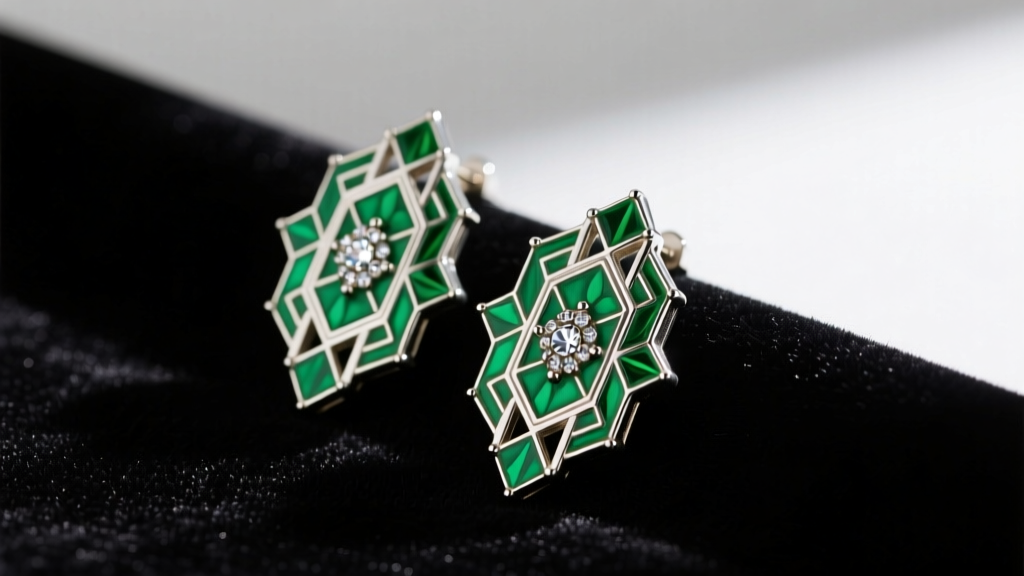
The Art Deco era (roughly 1920 to 1939) produced some of the most striking jewelry in history, characterized by bold geometric patterns, high contrast, and innovative materials. Among the most coveted pieces today are green Art Deco earrings, which frequently feature vibrant materials like chrysoprase, jade, green onyx, Bakelite, and guilloché enamel. However, surviving vintage pieces often arrive in your collection with significant wear, mechanical failures, or material degradation. Restoring these earrings requires a precise understanding of period-specific materials and modern conservation techniques.
Material Diagnostics: What Are You Actually Fixing?
Before applying any solvent or adhesive, you must accurately identify the materials. The 1920s and 30s saw a transitional period in jewelry manufacturing, meaning a single pair of earrings might combine precious metals with early synthetics.
Bakelite vs. Celluloid vs. Lucite
Green Bakelite was highly prized for its deep, opaque apple-green hues. To authenticate and assess its condition, use the Simichrome polish test: apply a small amount of Simichrome on a cotton swab and rub an inconspicuous area. If the swab turns yellow, it is likely Bakelite. Conversely, if the green material exhibits 'crazing' (a network of fine cracks) or smells faintly of camphor when rubbed, it is celluloid. Celluloid is highly unstable, flammable, and prone to spalling; it should never be exposed to heat or harsh chemicals during repair. Lucite, introduced later in the 1930s, is more stable but prone to surface scratching.
Pot Metal and Brass Bases
Many affordable Art Deco earrings were cast from 'pot metal' (a zinc-heavy alloy) or stamped from brass. These base metals are highly susceptible to oxidation and structural fatigue. If the metal feels unusually lightweight or shows signs of pitting beneath the plating, you are likely dealing with pot metal, which cannot be soldered using standard jeweler's torches due to its low melting point.
Troubleshooting Enamel, Marcasite, and Stone Damage
The visual impact of green Art Deco earrings relies heavily on the contrast between vibrant green elements and metallic or crystalline accents. Damage to these components requires specialized triage.
Guilloché Enamel Flaking
Guilloché involves fusing translucent glass enamel over an engine-turned, patterned metal base. According to the Lang Antiques University, the primary failure mode for guilloché is flaking caused by microscopic impacts or temperature shock. If you encounter lifting enamel, do not attempt to glue it down with standard cyanoacrylate (Super Glue), which will cloud the glass and ruin the optical effect. Instead, use a conservation-grade acrylic resin like Paraloid B-72, applied with a micro-brush under magnification, to stabilize the edges and prevent further delamination.
Marcasite Stone Loss
Marcasite (actually pyrite) was a staple of Art Deco pavé settings. These stones are typically set using tiny metal beads or prongs. When stones fall out, the empty settings can be re-filled using a two-part jeweler's epoxy (such as Devcon 5-Minute Epoxy) tinted with a microscopic amount of black pigment to mimic the dark oxidized background. Press the replacement marcasite into the epoxy and use a fine needle to push the surrounding metal beads over the girdle of the stone before the epoxy cures.
Cloudy Chrysoprase and Jade
Chrysoprase and jade were the premier green stones of the era. The Gemological Institute of America (GIA) notes that chrysoprase contains trace amounts of nickel, which can cause the stone to fade or turn cloudy if exposed to prolonged heat or intense sunlight. To restore luster to cloudy chrysoprase, tumble it gently in a rotary tumbler with walnut shell media and a mild jewelry polish. Do not use ultrasonic cleaners, as the vibrations can fracture internal inclusions common in vintage jade and chrysoprase cabochons.
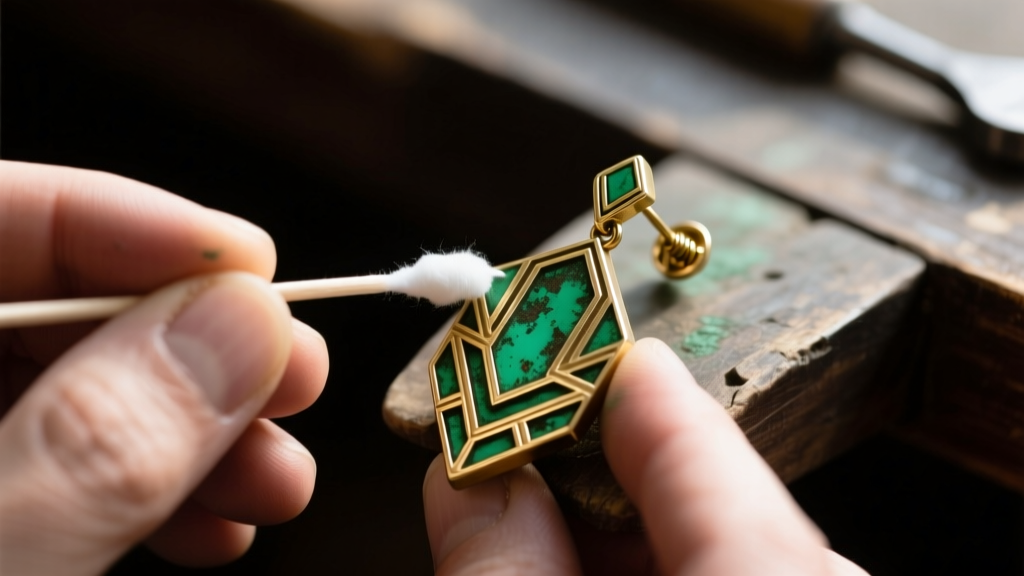
The Verdigris Eradication Protocol
Verdigris—the green, crusty copper acetate buildup that forms on brass and copper alloys—is the most common issue with vintage Art Deco earrings. It is highly corrosive and can cause skin irritation. Eradicating it requires a neutralization process, not just physical scraping.
- Mechanical Removal: Use a fiberglass scratch brush or a wooden dental pick to gently dislodge the bulk of the crusty buildup. Avoid steel tools, which will scratch the underlying brass or silver plating.
- Chemical Dissolution: Dip a cotton swab in distilled white vinegar and apply it directly to the remaining verdigris. The acetic acid will dissolve the copper salts. Limit application to 30 seconds per area to prevent the acid from eating into the base metal.
- Neutralization: Immediately follow the vinegar application with a swab dipped in a baking soda and distilled water paste. This halts the acidic reaction.
- Sealing: Once the piece is completely dry, apply a micro-thin layer of Renaissance Micro-Crystalline Wax to the treated area. This creates a moisture barrier that prevents oxygen and humidity from triggering new oxidation.
Upgrading Failing Vintage Findings
Vintage screw-backs and clip-ons are notorious for failing. Screw-back threads strip over time, and clip-on springs lose their tension, leading to lost earrings. Rather than struggling with worn vintage mechanisms, many collectors and jewelers opt to convert these pieces to modern friction posts or lever-backs.
| Vintage Finding Issue | Diagnostic Symptom | Modern Upgrade Solution | Required Tools & Materials |
|---|---|---|---|
| Stripped Screw-Backs | Post spins freely without tightening against the earlobe. | Cut off screw-back; solder or epoxy an 18-gauge sterling silver friction post. | Flush cutters, G-S Hypo Cement or laser welder, 18g sterling posts. |
| Weak Clip-On Springs | Earring slides off the earlobe with minor head movement. | Replace the entire clip mechanism with a modern padded clip-on or convert to a 20-gauge fishhook wire. | Jeweler's saw, two-part epoxy, 20g sterling wire, nylon jaw pliers. |
| Bent Pot Metal Posts | Post is warped and cannot pass through a standard ear piercing. | Do not bend back (pot metal snaps). Cut and epoxy a heavy-duty 16-gauge or 18-gauge steel post. | Heavy-duty flush cutters, Devcon 5-Minute Epoxy, 16g steel posts. |
When using epoxy to attach modern posts to non-solderable pot metal bases, scoring the base metal with a coarse file and roughing up the post base with 220-grit sandpaper will increase the surface area and create a mechanical bond that significantly outlasts a simple glue application.
Preventative Storage for Long-Term Preservation
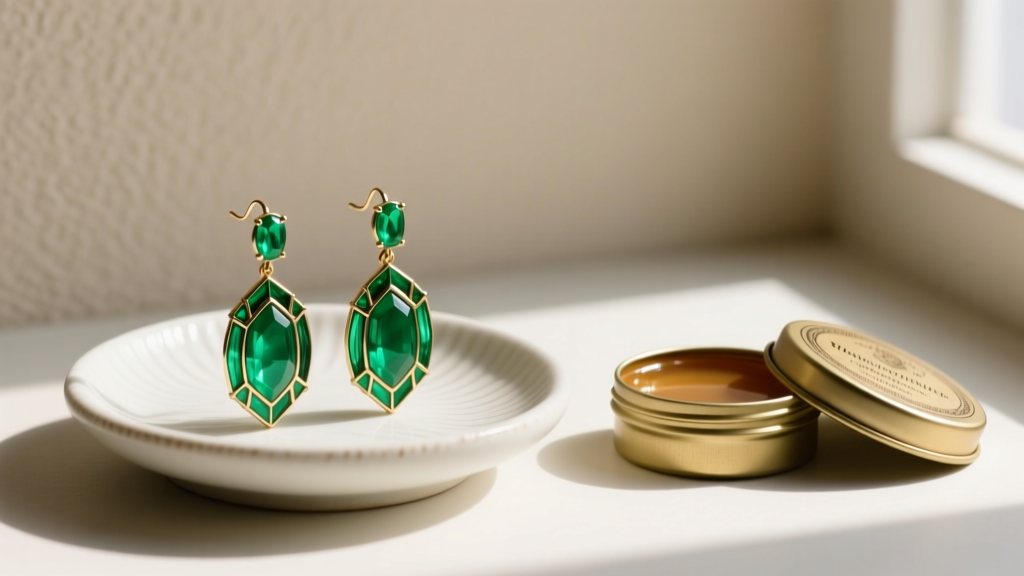
Once your green Art Deco earrings are restored, proper storage is critical to maintaining their condition. Early plastics like Bakelite and celluloid require oxygen to remain stable; storing them in airtight plastic bags or PVC containers can cause a chemical reaction known as 'blooming,' where a white, powdery residue forms on the surface. Instead, store these earrings in acid-free, unbleached cotton pouches or wrap them in unbuffered archival tissue paper. Keep them in a climate-controlled environment with a relative humidity of 45-55% to prevent the metal bases from expanding and contracting, which is the primary catalyst for enamel cracking and stone popping.
By approaching restoration with a diagnostic mindset and utilizing conservation-grade materials, you can ensure that these striking geometric masterpieces survive for another century of wear.


