Death Note Ryuk Earring: Technical Guide to Heavy Cosplay Jewelry
Master the Death Note Ryuk earring look safely. Our expert guide covers gauge sizes, titanium vs steel, weight distribution, and secure backings.

The Biomechanics of Anime Cosplay Jewelry
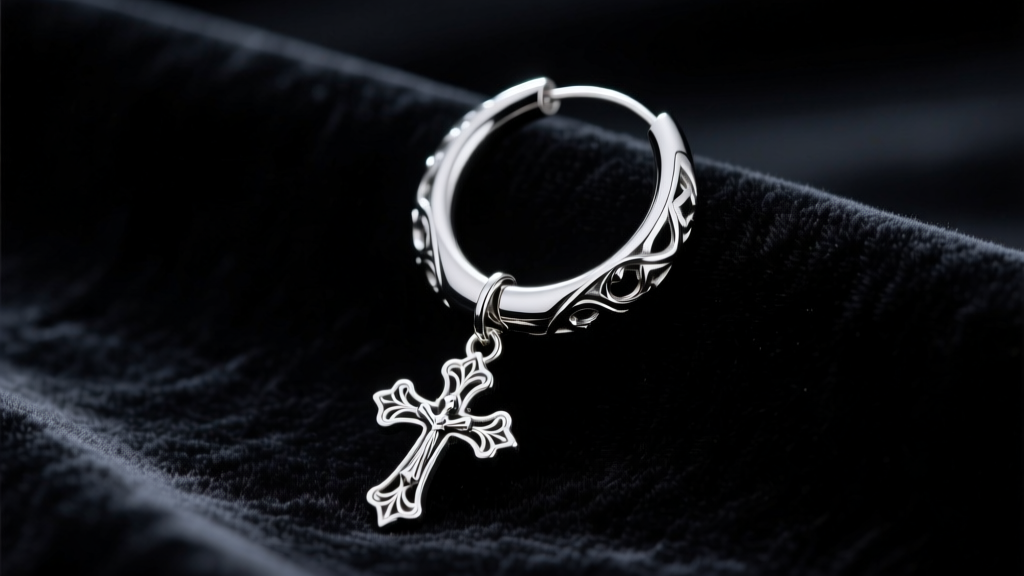
When replicating the iconic Death Note Ryuk earring, cosplayers and anime jewelry enthusiasts often prioritize visual accuracy over biomechanical safety. In Takeshi Obata’s canonical character designs, Ryuk sports oversized, heavy metallic hoops with dangling cross or spike motifs. While visually striking, translating these 2D designs into 3D wearable objects introduces significant physical challenges. A standard mass-market anime earring might weigh between 15 and 30 grams. When suspended from a standard earlobe piercing, this weight creates a pendulum effect, generating shear stress that can lead to the dreaded 'cheese-cutter effect'—where the jewelry slowly migrates through the tissue, ultimately tearing the earlobe.
As of 2026, the cosplay community has largely shifted away from cheap convention-floor merchandise toward technically sound, body-safe jewelry. This deep dive explores the metallurgy, structural engineering, and anatomical considerations required to wear heavy, oversized Shinigami-style earrings safely and comfortably for extended periods.
Anatomy and Canonical Dimensions
To accurately recreate the Death Note Ryuk earring, one must first understand the scale. Canonical artwork suggests an outer hoop diameter of approximately 45mm to 55mm, with a dangling pendant (usually a gothic cross or spiked cylinder) adding another 25mm to 35mm in length. The total vertical drop often exceeds 80mm.
This extreme length acts as a lever. Every time the wearer turns their head, the momentum of the dangling cross pulls laterally on the earlobe fistula (the piercing channel). If the jewelry is made from dense metals like solid brass or low-grade steel, the sheer mass exacerbates this lateral pull. Therefore, the primary engineering goal for a high-quality Ryuk earring is minimizing mass without sacrificing the dark, metallic aesthetic required for the Shinigami realm.
Material Science: ASTM F136 Titanium vs. 316L Steel
The vast majority of budget anime earrings are cast from zinc alloy or low-grade brass, then electroplated with a silver-colored nickel finish. According to the American Academy of Dermatology, nickel is the leading cause of contact dermatitis. When heavy earrings pull on the skin, they create micro-abrasions in the piercing channel, allowing nickel ions to enter the bloodstream and trigger severe allergic reactions, swelling, and hypergranulation.
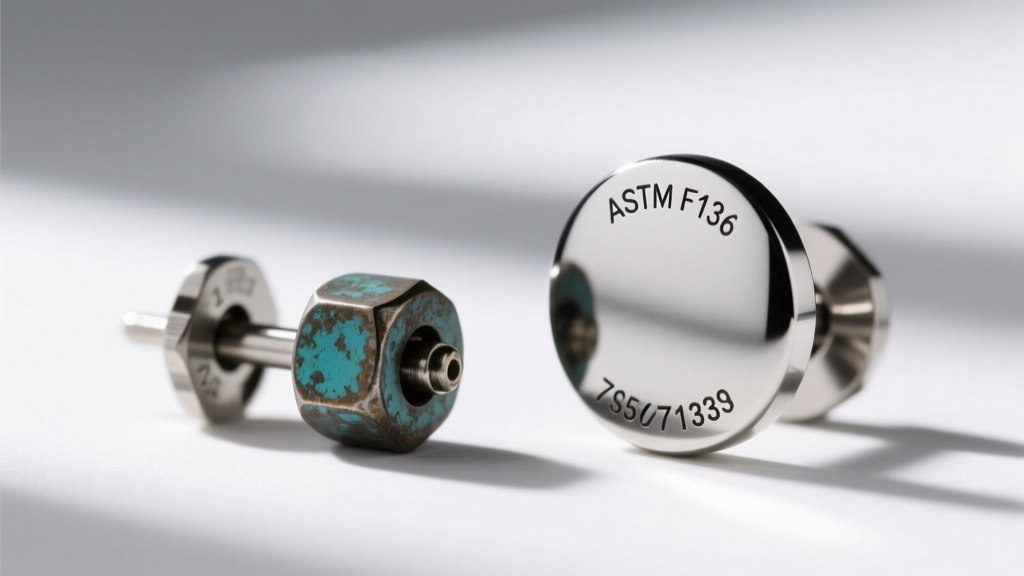
For a safe, convention-ready Death Note Ryuk earring, you must demand implant-grade materials. The two acceptable standards are:
- 316L Surgical Stainless Steel: A solid, affordable choice. It contains low levels of nickel, but the chromium oxide layer traps it. However, steel is dense. A 50mm 316L steel hoop with a cross drop can easily weigh 22 grams.
- ASTM F136 Implant-Grade Titanium: The gold standard recommended by the Association of Professional Piercers (APP). Titanium is entirely nickel-free and, crucially, 45% lighter than surgical steel. A custom-machined titanium Ryuk earring will weigh roughly 12 grams, drastically reducing earlobe fatigue during a 10-hour cosplay event.
Gauge Sizing and Weight Distribution
Standard lobe piercings are typically done at 20G (0.81mm) or 18G (1.02mm). However, these gauges are entirely insufficient for heavy cosplay drops. The thinner the wire, the higher the pounds-per-square-inch (PSI) of pressure exerted on the bottom of the piercing channel. To safely wear heavy hoops, the wire thickness must be increased to distribute the load.
| Gauge (AWG) | Wire Diameter | Material | Max Safe Continuous Weight | Suitability for Ryuk Hoops |
|---|---|---|---|---|
| 20G | 0.81 mm | Any | 3 - 5 grams | Unsafe (High tear risk) |
| 18G | 1.02 mm | Titanium | 8 - 10 grams | Poor (Requires support patches) |
| 16G | 1.29 mm | 316L Steel | 12 - 15 grams | Moderate (Good for medium hoops) |
| 14G | 1.63 mm | Titanium | 20 - 25 grams | Excellent (Ideal for heavy drops) |
| 12G | 2.05 mm | Titanium | 30+ grams | Superior (Oversized/Chunky builds) |
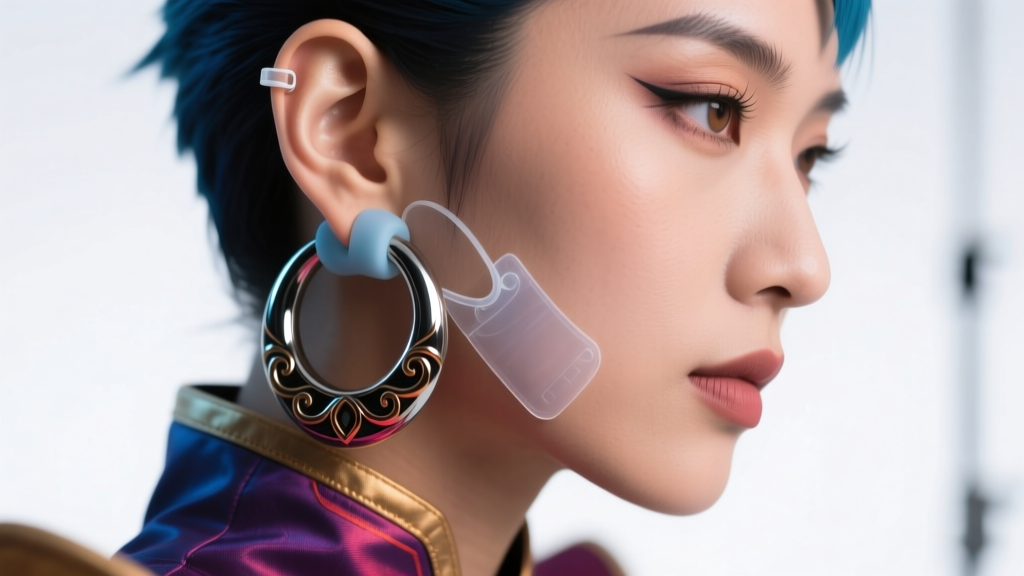
If your lobes are only pierced at 18G and you refuse to stretch them, you cannot safely wear a 20-gram steel Ryuk earring without external reinforcement. You must utilize transparent silicone earlobe support patches (such as Lobe Wonder) which adhere to the back of the ear and feature a reinforced mesh that distributes the shear force across a 15mm surface area rather than a 1mm puncture point.
Structural Failure Points in Mass-Market Replicas
Beyond the earlobe, the jewelry itself is prone to catastrophic failure. The most common point of failure in budget Death Note merchandise is the jump ring connecting the dangling cross to the main hoop. Manufacturers use unsoldered split rings to save time. Under the pendulum stress of walking or headbanging at a convention, the split ring slowly pulls apart, resulting in the loss of the cross pendant.
When commissioning or purchasing a high-end replica, inspect the connection points. The drop should be attached via a soldered jump ring (where the seam is fused shut with laser welding) or integrated directly into a Captive Bead Ring (CBR) mechanism where the cross itself acts as the tension-held bead. Furthermore, the hoop closure should not be a simple butt-joint (where two blunt ends meet); it should feature a precision-machined hinge or a secure clicker mechanism to prevent the hoop from sliding out of the ear unexpectedly.
Secure Backing Systems for Heavy Drops
The traditional 'butterfly' friction back is useless for heavy cosplay jewelry. The friction grip is easily overcome by the downward pull of a 50mm hoop, causing the earring to slide out and get lost on the convention floor. For the Death Note Ryuk earring, you must upgrade your backing system:
- Threaded Screw-Backs: Ideal for 14G or 12G posts. The backing screws onto a threaded post, making it physically impossible for the earring to slide out. Internal threading (where the post has the hole and the back has the screw) is preferred to avoid damaging the piercing channel during insertion.
- Silicone O-Rings: If using a standard straight post or a hoop with a removable ball, thick 3mm silicone O-rings provide vastly superior grip compared to metal friction backs. They stretch over the post and grip the skin, providing a buffer that prevents the metal from digging into the neck.
- Flat-Back Labret Posts: For extreme weights, some custom jewelers redesign the Ryuk hoop to hang from a flat-back labret post. The flat disc rests flush against the back of the earlobe, providing a massive surface area for weight distribution, completely eliminating the risk of the post pulling through the hole.
Sourcing, Pricing, and Commissioning
Finding the perfect balance of accuracy, safety, and budget requires knowing where to look. The market for anime jewelry is highly stratified:
- Mass-Market (AliExpress, Amazon, Convention Vendors): Priced between $8 and $15. These are almost exclusively zinc alloy, 20G or 18G, with unsoldered jump rings and nickel plating. They are acceptable for a 30-minute photoshoot but dangerous for all-day wear.
- Mid-Tier Artisans (Etsy, Instagram Jewelers): Priced between $25 and $50. Usually crafted from 316L stainless steel at 16G. These offer good durability and visual accuracy, though they may still be heavy for sensitive lobes.
- Custom Piercing Studios & Master Fabricators: Priced from $75 to $150+. Commissioning a local APP-certified piercer or a specialized metalsmith to CNC-mill or 3D-cast the earring in ASTM F136 titanium ensures a flawless, lightweight, body-safe piece. You can request custom anodization to give the titanium a dark, gunmetal grey or oxidized black finish, perfectly matching Ryuk’s macabre aesthetic without relying on toxic chemical patinas or flaking paint.
Final Verdict for Cosplayers
The Death Note Ryuk earring is a masterclass in character design, but it demands respect for human anatomy. By prioritizing ASTM F136 titanium, upgrading to a 14G or 12G wire thickness, and utilizing secure threaded backings or support patches, you can maintain the imposing Shinigami silhouette without sacrificing the structural integrity of your earlobes. Invest in the engineering, and the cosplay will endure.


