Rhombus Earrings: Technical Design, Materials & Fit Guide
Explore the engineering behind rhombus earrings. Learn about material grades, anti-flip mechanics, gauge sizing, and edge finishing for optimal wear.

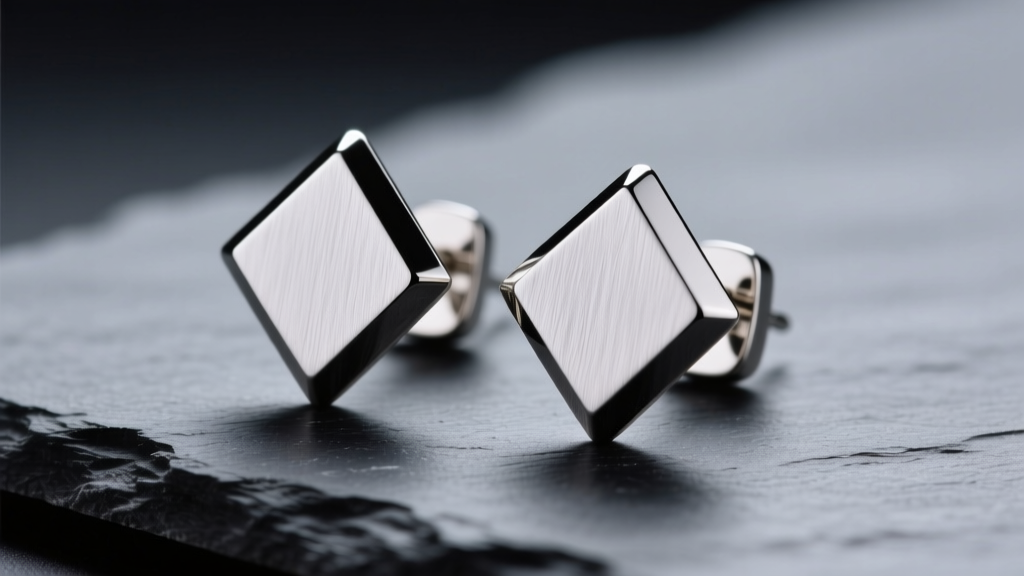
The Geometry of Rhombus Earrings: Why Angles Matter
While often categorized simply as 'geometric jewelry,' rhombus earrings present a unique set of engineering challenges that separate mass-produced accessories from fine jewelry. A true rhombus is a parallelogram with four equal sides, resulting in two acute angles (less than 90 degrees) and two obtuse angles (greater than 90 degrees). From a structural perspective, the acute vertices are the primary failure points and the greatest risk for wearer injury.
In jewelry manufacturing, sharp angles act as stress concentrators. When a rhombus earring is dropped or subjected to lateral tension, the kinetic energy transfers directly to the acute tips. If the metal has not been properly annealed or work-hardened, these vertices will bend, warp, or snap entirely. Furthermore, acute angles below 45 degrees pose a severe snagging hazard, easily catching on knitwear or hair, which can result in traumatic earlobe tearing.
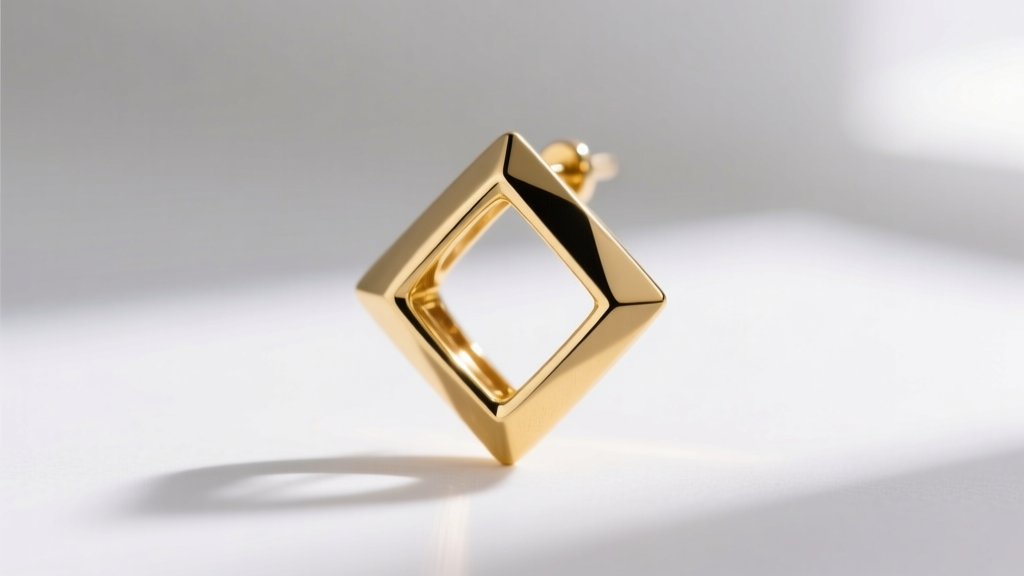
Material Selection and Structural Integrity
The choice of alloy dictates the lifespan of a rhombus earring. Soft metals like pure 24k gold or 999 fine silver are entirely unsuitable for the acute vertices of geometric drops due to their low Vickers Hardness (HV). They will deform upon the first impact. Instead, expert jewelers rely on specific alloy blends that balance malleability during the manufacturing process with rigid durability for daily wear.
| Material Grade | Vickers Hardness (HV) | Vertex Durability | Average Price Range (Pair) |
|---|---|---|---|
| Grade 23 Titanium (Ti-6Al-4V) | 300 - 330 HV | Exceptional (Hypoallergenic) | $85 - $150 |
| 316L Surgical Stainless Steel | 150 - 190 HV | High (Requires PVD coating) | $35 - $75 |
| 14k Yellow Gold (58.5% Au) | 130 - 160 HV | High (Premium standard) | $350 - $800 |
| Sterling Silver (92.5% Ag) | 60 - 80 HV | Moderate (Prone to bending) | $45 - $120 |
According to metallurgical guidelines from Rio Grande, when working with sterling silver or 14k gold for geometric shapes, the metal must undergo precise annealing cycles. If a rhombus is die-struck, the acute corners undergo extreme compression. Without intermediate annealing, the grain structure at the tips becomes brittle, leading to micro-fractures that eventually cause the vertex to snap off.
Ergonomics and Anti-Flip Mechanics
One of the most common complaints regarding geometric drop earrings is the 'forward flip'—where the earring rotates 180 degrees on the earlobe, showing the post and clutch instead of the decorative face. This is a physics problem related to the center of gravity.
Recalculating the Y-Axis Soldering Point
In a standard top-heavy rhombus drop, the mass is concentrated in the lower half of the shape. If the earring post is soldered exactly at the topmost acute vertex, the center of gravity sits below the pivot point (the earlobe piercing), creating a pendulum effect. To counteract this, master jewelers shift the post soldering point down the Y-axis by 2mm to 4mm. This raises the center of gravity closer to the pivot point, stabilizing the earring and preventing the forward flip.
Clutch and Backing Solutions
For heavier solid gold rhombus earrings (exceeding 6 grams per earring), standard butterfly friction backs are insufficient. The narrow surface area of a butterfly back allows the earring to tilt downward, stretching the piercing. Upgrading to a flat-backed omega clutch or a jumbo silicone disc distributes the weight across a wider surface area of the earlobe, maintaining the rhombus in a strict vertical alignment.
Edge Finishing Techniques for Acute Vertices
How a rhombus earring feels against the skin is entirely dependent on the edge finishing technique. Mass manufacturers often rely on vibratory tumbling to polish jewelry. However, standard ceramic tumbling media cannot penetrate tight acute angles (less than 60 degrees). This leaves the acute vertices rough, sharp, and unfinished.

High-end geometric jewelry requires a secondary hand-finishing process known as micro-beveling. Using a flex-shaft rotary tool with a fine grit polishing bob, the jeweler manually shaves a microscopic 45-degree chamfer onto the sharp edges of the acute vertices. This removes the 'knife-edge' effect, ensuring the earring glides over skin and fabric without laceration or snagging. When inspecting rhombus earrings for purchase, run a cotton swab along the acute tips; if the cotton catches or tears, the micro-beveling was skipped.
Sizing, Gauge, and Piercing Compatibility
The structural demands of a rhombus shape extend to the earring post or wire itself. The gauge (thickness) of the metal passing through the earlobe must be matched to the overall weight and surface area of the rhombus drop to prevent the 'cheese-cutter effect'—a phenomenon where a thin wire slowly migrates through the earlobe tissue due to constant gravitational pull.
- 20 Gauge (0.81mm): Suitable only for lightweight, hollow, or stamped sheet-metal rhombus studs weighing under 2 grams.
- 18 Gauge (1.02mm): The optimal standard for solid metal rhombus drops ranging from 3 to 7 grams. Provides sufficient rigidity to prevent bending.
- 16 Gauge (1.29mm): Mandatory for oversized, heavy statement rhombus earrings (8+ grams) or for wearers with previously stretched or fragile earlobe piercings.
For those with sensitive or newly healed piercings, the Association of Professional Piercers (APP) strongly recommends internally threaded or threadless (push-pin) posts. Externally threaded posts feature microscopic ridges that can harbor bacteria and tear the delicate fistula of the piercing upon insertion, a risk amplified when dealing with the heavier weight of geometric drops.
Troubleshooting Common Rhombus Earring Failures
Even well-crafted rhombus earrings can experience mechanical failures over time. Understanding these failure modes allows collectors and jewelers to diagnose and repair them effectively.
The Porosity Problem in Cast Rhombus Earrings: When rhombus earrings are created via CAD and lost-wax casting, the molten metal cools at different rates. The acute tips cool much faster than the thick center. This uneven cooling can trap gas bubbles, resulting in porosity (tiny internal voids) near the vertices. If a cast rhombus earring snaps cleanly near the tip, it is likely due to subsurface porosity, not normal wear and tear.
Post Detachment: Because rhombus studs often feature a wide, flat backplate, the post is usually laser-welded or soldered to a broad surface area. If the post snaps off, avoid using cyanoacrylate (super glue) for repairs. The chemical breakdown of the glue will react with the skin's natural oils and the metal alloy, causing contact dermatitis. Always seek a professional jeweler to re-laser-weld the post, which fuses the metals at a molecular level without introducing foreign adhesives.
By understanding the intricate balance of geometry, metallurgy, and ergonomics, you can select rhombus earrings that are not only visually striking but engineered to last a lifetime of daily wear.


