Rotating Earring Holder 2026: Budget & Value Assessment
Discover if a rotating earring holder is worth your money in 2026. We compare materials, mechanisms, and price tiers to find the best storage value.

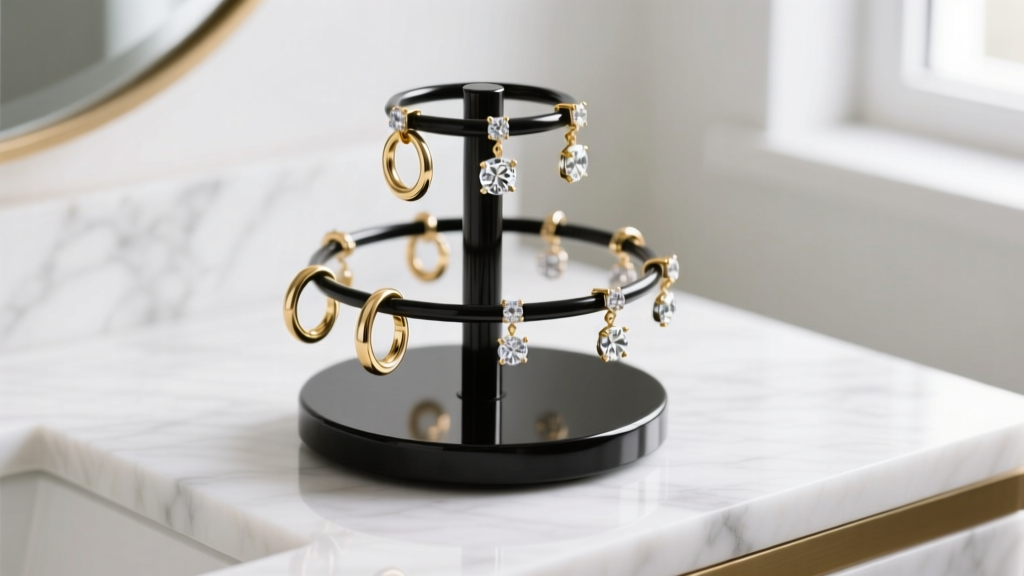
The True Cost of Earring Storage: Why Rotation Matters
As jewelry collections evolve from a few basic studs to an expansive array of hoops, drops, and statement pieces, the necessity for efficient organization becomes undeniable. Enter the rotating earring holder—a vertical storage solution designed to maximize capacity while minimizing dresser footprint. But with the market flooded with options ranging from $15 acrylic novelties to $150 architectural steel towers, how do you determine the actual value? In 2026, assessing the budget and value of a rotating earring holder requires looking far beyond the sticker price. True value is calculated through a matrix of material longevity, mechanical smoothness, jewelry preservation, and spatial efficiency. A cheap tower that micro-scratches your 14k gold posts or tips over under the weight of brass dangles is a net loss, regardless of its low initial cost.
Post Gauge Precision and Hole Quality
The most critical, yet frequently overlooked, point of contact between your jewelry and your storage is the earring hole itself. Standard earring posts range from 20-gauge (0.81mm) to 18-gauge (1.02mm), with some heavy-duty cartilage or lobe pieces utilizing 16-gauge (1.29mm) wires, as detailed by the Fire Mountain Gems Encyclopedia. Budget MDF and cheap laser-cut acrylic holders often feature 1.5mm to 2.0mm holes. The issue is not the size, but the finish. Inexpensive laser cutting leaves microscopic, hardened burrs along the edges of acrylic and wood. Every time you insert or remove a soft gold, silver, or platinum post, these burrs act like a micro-file, shaving off layers of precious metal and dulling the post over time.
Premium rotating earring holders solve this failure mode by utilizing velvet-punched inserts, deburred brass grommets, or precision-milled metal slots. When evaluating a budget holder, run a piece of soft cotton thread through the holes; if it snags, it will eventually snag and scratch your fine jewelry posts. Spending an extra $20 on a model with finished, lined holes protects hundreds of dollars worth of precious metal hardware.
Material Tiers and Cost-Per-Use Analysis
The material of the rotating tower dictates its lifespan, aesthetic integration, and structural integrity. Below is a breakdown of the three dominant materials in the 2026 market and their true value propositions.
| Material | Avg. Price Range | Durability & Lifespan | Best Application |
|---|---|---|---|
| MDF / Painted Wood | $15 - $25 | Low (1-2 years) | Lightweight studs, small sleepers, and teen collections |
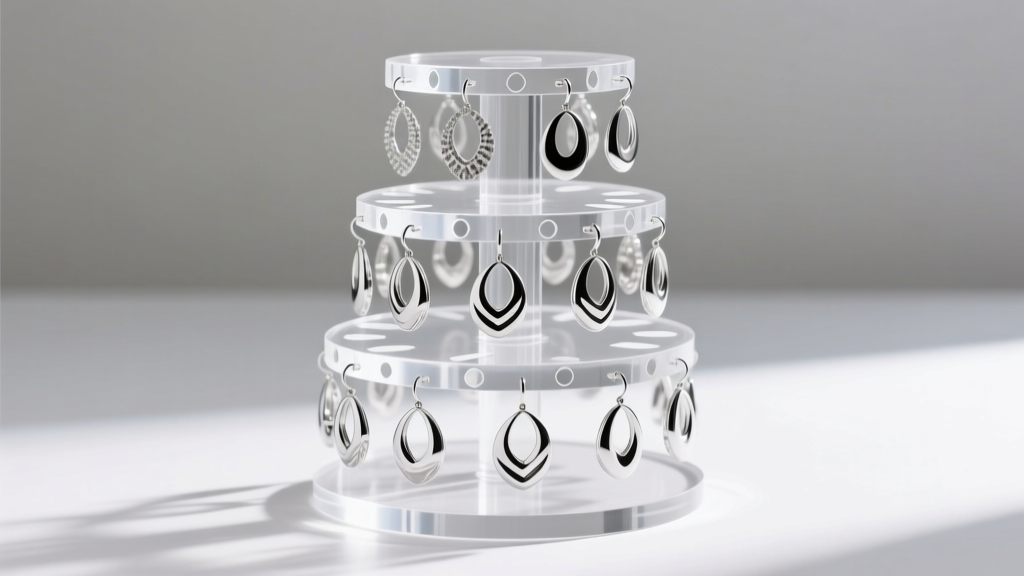
| Cast Acrylic | $25 - $55 | Medium (3-5 years) | Visual inventory of drops, dangles, and colorful resin hoops |
| Powder-Coated Steel | $60 - $130 | High (10+ years) | Heavy statement pieces, fine jewelry, and high-volume collectors |
MDF models are highly affordable but suffer from humidity damage. If placed in a bathroom or near a vanity mirror where hairspray and moisture accumulate, the MDF base will swell, causing the rotation spindle to bind. Cast acrylic offers excellent visibility—allowing you to see your entire collection at a glance—but is prone to micro-scratching from dust and jewelry friction, eventually turning cloudy. Powder-coated steel is the undisputed king of longevity. The baked-on enamel finish resists chipping, and the inherent weight of the steel provides a naturally low center of gravity.
The Mechanics of Rotation: Friction vs. Bearings
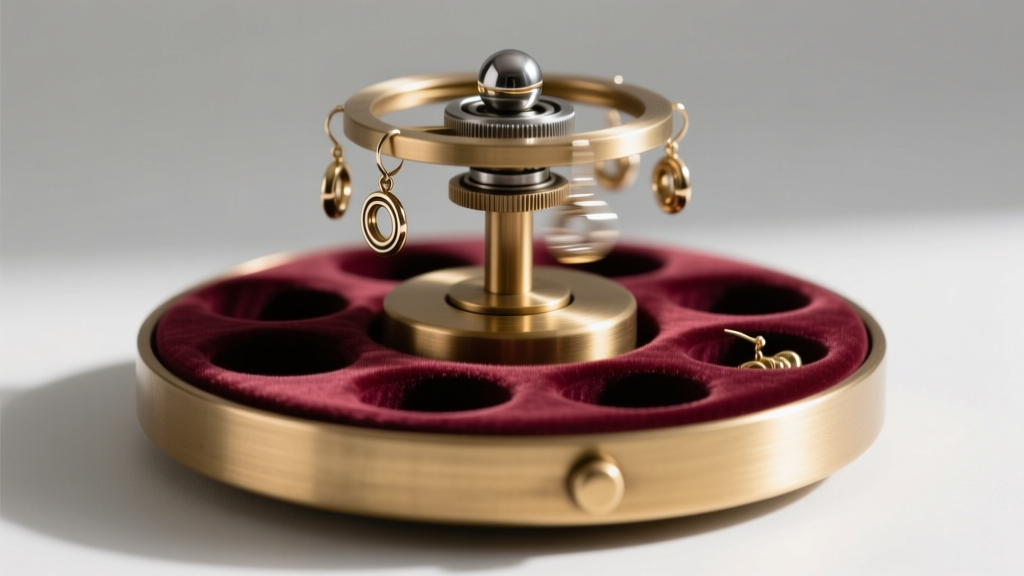
The rotation mechanism is where budget models invariably fail, transforming a convenient organizer into a frustrating obstacle. Entry-level spinners rely on a friction spindle—essentially a plastic or wooden peg rotating inside a slightly larger hole. Over 12 to 18 months, dust accumulation, skin oils, and repeated friction warp the plastic or compress the wood. This results in a gritty, stuttering rotation that requires two hands to operate: one to hold the base, and one to force the tower to spin.
High-value models utilize a steel-on-steel ball-bearing raceway hidden within the base. This mechanism, similar to those used in high-end lazy Susans or industrial turntables, supports up to 5 lbs of asymmetrical weight and guarantees a silent, fluid spin for decades. When assessing value, physically test the rotation. If you feel any "grinding" or lateral wobble, the spindle is poorly calibrated, and the tiers will eventually droop under the weight of your jewelry.
Weight Distribution and the Tipping Point
Weight distribution is a hidden value killer that plagues lightweight organizers. If you collect heavy geometric brass dangles, large resin statement hoops, or cluster gemstone drops, placing them all on one side of a lightweight acrylic or MDF spinner shifts the center of gravity. The tower tips, potentially bending your delicate earring wires, dropping fine jewelry onto hard surfaces, and scratching your vanity.
A high-ROI rotating earring holder features a heavily weighted base. Manufacturers achieve this via a concealed steel plate inside a wooden foot, a solid brass base, or a wide, flared metal footprint that extends beyond the diameter of the tiers. Before purchasing, check the product specifications for the base weight. A base that accounts for at least 40% of the total product weight is generally sufficient to prevent tipping, even when fully loaded with heavy brass or copper statement pieces on a single tier.
Tarnish Prevention: An Environmental Value Metric
Open-air storage exposes sterling silver (925) and porous gems like pearls or turquoise to ambient sulfur, humidity, and airborne cosmetics, accelerating tarnish and degradation. The GIA Gem Care Guidelines emphasize keeping silver and delicate gems away from sulfur-rich environments and excessive moisture. While no rotating holder is completely airtight, premium models in 2026 are now incorporating anti-tarnish features to justify their higher price points.
Some high-end spinners include a hidden compartment in the base for activated carbon discs or silica gel packets to control localized humidity. Others offer fitted, Pacific cloth (anti-tarnish flannel) covers that drape over the tower when not in use. When calculating your budget, factor in the cost of replacing tarnished silver or the hours spent polishing; a $75 holder with integrated anti-tarnish environmental controls pays for itself by preserving the pristine condition of a $300 silver drop earring collection.
Spatial Footprint vs. Capacity
Value is also measured in spatial efficiency. A standard 4-tier acrylic spinner holds roughly 80 pairs of earrings but occupies a 10-inch diameter on your dresser. Compare this to a multi-drawer jewelry armoire, which might hold the same amount but requires 15x20 inches of surface space. For apartment dwellers or those with compact vanities, the verticality of a rotating earring holder offers an unmatched price-per-square-inch ratio. However, ensure you measure the vertical clearance above your vanity; a fully loaded 5-tier spinner can reach up to 18 inches in height, which may conflict with wall-mounted shelves or low-hanging pendant lights.
Final Verdict: Calculating Your Storage ROI
Ultimately, the best rotating earring holder for your budget depends entirely on the composition of your jewelry collection. If your collection consists primarily of lightweight titanium studs, small 10mm gold hoops, and acrylic novelty pieces, a $20 MDF or basic acrylic spinner offers excellent value and sufficient structural integrity.
However, if your collection includes heavy brass dangles, 14k/18k gold wire posts, or sterling silver pieces that require environmental protection, investing in a $60 to $120 powder-coated steel tower with a ball-bearing base and velvet-lined slots is a non-negotiable necessity. The upfront cost is higher, but the elimination of post-scratching, the prevention of tipping accidents, and the decade-long mechanical lifespan result in a vastly superior long-term ROI. Treat your jewelry storage not as a cheap accessory, but as a protective vault for your wearable investments.


