Short Hair and Earrings: A Technical Guide to Proportions & Metals
An expert technical guide to short hair and earrings, covering gauge sizing, flat-back biomechanics, metal finishes, and visual weight.

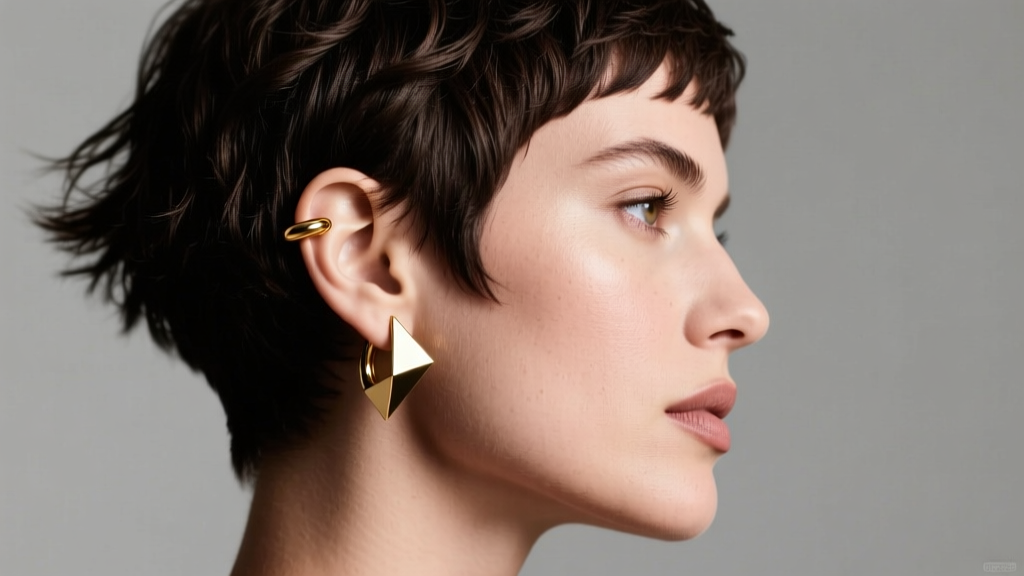
The Biomechanics of Exposure: Why Short Hair Changes Earring Dynamics
When transitioning to a cropped silhouette—whether a tight pixie, a blunt French bob, or an ear-grazing lob—the structural relationship between your auricle and your jewelry fundamentally shifts. In technical styling terms, long hair acts as both a visual dampener and a physical buffer. Short hair and earrings, by contrast, exist in an environment of total exposure. This lack of buffering means that every millimeter of an earring's profile, its acoustic properties, and its metal reflectivity are magnified. Without the soft framing of longer layers, the ear becomes a primary architectural focal point of the face, requiring a highly calculated approach to jewelry selection.
The mastoid bone and the entire cartilage ridge are suddenly laid bare. This exposure dictates that the backing of the earring is just as critical as the front. A standard butterfly friction back, which may hide easily beneath shoulder-length hair, now protrudes awkwardly behind the ear, creating visual clutter and increasing the risk of snagging on high-collared garments. In 2026, the industry standard for exposed ears has firmly shifted toward flush-fitting, threadless flat-back labrets, which eliminate the mechanical protrusions that catch on short, layered nape hair.
Gauge, Weight, and Cartilage Placement for Pixie and Bob Cuts
Selecting the correct gauge (the thickness of the jewelry post) is paramount when your ear is fully visible. While standard lobe piercings are often done at 20G (0.8mm) or 18G (1.0mm), cartilage piercings exposed by short hair benefit structurally and aesthetically from thicker gauges. A 16G (1.2mm) or 14G (1.6mm) post provides a more deliberate, intentional look that balances the sharp lines of a blunt bob or the textured edges of a pixie cut. Furthermore, thicker posts in ASTM F-136 implant-grade titanium offer superior rigidity, preventing the subtle bending that can occur with thinner, softer metals like 24k gold or low-grade silver.
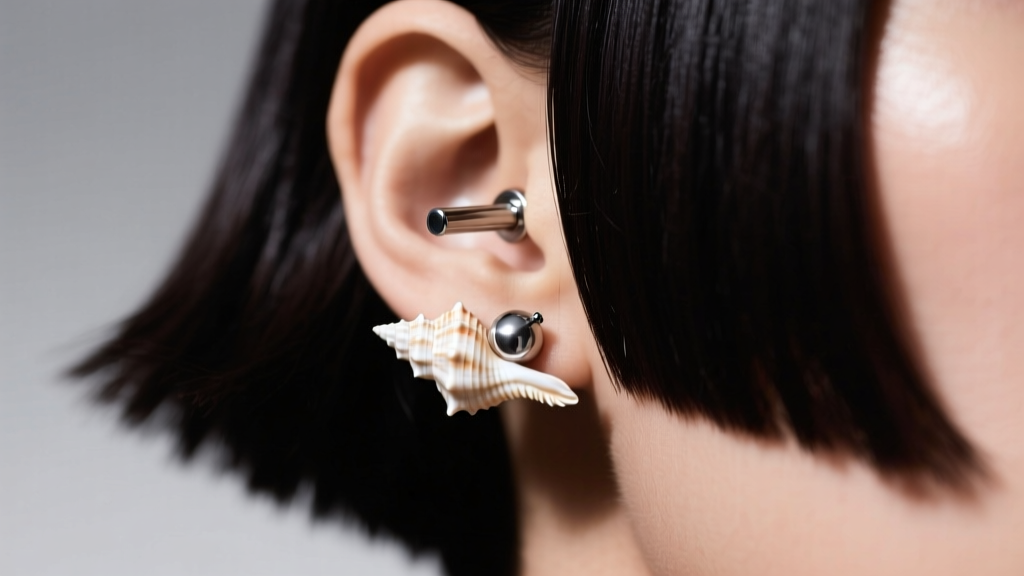
According to the Association of Professional Piercers (APP), internally threaded or threadless (push-pin) jewelry is the gold standard for both healing and long-term wear. For short hair, threadless systems are particularly advantageous. The slight bend in the pin creates tension against the inside of the shaft, securing the jewelry without the external screw threads that act like tiny hooks for short, fine baby hairs at the nape of the neck.
| Backing Type | Short Hair Compatibility | Recommended Gauge | Best Placement |
|---|---|---|---|
| Butterfly Friction | Poor (High snag risk, visual clutter) | 20G - 18G | Standard Lobe Only |
| Flat-Back Threadless | Excellent (Flush fit, zero snag) | 18G - 14G | Conch, Helix, Flat |
| Internally Threaded | Very Good (Smooth exterior) | 16G - 12G | Industrial, Scaffold |
| Hinge Segment Ring | Good (Watch for nape catch on bobs) | 16G - 14G | Daith, Rook, Tragus |
Visual Weight and Metal Finishes: A Proportion Framework
With the jawline and neck fully exposed, the visual weight of your earrings must be calibrated to your facial structure. A 5mm gold stud peeking through long hair appears subtle; the exact same stud on an exposed ear can look disproportionately large or overly stark depending on the metal finish. High-polish 18k yellow gold possesses a high albedo (reflectivity), which draws the eye immediately. If you have a petite ear structure exposed by a micro-pixie, opt for brushed or matte finishes, or step down to 14k gold, which has a slightly cooler, less aggressive reflectivity due to its copper and silver alloy content.
"In 2026, the shift toward threadless flat-back systems isn't just about piercing health; it's a styling necessity for short hair. A flush 16G titanium back eliminates the visual clutter and physical snagging that traditional butterfly backs introduce to a clean nape line, allowing the front-facing gemstone to command attention without distraction."
For those utilizing ear cuffs or non-pierced cartilage clips, the tension mechanism must be precisely calibrated. Short hair offers no cover to hide the mechanical hinge or spring of a poorly fitted cuff. Look for C-shaped ear cuffs crafted from memory metals like niobium or beta-titanium, which can be gently squeezed to match the exact millimeter thickness of your specific helix ridge, ensuring a flush, seamless appearance that mimics a true piercing.
The Acoustic Factor: Managing Metal-on-Hair Friction
An often-overlooked technical detail of short hair and earrings is acoustics. Blunt-cut bobs and sharp lobs create a solid perimeter of hair that frequently brushes against the lower earlobe and jawline. When wearing dangle earrings or large hoops, the constant friction of hair striking metal produces a distinct, sometimes distracting "tinkling" sound. This is exacerbated by hard, high-polish metals and hollow-tube hoop constructions.
To mitigate acoustic friction, experts recommend solid-core hoops or huggies featuring PVD (Physical Vapor Deposition) coatings. PVD coating, often used over a 316L stainless steel or titanium base, not only provides highly durable, hypoallergenic color options (like matte black or rose gold) but also slightly dampens the acoustic resonance of the metal. Alternatively, incorporating small, medical-grade silicone O-rings at the hinge points of segment rings can silently absorb the kinetic impact of hair brushing against the jewelry.
Expert Troubleshooting: Common Failure Modes with Short Styles
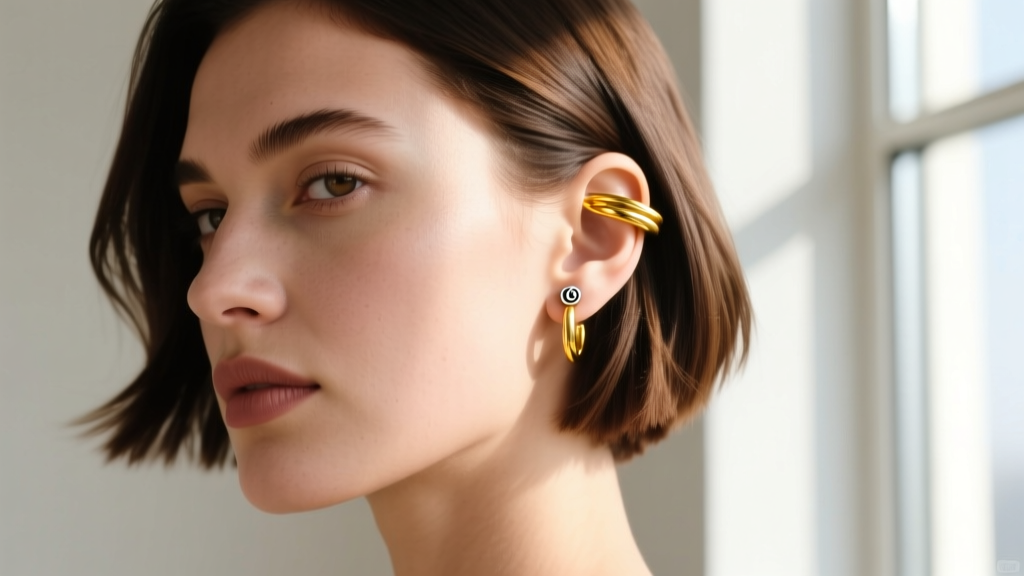
Styling short hair with curated ear stacks introduces specific mechanical and dermatological failure modes that do not occur when hair is worn long and down. Addressing these proactively ensures both comfort and aesthetic integrity.
- Post Length Mismatch in Flat Backs: Standard 6mm flat-back posts are often too short for thicker cartilage ridges or recently pierced lobes, causing the decorative end to press into the skin and create pressure necrosis. For short hair, where the back of the ear is visible, an 8mm or 10mm post that sits perfectly flush without indenting the skin is crucial. Have a professional piercer measure your tissue depth with a digital caliper before purchasing threadless ends.
- Galvanic Skin Response and Sweat: Long hair wicks sweat away from the neck and behind the ears. Short hair, particularly tight fades or pixie cuts, leaves the post and backing directly exposed to environmental elements and skin oils. The American Academy of Dermatology (AAD) notes that prolonged exposure to sweat can accelerate the leaching of nickel from lower-grade alloys. Always insist on ASTM F-136 titanium or solid 14k/18k gold for daily wear to prevent contact dermatitis on the exposed mastoid area.
- Collar Snagging on Dangles: Short hair often encourages the wearing of high-necked garments, turtlenecks, and structured collars to balance the exposed neck. Long dangle earrings with intricate filigree or prong-set stones act as grappling hooks for wool and cotton fibers. For winter styling with short hair, transition to geometric, bezel-set drops or solid metal huggies that offer a smooth, snag-free profile against winter fabrics.
- Asymmetry Amplification: Without hair to frame and soften the face, any natural asymmetry in ear placement or lobe size is magnified. When building an ear stack, use a unifying metal tone and repeat a specific motif (e.g., three 2mm bezel-set diamonds spaced across the helix and lobe) to create a deliberate, engineered look that overrides natural anatomical asymmetries.
Mastering the intersection of short hair and earrings requires moving beyond basic color matching and into the realm of structural styling. By prioritizing flush-fitting threadless mechanics, calculating the visual albedo of your chosen metals, and respecting the acoustic realities of your specific haircut, you transform your exposed ear into a masterclass of precision styling.


