Silver Geometric Earrings: Material Grades & Property Guide
Compare sterling, Argentium, and fine silver for geometric earrings. Learn how metal grades impact durability, tarnish, and sharp edge casting.

The Metallurgy of Angular Design: Why Alloy Matters
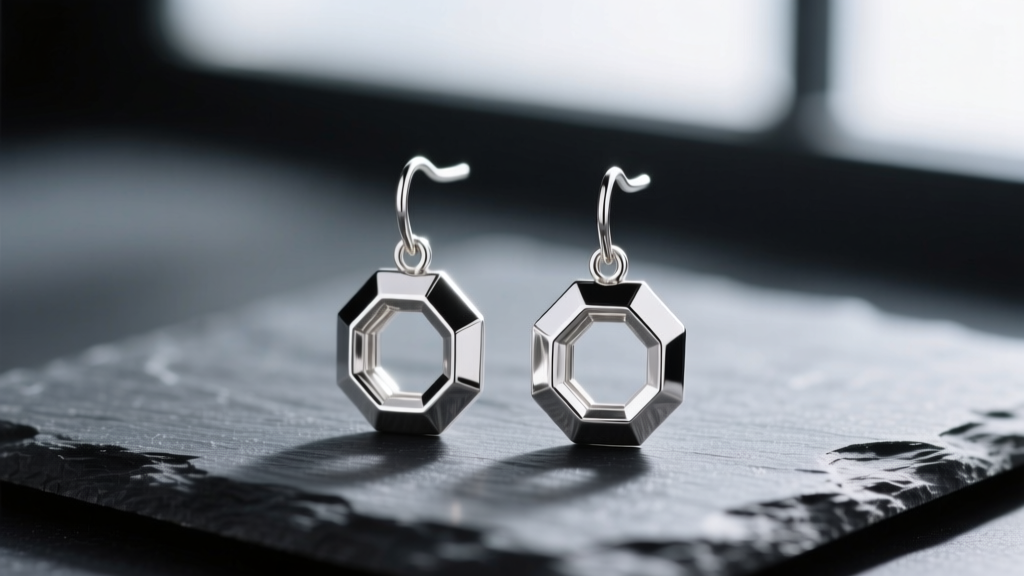
In the contemporary jewelry landscape, silver geometric earrings have cemented their status as a staple of architectural minimalism. From sharp-angled triangles and interlocking hexagons to solid cubic drops, these designs rely heavily on precise lines and crisp vertices. However, the aesthetic demand for sharp geometry introduces unique metallurgical challenges. Pure silver is inherently too soft to maintain a sharp edge under daily wear; it will dent, warp, and lose its angular definition. Therefore, understanding the specific alloy grades used in modern silver jewelry is critical for both designers and consumers looking for structural longevity.
According to the Gemological Institute of America (GIA), pure silver possesses a Vickers Hardness (HV) of roughly 25, making it entirely unsuitable for geometric shapes that require edge retention. To achieve the necessary tensile strength, silver must be alloyed with other metals. The choice of alloying element—typically copper, but increasingly germanium in advanced alloys—dictates the earring's hardness, tarnish resistance, and casting behavior at sharp vertices.
Silver Grades Compared: Sterling vs. Argentium vs. Fine
When shopping for or designing geometric silver earrings, you will primarily encounter three material classifications. Each behaves differently when subjected to the stresses of angular wear and manufacturing processes.
Sterling Silver (925)
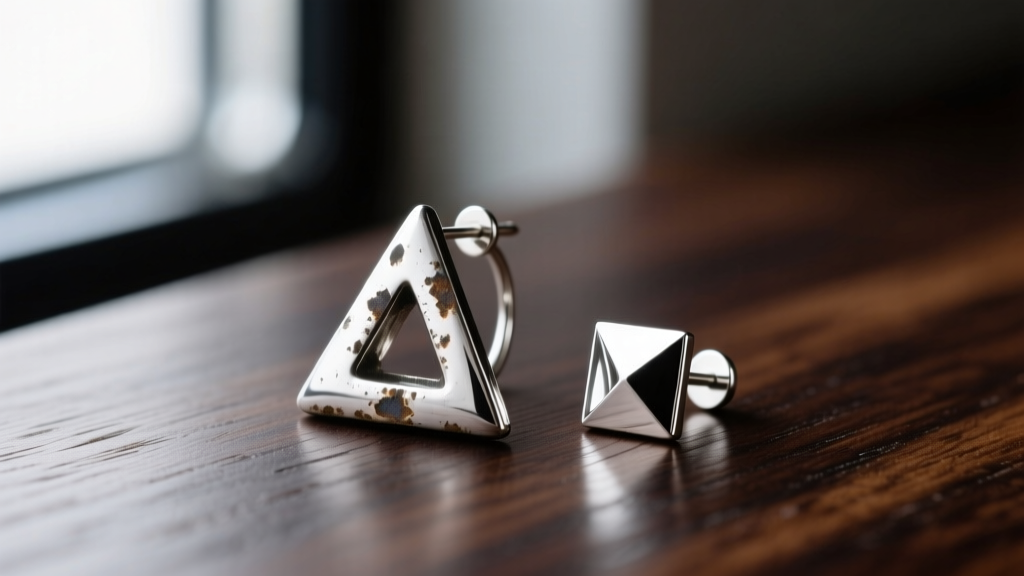
Sterling silver is the industry standard, comprising 92.5% silver and 7.5% copper. The copper addition raises the Vickers Hardness to approximately 65-70 HV in its annealed state. While this provides adequate strength for basic hoops and studs, the copper content makes Sterling highly susceptible to oxidation (tarnish) when exposed to atmospheric sulfur. Furthermore, during the casting of intricate geometric shapes, the copper can cause "firescale," a deep purplish oxidation that is difficult to polish out of sharp, recessed corners without rounding the edges.
Argentium Silver (935 / 960)
Argentium replaces a portion of the copper with germanium. This modern alloy has seen massive adoption by 2026 for high-end geometric jewelry. The germanium forms a transparent oxide layer on the surface, making it highly tarnish-resistant. More importantly for geometric designs, Argentium can be precipitation-hardened in a kiln, pushing its Vickers Hardness up to 130 HV—nearly double that of standard Sterling. This extreme hardness ensures that sharp triangle points and hexagon corners resist scratching and deformation.
Fine Silver (999)
Comprising 99.9% pure silver, this grade is exceptionally soft (HV ~25). While it is completely hypoallergenic and immune to firescale, it should be strictly avoided for geometric earrings. A sharp 90-degree angle on a fine silver cube will quickly deform into a rounded edge simply from being bumped against a table or caught on clothing.
| Alloy Grade | Silver Content | Primary Alloying Element | Vickers Hardness (Max) | Tarnish Resistance | Best Geometric Application |
|---|---|---|---|---|---|
| Fine 999 | 99.9% | None | ~25 HV | Excellent | Bezel wire (not structural shapes) |
| Sterling 925 | 92.5% | Copper (7.5%) | ~70 HV | Poor | Stamped flat geometric sheets |
| Argentium 935 | 93.5% | Copper / Germanium | ~130 HV | Excellent | Cast 3D cubes, sharp vertices |
| Argentium 960 | 96.0% | Copper / Germanium | ~110 HV | Excellent | Premium lightweight geometry |
Structural Integrity and Manufacturing Nuances
The method used to manufacture silver geometric earrings drastically affects their structural integrity, particularly at the vertices where stress concentrates.
- Lost-Wax Casting: Most 3D geometric shapes (like pyramids or spheres) are cast. A common failure mode in cast silver is porosity—tiny air bubbles trapped in the metal. If porosity occurs at a sharp geometric corner, the vertex becomes brittle and can snap off under minor torsional stress. High-quality jewelers use vacuum casting and centrifugal force to minimize this risk.
- Die Stamping & Laser Cutting: Flat geometric designs (hexagon discs, triangle sheets) are often laser-cut or stamped from rolled silver sheet. Laser cutting leaves a microscopic heat-affected zone that must be carefully filed. If not polished correctly, these edges can harbor microscopic burrs that snag on silk or fine hair.
- Rhodium Plating: Many Sterling silver geometric earrings are plated with rhodium to prevent tarnish and add a bright, white-metal finish. For sharp edges, the plating thickness is critical. A standard flash plate (0.05 microns) will wear off the high-friction corners within weeks, revealing the yellowing Sterling beneath. Look for a heavy plate of at least 0.5 to 1.0 microns on geometric edges.
Gauge, Weight, and Lobe Stress Management
Geometric designs often carry more mass than delicate floral or minimalist bar earrings. A solid sterling silver cube or a large, hollow but heavily reinforced hexagon can easily weigh between 8 to 15 grams per ear. This weight introduces the "cheese cutter" effect, where a thin earring wire slices through the earlobe tissue over time.
Selecting the Correct Wire Gauge
The Silver Institute notes that standard earring wires are typically 20-gauge (0.81mm). However, for heavy geometric drops, 20-gauge is insufficient. You must specify or look for 18-gauge (1.02mm) or even 16-gauge (1.29mm) ear wires. The thicker wire distributes the weight across a wider surface area of the piercing, preventing downward stretching and lobe fatigue.
Friction Backs vs. Secure Clasps
Standard butterfly friction backs are inadequate for heavy geometry. The weight of a swinging geometric pendant will cause the earring to tilt forward, placing uneven stress on the lobe. Instead, opt for:
- La Pousette Backs: These feature a locking mechanism that securely grips the ear wire groove, preventing the heavy earring from slipping.
- Omega or Hinged Snap Backs: For geometric studs with significant forward weight, an omega clip distributes the pressure across the back of the earlobe rather than relying solely on the piercing hole.
Maintenance: Polishing Without Rounding Edges
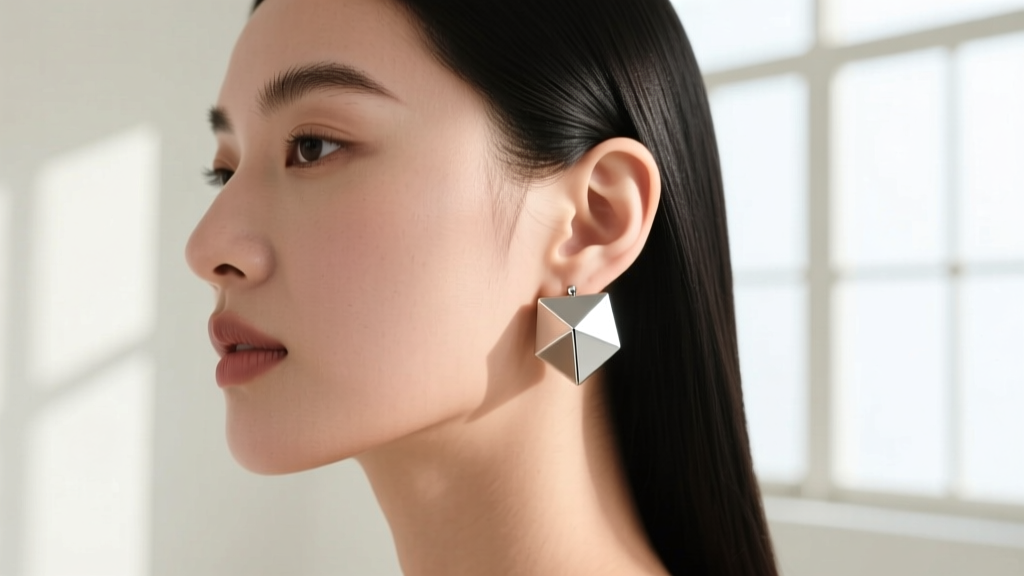
Maintaining the crisp lines of silver geometric earrings requires specialized care. The most common mistake consumers make is using aggressive liquid silver dips or rotary polishing tools, which strip away microscopic layers of metal. Over time, this erodes sharp 90-degree angles into soft, rounded bevels, ruining the architectural intent of the piece.
Expert Care Tip: To remove tarnish from Sterling geometric earrings without compromising the vertices, use a high-quality micro-abrasive polishing cloth (impregnated with jeweler's rouge). Fold the cloth to create a firm edge, and polish the flat planes of the geometry in straight, unidirectional strokes. Never use a circular buffing motion on a sharp corner.
For oxidized geometric earrings—where the recessed corners are intentionally blackened to create high-contrast depth—never use liquid dips. The chemicals will strip the liver of sulfur oxidation from the crevices, leaving the piece looking flat and one-dimensional. Instead, use a polishing pad wrapped tightly around a toothpick to carefully shine only the raised, flat surfaces of the geometry.
Expert Buying Framework for 2026
When investing in premium silver geometric earrings, use this checklist to ensure you are acquiring a piece that will retain its structural and aesthetic integrity:
- Verify the Alloy: Look for hallmarks indicating Argentium (often stamped with a unicorn or '935') if you want sharp, untarnished edges. If buying Sterling 925, ensure it has a heavy rhodium flash.
- Inspect the Vertices: Use a jeweler's loupe to examine the sharp corners. They should be crisp, not pitted or rounded. Pitting indicates poor casting porosity.
- Check the Wire Gauge: Ensure the ear wire is at least 18-gauge (1.02mm) if the geometric drop exceeds 6 grams.
- Assess the Clasp: Reject heavy geometric dangles that rely on standard push-back butterflies; demand locking mechanisms or lever-backs.
By understanding the metallurgical properties of silver alloys and the structural demands of angular design, you can curate a collection of geometric earrings that remain as sharp and striking as the day they were forged.


