How to Size Earring Cards and Necklace Display Cards Correctly
Master how to size earring cards and necklace display cards correctly by aligning material properties, GSM weights, and jewelry dimensions.

The Physics of Jewelry Display: Why Material Dictates Size
When merchandising fine jewelry, the structural integrity of your packaging is just as critical as the pieces themselves. Understanding how to size earring cards and necklace display cards correctly requires a deep dive into material science, shear strength, and the specific gravitational pull of varying metal alloys. A delicate 20-gauge gold stud exerts minimal torque on a display card, whereas a pair of solid brass statement dangles weighing 25 grams or more can easily warp, tear, or snap standard retail packaging. As consumer expectations for premium unboxing and sustainable retail experiences evolve in 2026, jewelry makers must align their display dimensions with the physical properties of their chosen backing materials.
The core challenge lies in the intersection of jewelry weight and material tensile strength. According to metallurgical data from the Gemological Institute of America (GIA), the density of precious metals varies wildly; a solid 14k gold hoop might weigh 8 grams, while a similarly sized stainless steel or brass piece could exceed 15 grams. This weight discrepancy dictates not only the thickness of your display card but also its overall surface area to maintain a stable center of gravity on retail shelves.
Material Breakdown: Cardstock, Acrylic, and Eco-Board
Before determining the exact dimensions of your display cards, you must select the appropriate substrate. Each material possesses unique structural properties that influence how large or small a card can be cut without compromising its rigidity.
GSM and Ply: The Hidden Metrics of Cardstock
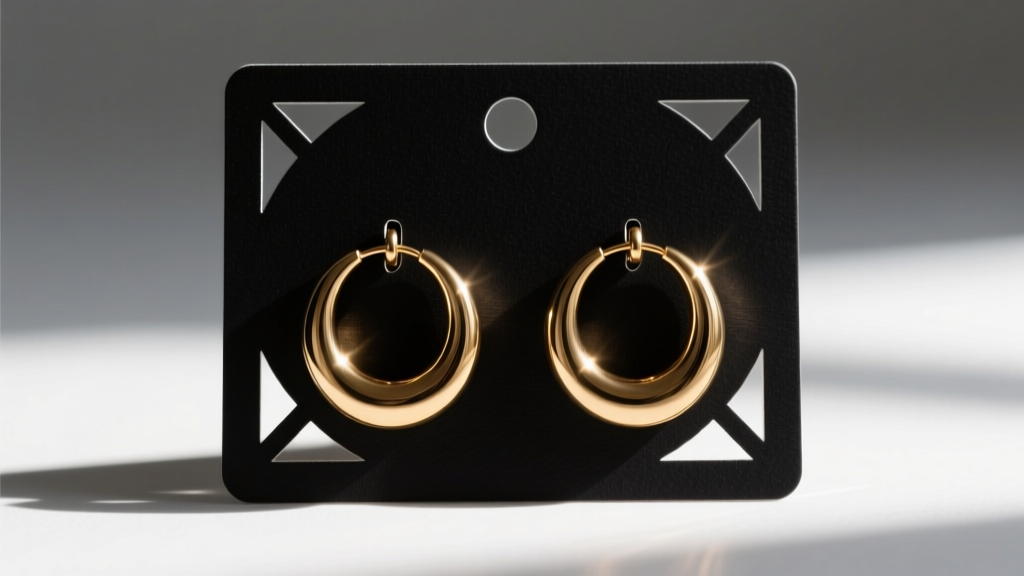
Standard retail earring cards are typically printed on 16pt (300 GSM) cardstock. While sufficient for lightweight studs and small huggies, 16pt stock is highly susceptible to 'bowing'—a failure mode where the card bends forward under the weight of drop earrings, causing the display to tip over. For heavy dangles, upgrading to 32pt (600 GSM) duplex or triplex cardstock is mandatory. The thicker the ply, the wider the card can be sized without requiring a secondary easel back. Industry resources like PaperSpecs emphasize that a 32pt stock allows for taller, narrower profiles (such as 2x4 inches) that remain perfectly vertical, whereas 16pt stock requires a wider, squatter base (like 3x3 inches) to compensate for its lower flexural rigidity.
Acrylic and PET Plastics: Thickness vs. Brittleness
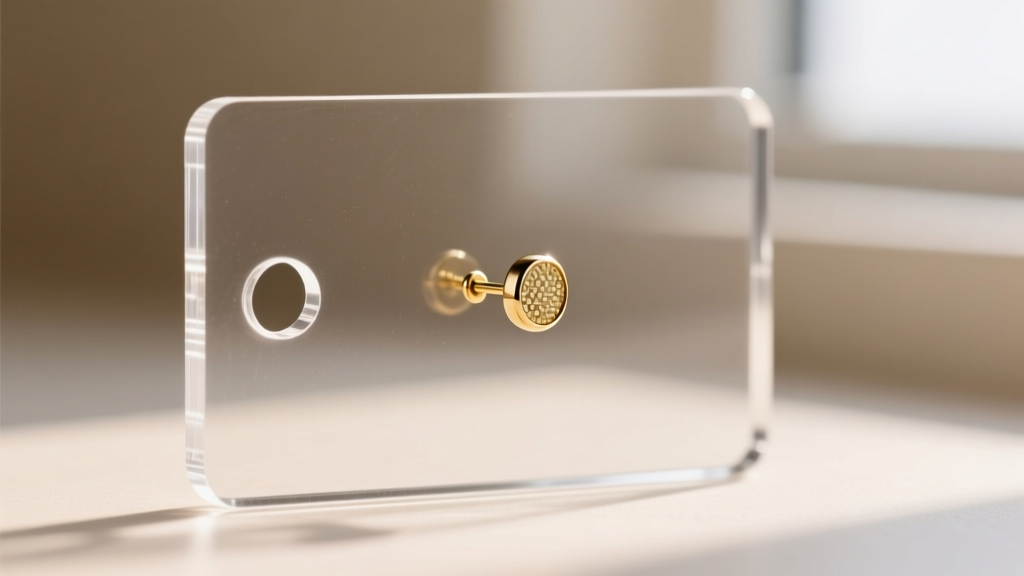
Acrylic display cards offer a modern, high-end aesthetic and are entirely impervious to humidity-induced warping. However, cast acrylic behaves differently than extruded acrylic when machined. A 2mm extruded acrylic card is prone to micro-fractures around punched holes, limiting how closely you can place earring holes to the edge of the card. For acrylic, a minimum 3mm thickness is recommended for heavy pieces, and the card dimensions must include at least a 5mm margin between the jewelry slit and the card's outer edge to prevent catastrophic snapping during transit.
Eco-Friendly Kraft and Molded Pulp
With the 2026 retail landscape heavily favoring sustainable packaging, unbleached Kraft paper and molded pulp have surged in popularity. Kraft paper is inherently more fibrous and tear-resistant than coated cardstock, allowing for slightly thinner profiles (14pt or 250 GSM) while maintaining excellent shear strength. However, Kraft lacks the stiffness of clay-coated boards, meaning Kraft earring cards must be sized with a wider footprint or feature structural scoring (folds) to create a built-in tent display.
How to Size Earring Cards and Necklace Display Cards Correctly by Weight
To master how to size earring cards and necklace display cards correctly, you must categorize your inventory by weight and physical drop length. A card that is too small will allow long dangles to drag on the shelf surface, while a card that is too large wastes valuable retail real estate and increases shipping costs. Below is a definitive sizing framework based on material and jewelry type.
| Jewelry Type | Avg. Weight | Ideal Cardstock Size | Ideal Acrylic Size | Material Requirement |
|---|---|---|---|---|
| Standard Studs (18g-20g) | 1g - 3g | 2' x 2' or 2' x 3' | 2' x 2' (2mm) | 14pt - 16pt Cardstock |
| Huggies & Small Hoops | 3g - 8g | 2' x 3.5' | 2' x 3' (2mm) | 16pt Cardstock / PET |
| Heavy Drop Dangles | 12g - 25g+ | 2.5' x 4.5' | 2.5' x 4' (3mm) | 32pt Duplex / Cast Acrylic |
| 16' Choker Necklaces | 15g - 30g | 3' x 5' | 3' x 5' (3mm) | 18pt+ with reinforced notches |
| 18'-20' Chain Necklaces | 20g - 45g | 4' x 6' | 4' x 6' (4mm) | 32pt Triplex / Rigid Board |
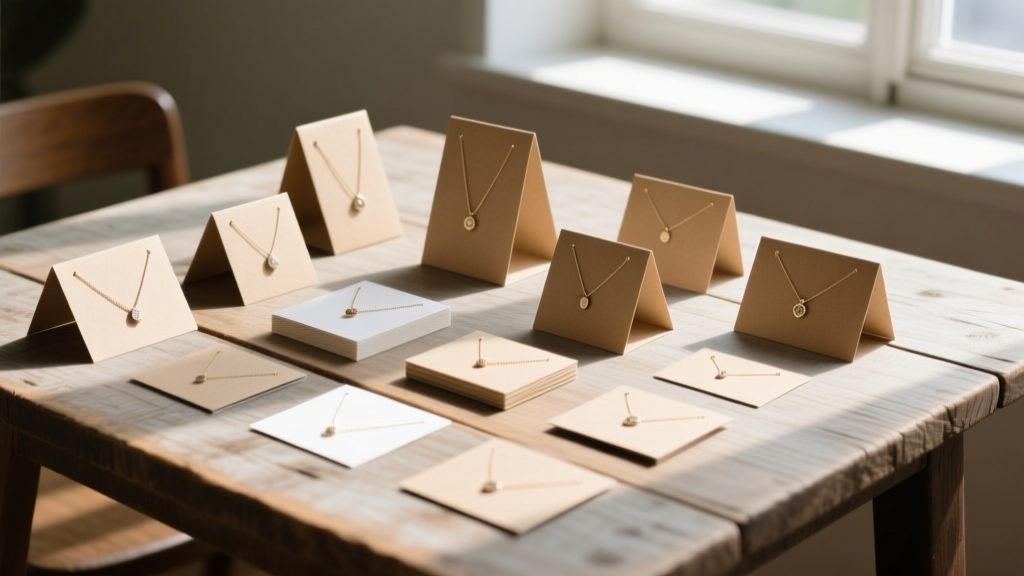
When sizing necklace cards, the vertical dimension must accommodate the chain's drape without forcing the clasp to rest awkwardly on the card's edge. For an 18-inch chain, a 4x6 inch card provides the necessary surface area to wrap the chain securely while leaving room for brand storytelling on the reverse side. As noted by retail trend analysts at Retail Dive, modern consumers view packaging as an extension of the product; a poorly sized card that leaves chains tangled or earrings dragging severely diminishes the perceived value of the jewelry.
Hole Punching and Slit Engineering
Sizing the exterior dimensions of the card is only half the battle; the internal geometry of the holes and slits must be calibrated to the specific gauge and style of the earring.
Gauge-Specific Hole Sizing
Standard lobe piercings are typically 20-gauge (0.81mm) or 18-gauge (1.02mm). For these, a 1.2mm to 1.5mm punched hole is ideal, providing enough friction to hold the earring back securely without bending the post. However, cartilage jewelry, such as 16-gauge (1.29mm) or 14-gauge (1.63mm) labret studs and thick wire hoops, requires a 2.0mm hole. If you attempt to force a 14-gauge post through a standard 1.5mm hole on a 32pt cardstock, the friction will delaminate the paper plies, ruining the card.
Preventing Tear-Out on Heavy Dangles and Hoops
Hoops and huggies require slits rather than circular holes. A common failure mode in display packaging is the 'zipper effect,' where the weight of a heavy hoop tears through the slit to the edge of the card. To prevent this, never use a simple linear slit. Instead, engineer a slit that is 1.5mm wide and 15mm to 20mm long, terminating in a 2.5mm circular 'stop-hole' at the top. This stop-hole distributes the shear stress radially, effectively eliminating the risk of tear-out even when holding heavy 20-gram brass hoops on 16pt cardstock.
Environmental Factors: Humidity and Material Warping
Material properties are not static; they react to the environment. Cardstock and Kraft paper are hygroscopic, meaning they absorb moisture from the air. In high-humidity environments, a tall, narrow earring card (e.g., 2x5 inches) made from 16pt stock will inevitably warp into a convex curve. This warping shifts the center of gravity forward, causing the display to fall. If your jewelry brand ships to or retails in humid climates, you must either size your cards wider (e.g., 3x4 inches) to create a broader base, or apply a moisture-barrier coating such as a soft-touch aqueous finish to seal the paper fibers. Acrylic and PET plastics bypass this issue entirely, making them the superior choice for consistent, warp-free sizing in global retail distribution.
Final Sizing Framework for Retail Displays
Ultimately, learning how to size earring cards and necklace display cards correctly is an exercise in balancing aesthetic minimalism with structural engineering. By matching the GSM and ply of your cardstock to the exact gram-weight of your metal alloys, engineering stress-relieving stop-holes for hoops, and respecting the hygroscopic nature of paper products, you ensure that your jewelry is presented flawlessly. Whether you are displaying delicate 20-gauge gold studs on a compact 2x2 acrylic square or merchandising heavy statement necklaces on a 4x6 triplex board, precise material-to-size alignment is the hallmark of a premium jewelry brand.


