How to Choose Slimming Earrings to Elongate Your Face Shape
Discover how slimming earrings elongate your face shape. Learn expert tips on drop lengths, visual weight, and metals to flatter round and square faces.


The Optical Illusion of Slimming Earrings
In the world of jewelry styling, the term 'slimming' does not refer to physical weight loss, but rather to the manipulation of visual weight and facial proportions. By leveraging the Gestalt principles of visual perception, stylists use specific earring geometries to draw the eye vertically, creating an elongating effect that slims the jawline and neck. According to facial proportion guidelines outlined by the American Academy of Facial Plastic and Reconstructive Surgery, the human eye naturally follows continuous vertical lines, which can visually stretch the lower third of the face. This beginner-friendly guide will decode the exact measurements, materials, and shapes required to master the art of proportional styling with slimming earrings.
Mapping Face Shapes to Vertical Geometry
The effectiveness of a slimming earring depends entirely on how its geometry interacts with your underlying bone structure. Not all drop earrings are created equal; a shape that slims a round face might overwhelm a heart-shaped face. Here is the strategic breakdown for the most common face shapes.
Round Faces: The Elongation Strategy
Round faces are characterized by equal width and length, with soft, curved jawlines and fuller cheeks. The primary goal is to introduce sharp vertical lines to break the circular symmetry. Opt for linear drop earrings, narrow rectangular dangles, or slender column styles. The ideal length sits between 2.5 and 3.5 inches, terminating just below the jawline to draw the eye downward. Crucially, the width of the earring should remain under 0.4 inches to prevent adding horizontal visual weight. Avoid large hoops, circular studs, and wide cluster earrings entirely, as they will mirror and amplify the roundness of your face.
Square Faces: Softening the Angular Jaw
Square faces feature a strong, wide jawline and a broad forehead. While vertical elongation is still desired, introducing harsh, rigid geometric lines can clash with the natural angularity of the bone structure. The solution is to use curved vertical drops. Teardrop shapes, elongated oval dangles, and slender marquise cuts provide the necessary downward visual pull while softening the sharp corners of the jaw. Aim for lengths of 2 to 3 inches. Steer clear of wide, chunky hoops and sharp, square geometric dangles, which will only emphasize the width of the mandible.
Heart Faces: Balancing Proportions
Heart-shaped faces have a wider forehead that tapers down to a narrow, delicate chin. The goal here is not aggressive slimming, but rather balancing the lower half of the face. Choose earrings that are slightly bottom-heavy but maintain a narrow profile, such as slender chandeliers or tapered teardrops. Keep the length moderate—around 1.5 to 2.5 inches—so the earring does not overwhelm the delicate chin. Avoid top-heavy triangles or wide, inverted shapes that will make the forehead appear broader by comparison.
The Anatomy of a Slimming Earring
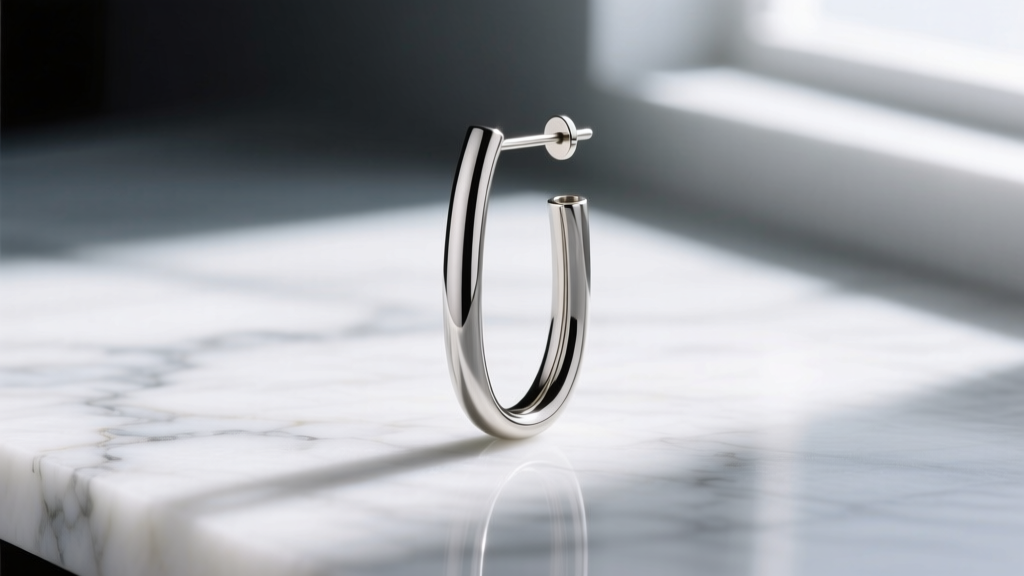
To build a versatile collection, it is essential to understand the specific dimensions that dictate an earring's slimming properties. The table below serves as a quick-reference blueprint for selecting the right silhouette based on your styling goals.
| Earring Style | Ideal Face Shape | Optimal Length | Width Limit | Visual Effect |
|---|---|---|---|---|
| Linear Column Drop | Round | 2.5 - 3.5 inches | 0.4 inches | Maximum vertical elongation |
| Elongated Teardrop | Square, Heart | 2.0 - 3.0 inches | 0.6 inches | Softens jawline, draws eye down |
| Narrow Marquise Dangle | Round, Square | 1.5 - 2.5 inches | 0.5 inches | Adds elegant, tapered length |
| Slender Chain Threader | All Shapes | 3.0 - 4.0 inches | 0.1 inches | Creates uninterrupted vertical lines |
Metallurgy and Weight: Protecting Your Lobes
A common pitfall when shopping for long, slimming dangles is ignoring the physical weight of the materials. Long earrings act as levers; even a modest weight at the bottom of a 3-inch drop creates significant torque on the earlobe fistula. Prolonged wear of heavy metals can cause micro-tears, lobe fatigue, and permanent stretching of the piercing tract.
To mitigate this, material selection is critical. While 14k and 18k gold are premium choices, they are dense and heavy. For elongated styles, the Gemological Institute of America (GIA) notes that alternative alloys offer superior strength-to-weight ratios. Grade 23 Titanium (Ti-6Al-4V) is the gold standard for lightweight, hypoallergenic jewelry. It weighs approximately 45% less than 316L surgical stainless steel while offering superior tensile strength. Hollow-tube construction in sterling silver or gold vermeil is another excellent technique used by jewelers to maintain the visual volume of a piece without the punishing weight.
Gauge Sizing and Structural Integrity
The thickness of the ear wire—measured in gauge—dictates how well the earring holds its shape. Standard lobe piercings are typically 20-gauge (0.81mm) or 18-gauge (1.02mm). While 20-gauge is fine for lightweight studs, it is entirely insufficient for slimming drops over 2 inches in length; the wire will easily bend and warp under the leverage of the dangle. Always opt for 18-gauge (1.02mm) or even 16-gauge (1.29mm) ear wires for long drops, provided your piercing can accommodate the slightly thicker wire. To keep the overall weight safe, ensure the earring does not exceed 12 grams per ear.
Finishes and Light Reflection
The surface finish of the metal also plays a subtle role in visual weight. High-polish finishes reflect light aggressively, which can make a piece appear wider and more prominent. If your goal is a sleek, uninterrupted, and ultra-slimming vertical line, look for brushed, matte, or satin finishes. These textures absorb light and create a shadowed, streamlined effect that enhances the elongating illusion. Conversely, if you want the earring to act as a focal point that distracts from a wider jawline, a high-polish finish paired with a narrow silhouette is your best strategy.

Common Mistakes That Add Visual Width
Even experienced jewelry wearers occasionally fall into styling traps that sabotage the slimming effect. Avoid these common proportional errors:
- Oversized Hoops: Any hoop with a diameter exceeding 40mm will inherently draw the eye horizontally, widening the appearance of the face and neck.
- Chunky Cluster Studs: Wide, circular gemstone clusters sit flush against the lobe and add immediate horizontal bulk to the side of the face.
- Top-Heavy Chandeliers: Earrings that are wider at the top than the bottom create an inverted triangle effect, which visually widens the cheekbones and forehead.
- Wide Huggies: Thick, wide-band huggie hoops add unnecessary volume directly at the jaw hinge, emphasizing the width of the lower face.
Pricing and Investment Tiers
Building a collection of structurally sound, slimming earrings requires navigating different market tiers. Here is what you can expect regarding pricing and quality:
- Fashion & Entry-Level ($15 - $45): Typically made from brass or zinc alloys with thin gold plating. While affordable, these often use flimsy 22-gauge wires that bend easily and may cause contact dermatitis. Best for occasional wear.
- Bridge & Mid-Tier ($50 - $150): The sweet spot for everyday wear. Expect solid sterling silver, heavy gold vermeil, and properly engineered 18-gauge wires. Brands in this tier often utilize hollow-core techniques to keep long drops lightweight.
- Fine Jewelry ($300 - $1,500+): Solid 14k or 18k gold, often featuring precision-set diamonds or gemstones. Because solid gold is heavy, fine jewelers will use articulated joints and graduated sizing to distribute weight evenly and protect the earlobe.
'True proportional styling is about mastering the negative space around the jewelry. A slimming earring doesn't just decorate the ear; it redraws the architecture of the face by commanding the eye to travel downward.' — Senior Jewelry Stylist
Final Framework for Selection
When shopping for your next pair of slimming earrings, run the piece through this quick mental checklist: Is the length at least twice the width? Does the shape complement or counteract my natural jawline? Is the ear wire thick enough (18g) to support the lever-action of the drop without bending? Finally, is the overall weight under 12 grams to preserve the health of my piercing? By prioritizing vertical geometry, intelligent metallurgy, and precise gauge sizing, you can effortlessly manipulate visual weight and elevate your everyday styling with architectural precision.


