Small Gold Square Earrings: The Ultimate Buying Guide
Discover what to look for when buying small gold square earrings. Learn about karat weights, edge finishes, backing types, and pricing in our expert guide.
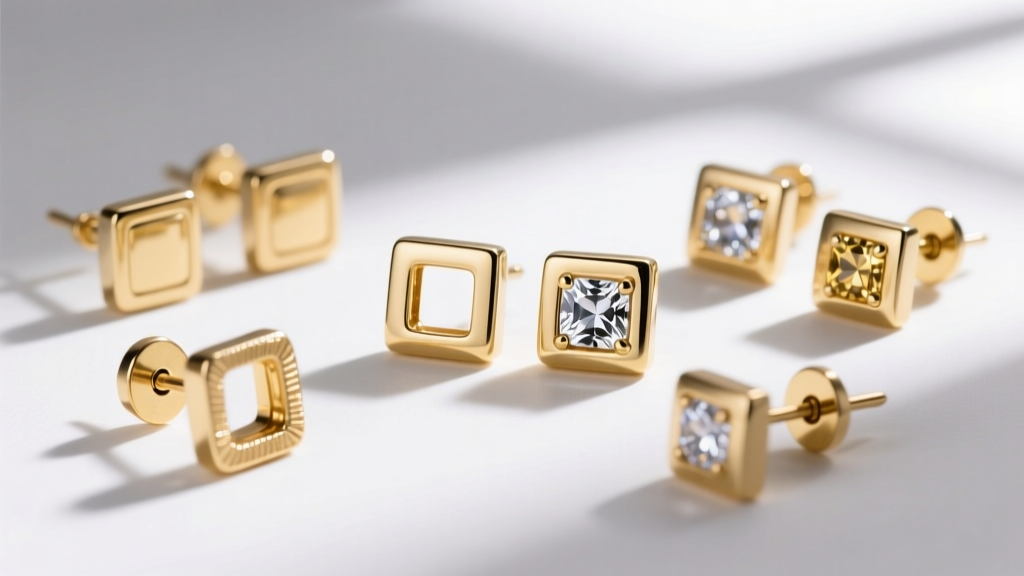
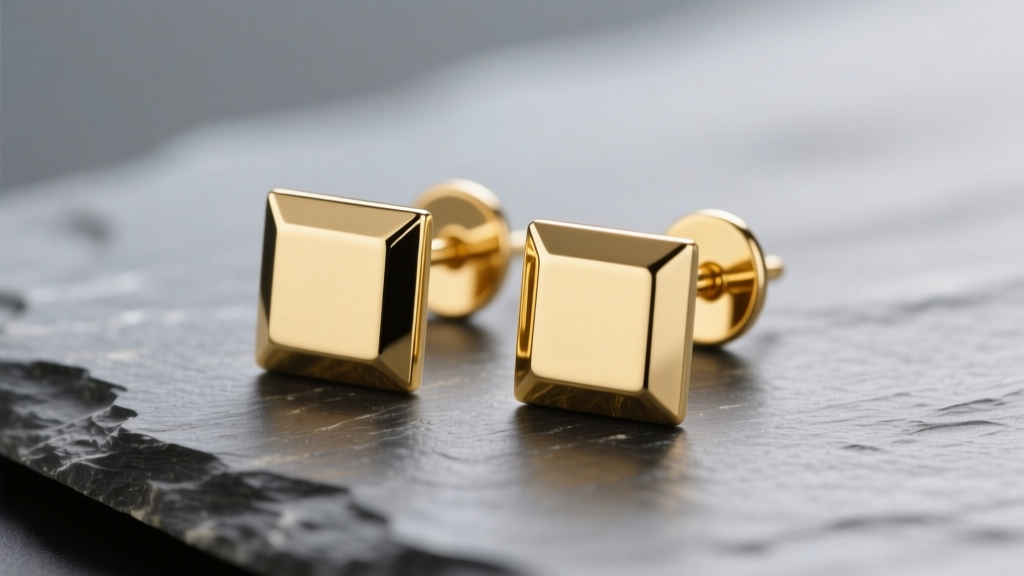
Geometric minimalism has cemented its place in modern jewelry, and small gold square earrings are at the forefront of this architectural trend. Unlike traditional round studs, which scatter light and hide imperfections, square earrings rely on crisp lines, flat planes, and precise angles to make their statement. However, these very design elements introduce unique metallurgical and structural challenges that most standard buying guides overlook.
Whether you are shopping for a subtle 3mm micro-square for a secondary piercing or a bold 6mm architectural stud for your primary lobe, understanding the nuances of gold hardness, edge chamfering, and post placement is critical. This comprehensive guide breaks down exactly what to look for to ensure your geometric earrings remain sharp, secure, and scratch-free for years to come.
The Metallurgy of Flat Surfaces: Why Squares Scratch Faster
The most common complaint among buyers of geometric jewelry is the rapid appearance of micro-scratches. This is not necessarily a sign of poor quality, but rather a byproduct of physics. A round or domed stud disperses light across a curved surface, making minor abrasions virtually invisible. A flat, mirror-polished square, however, acts like a canvas. Every micro-abrasion disrupts the uniform reflection of light, making scratches glaringly obvious.
To combat this, you must pay close attention to the Vickers hardness of the gold alloy. Pure gold (24k) is exceptionally soft and entirely unsuitable for flat geometric studs. According to the Gemological Institute of America (GIA), alloying gold with metals like copper, silver, and zinc not only changes its color but significantly increases its durability. For flat square earrings, a harder alloy is paramount to maintaining that pristine, mirror-like finish.
Karat Weight Breakdown for Geometric Studs
Choosing the right karat weight is a balancing act between color richness and scratch resistance. Here is how the most common gold purities perform specifically in square, flat-faced designs:
| Karat | Gold Purity | Vickers Hardness | Scratch Visibility | Best Use Case |
|---|---|---|---|---|
| 10k | 41.7% | High | Lowest | High-impact daily wear, active lifestyles |
| 14k | 58.3% | Medium-High | Low | The ideal sweet spot for everyday square studs |
| 18k | 75.0% | Medium | Medium-High | Occasional wear, premium color enthusiasts |
| 22k | 91.6% | Low | Extreme | Not recommended for flat mirror-finish squares |
For the vast majority of buyers, 14k solid gold is the superior choice for small gold square earrings. It offers enough alloyed hardness to resist the inevitable friction from hair, towels, and phones, while still providing a rich, warm yellow hue.
Edge Architecture: Beveled vs. Knife-Edge
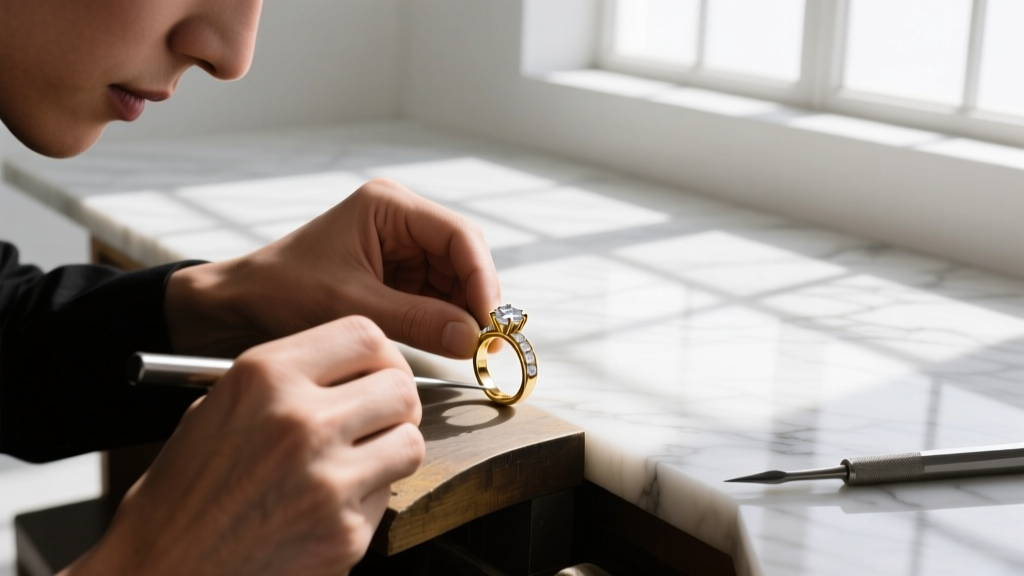
The perimeter of a square earring dictates both its comfort and its longevity. Mass-produced geometric earrings are often stamped or cast with harsh, 90-degree "knife-edges." While this looks sharp in a product photo, it is a functional nightmare. Sharp 90-degree edges act as tiny blades that snag on knit sweaters, catch in your hair, and are highly prone to denting if dropped on a hard surface.
The Importance of the Micro-Chamfer
When evaluating high-end small gold square earrings, look for product descriptions that mention chamfered or micro-beveled edges. A master jeweler will shave off a microscopic 0.2mm to 0.5mm angle along the perimeter of the square. This micro-bevel accomplishes three things:
- Prevents Snagging: Allows the earring to glide smoothly through hair and fabric.
- Protects the Corners: The four corners of a square are its most vulnerable points. Beveling removes the fragile apex, preventing dents and dings.
- Enhances Light Return: A beveled edge catches the light at a different angle than the flat face, creating a stunning, multi-dimensional halo effect around the earring.
Post Placement and the "Droop" Factor
One of the most frequent structural failures in geometric earrings is the "forward droop." Because a square has a distinct center of gravity, if the solder post is placed perfectly in the dead center of the backing plate, the weight of the bottom half of the square will pull the earring forward, causing it to tilt awkwardly on the earlobe.
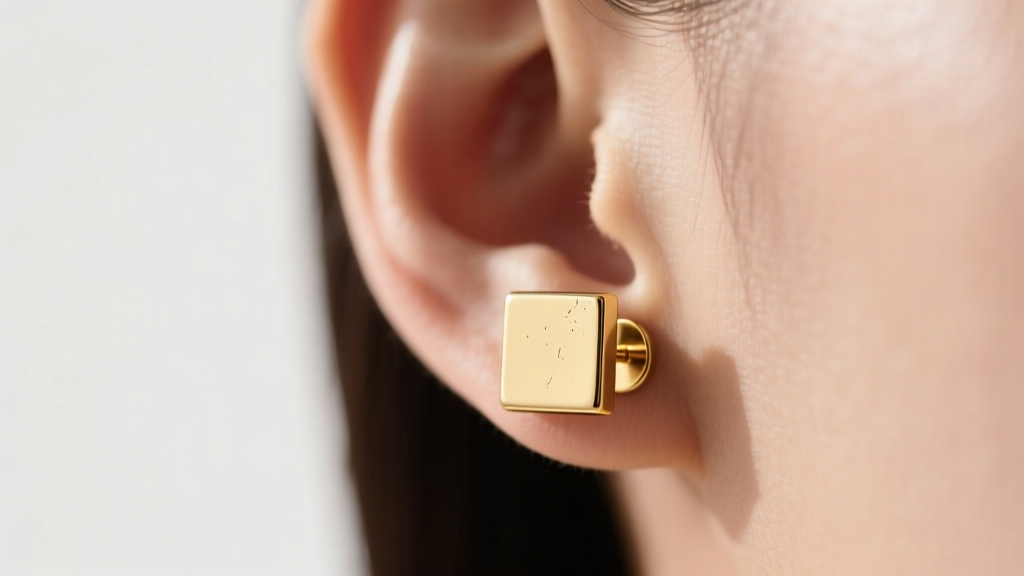
To solve this, premium jewelry designers employ two specific engineering fixes:
- Offset Soldering: The post is soldered slightly above the true center (usually by 0.5mm to 1mm) to counteract the downward pull of gravity.
- Wide-Base Backings: Standard butterfly friction backs often fail to support the flat plane of a square stud. Look for earrings that come with La Pousette backings (which feature a wide, flat disc that locks securely into a grooved post) or oversized 6mm flat disc friction backs. This creates a wider fulcrum against the earlobe, keeping the square perfectly flush and level.
Sizing Guide: Millimeter Dimensions on the Earlobe
Square earrings wear differently than round ones. A 5mm square has a larger total surface area and a wider diagonal span than a 5mm round stud. Here is a practical sizing framework:
- 3mm (The Micro-Square): Extremely delicate. Ideal for second, third, or upper lobe piercings. Offers a tiny, subtle glint of geometry.
- 4mm (The Everyday Standard): The most versatile size for primary lobe piercings. Provides a clear geometric shape without overwhelming the earlobe or interfering with over-ear headphones.
- 5mm (The Statement Minimalist): Bold and modern. Excellent for those who want a noticeable architectural presence while maintaining a minimalist aesthetic.
- 6mm (The Architectural Edge): Best suited for thicker earlobes or cartilage placements like the flat. Ensure the post is at least 18-gauge (1.0mm thick) to support the wider surface area without bending.
Pricing, Authenticity, and Skin Sensitivities
When shopping for small gold square earrings, pricing is heavily dictated by the manufacturing method and the base material. Because flat surfaces require extensive hand-polishing to achieve a true mirror finish, labor costs are higher than with cast, domed jewelry.
Material Tiers and Price Ranges
- Gold Vermeil (Sterling Silver Base): $25 - $55. Warning: The flat faces of square earrings experience high friction. Vermeil will eventually wear down to the silver base, creating a two-tone effect that cannot be easily fixed.
- Gold-Filled (Brass Base): $40 - $80. Offers a thicker layer of gold than vermeil, but the sharp corners of a square are still prone to edge-wear over time.
- Solid 14k Gold: $90 - $180. The most highly recommended tier for geometric shapes. It will never wear away, and minor scratches can be polished out by a jeweler indefinitely.
- Solid 18k Gold: $160 - $350. A premium investment for those who prioritize the deep, rich color of high-purity gold and are willing to handle them with meticulous care.
Hallmarks and Allergy Safety
Always verify the hallmark. According to the Federal Trade Commission (FTC) Jewelry Guides, gold jewelry sold in the US must be accurately stamped with its karatage (e.g., 14K, 585, 18K, 750) alongside the manufacturer's trademark. If your square earrings lack a maker's mark, their purity is unverified.
Furthermore, if you have sensitive ears, be wary of white gold square earrings. The American Academy of Dermatology notes that nickel is a primary contact allergen, and it is frequently used in white gold alloys to achieve a silvery color. For geometric studs that sit flush against the skin, opt for 14k or 18k yellow or rose gold, or ensure the white gold is explicitly alloyed with palladium rather than nickel.
"A square earring is unforgiving. It doesn't hide behind curves or textures. When you buy geometric jewelry, you are buying the precision of the jeweler's file and the integrity of the alloy."
By prioritizing 14k solid gold, seeking out micro-beveled edges, and ensuring your earrings are equipped with wide-base backings, you can invest in small gold square earrings that remain sharp, secure, and effortlessly modern for a lifetime.


