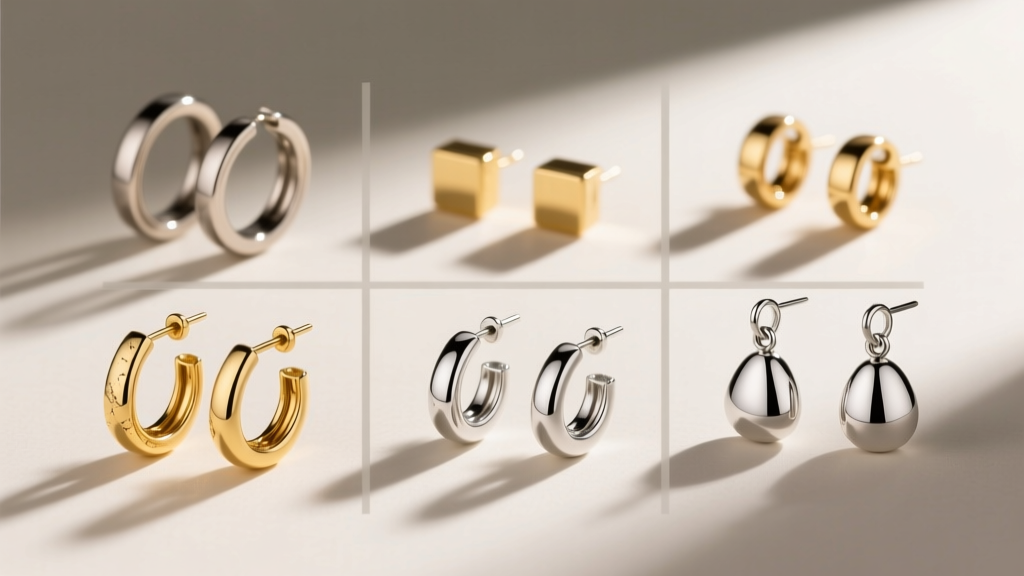
Small Stud Earring Anatomy: Gauges, Alloys, and Backing Types
Master the technical anatomy of a small stud earring. Explore exact gauge sizes, implant-grade alloys, and backing mechanisms for optimal piercing health.

The Engineering Behind the Everyday Stud
When most consumers shop for jewelry, they focus entirely on the decorative face of the piece. However, as a domain expert in body jewelry metallurgy and piercing biomechanics, I evaluate a small stud earring primarily by its structural anatomy. The post, the threading mechanism, and the backing system dictate whether a piece will sit flush, heal properly, or cause long-term tissue damage. In 2026, the market has shifted dramatically away from mass-produced friction-back studs toward precision-machined, anatomically correct jewelry. Understanding the exact tolerances, material grades, and retention mechanics is essential for anyone managing lobe or cartilage piercings.
Post Gauge and Dimensional Tolerances
The "gauge" refers to the thickness of the earring post, and it is the most critical factor in preventing the "cheese-cutter effect"—a biomechanical failure where a thin wire slowly migrates through tissue under the weight of the earring top. For a small stud earring, precise gauge matching to the piercing channel is non-negotiable.
- 20-Gauge (0.81mm): Standard for traditional, healed earlobe piercings created by piercing guns (which we strongly advise against for fresh piercings). While fine for lightweight, healed lobes, a 20g post lacks the structural rigidity for cartilage and can bend under minor impact.
- 18-Gauge (1.02mm): The modern baseline for standard lobe piercings and some delicate cartilage placements like the rook or tragus. It offers a balance of delicate aesthetics and sufficient tensile strength.
- 16-Gauge (1.29mm): The gold standard for cartilage (helix, conch, forward helix). The increased surface area distributes pressure evenly, minimizing migration risks and providing a stable platform for heavier ornamental tops.
Equally important is post length. A standard lobe stud post is 1/4" (6.35mm) to 5/16" (7.94mm). However, for cartilage, a flat-back labret style in 3/16" (4.76mm) or 1/4" is required to prevent the post from snagging on hair and clothing, which introduces shear stress to the fistula (the healed tissue tube).
Metallurgical Standards: ASTM F136 vs. Precious Alloys
The environment inside a piercing channel is warm, moist, and highly saline. This makes it an aggressive environment for base metals. According to the Association of Professional Piercers (APP), only specific, highly regulated alloys should be used for long-term wear.
Implant-Grade Titanium (ASTM F136)
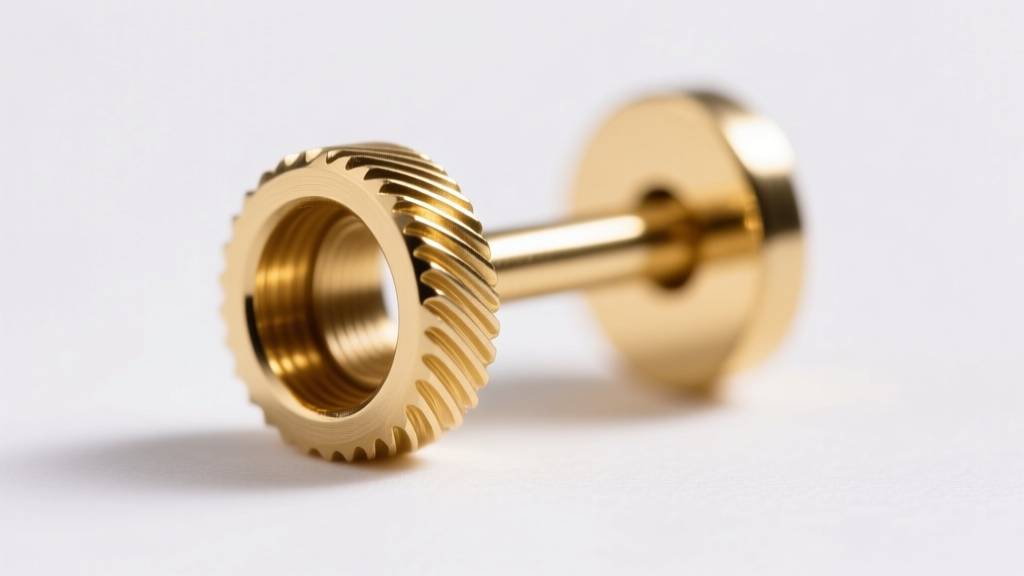
The absolute pinnacle of hypoallergenic jewelry is Ti6Al4V ELI (Extra Low Interstitial), designated as ASTM F136. This alloy contains zero nickel, making it completely inert. It is lightweight, highly resistant to galvanic corrosion, and can be anodized to create vibrant surface colors without using chemical dyes or plating that could flake off inside the piercing channel.
Karat Gold Alloys and Nickel Sensitization
While 14k and 18k gold are premium choices, their alloy composition matters immensely. Pure 24k gold is too soft for jewelry posts. To achieve 14k (58.5% gold) or 18k (75% gold), metals like copper, silver, and zinc are added. Historically, nickel was used to create white gold, but the National Center for Biotechnology Information (NCBI) notes that nickel is the leading cause of allergic contact dermatitis. Today, high-end manufacturers use palladium or silver to create nickel-free white gold. Always verify that a gold small stud earring is explicitly marketed as "nickel-free" or "cadmium-free" before purchasing.
Expert Warning: Avoid "surgical steel" or "316L" for fresh piercings or sensitive ears. 316L contains 10-14% nickel. While the nickel is theoretically bound within the alloy, the saline environment of a healing piercing can cause ion leaching, triggering severe contact dermatitis.
Retention Mechanics: Comparing Backing Systems
The backing mechanism dictates the security of the earring and the ease of insertion. The traditional "butterfly" friction back is rapidly being replaced by engineered alternatives in the professional market.
| Backing Type | Mechanism | Best Use Case | Failure Mode / Risk |
|---|---|---|---|
| Friction (Butterfly) | Tension-based metal scroll grips a grooved post. | Standard healed lobe piercings. | Harbors bacteria in the scrolls; easily knocked loose by hair or towels. |
| Internal Thread | Threads are machined into the hollow post; the screw attaches to the decorative top. | Premium lobe and cartilage studs. | Requires precise alignment to avoid cross-threading; higher manufacturing cost ($80-$250). |
| Threadless (Push-Pin) | Tension-fit; a slightly bent titanium pin inserts into a hollow post. | Cartilage, helix, and conch piercings. | Can pop out if bent incorrectly or subjected to extreme lateral shear force. |
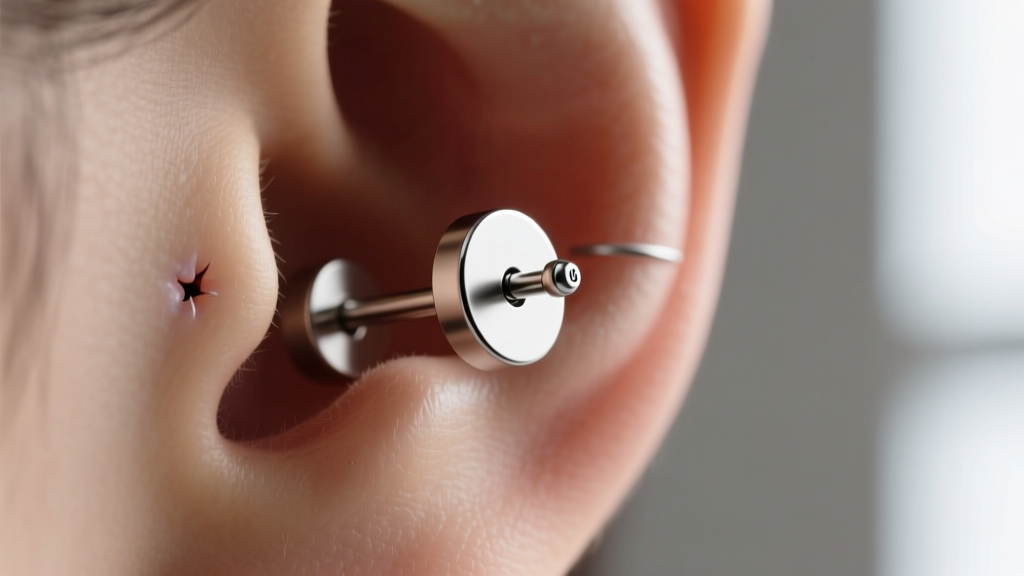
| Flat-Back (Labret) | A solid disc rests flush against the back of the ear, secured via threading or push-pin. | All cartilage placements; sleeping comfort. | Disc can embed in tissue if the post is too short during the swelling phase. |
Biomechanics and the Center of Gravity
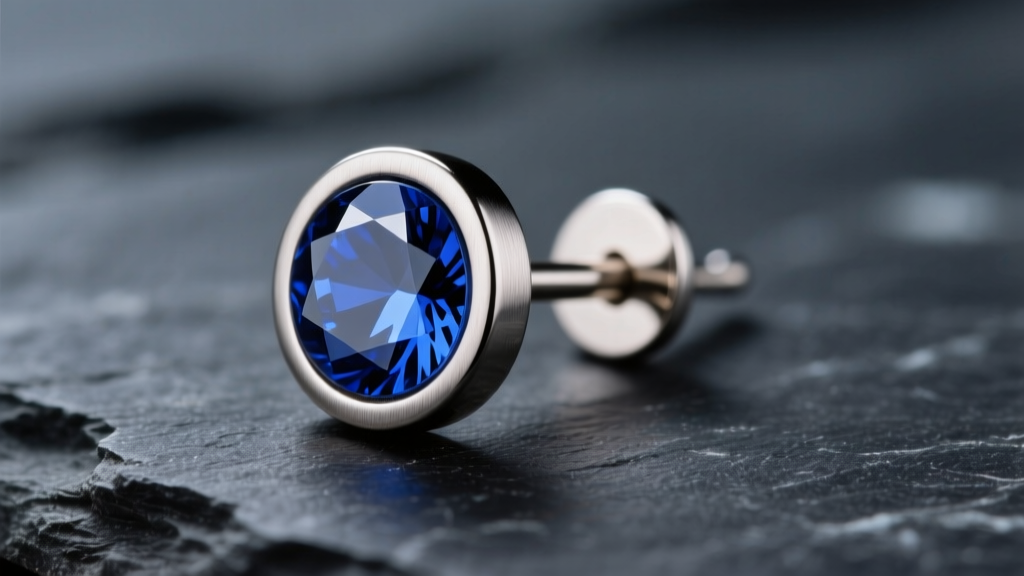
A common mistake consumers make is pairing a heavy, oversized decorative top with a thin, lightweight post. In a small stud earring, the center of gravity must remain as close to the skin's surface as possible. If a heavy gemstone is set on a long, 20-gauge post, the weight will pull the top forward, angling the post downward inside the fistula. Over time, this uneven pressure causes the piercing channel to stretch and migrate.
For bezel-set gemstones larger than 4mm, experts recommend stepping up to a 16-gauge post and utilizing a flat-back labret style. The flat disc provides a wider surface area against the back of the ear, counteracting the forward leverage of the gemstone and keeping the jewelry seated perfectly perpendicular to the tissue.
The Expert Procurement Checklist
Before purchasing your next small stud earring, run it through this technical checklist to ensure you are investing in a piece that promotes piercing longevity and tissue health:
- Verify the Alloy: Look for ASTM F136 Titanium, ASTM F1295 Niobium, or explicitly nickel-free 14k/18k gold.
- Check the Threading: Opt for internally threaded or threadless (push-pin) systems to prevent tissue micro-tears during insertion.
- Measure the Post: Ensure the gauge matches your piercing (18g for lobes, 16g for cartilage) and the length is appropriate for your anatomy (usually 1/4" for healed lobes, 3/16" or 1/4" for cartilage).
- Assess the Profile: Choose bezel-set or low-profile prong settings to minimize snagging on textiles and hair.
By prioritizing structural engineering and metallurgical purity over fast-fashion aesthetics, you ensure that your jewelry remains a safe, comfortable, and permanent fixture of your personal style.