Small Thick Hoop Earrings: Metallurgy, Gauge, and Fit Guide
Master the technical specs of small thick hoop earrings. Explore gauge thickness, ASTM metal grades, clasp mechanics, and lobe weight distribution.

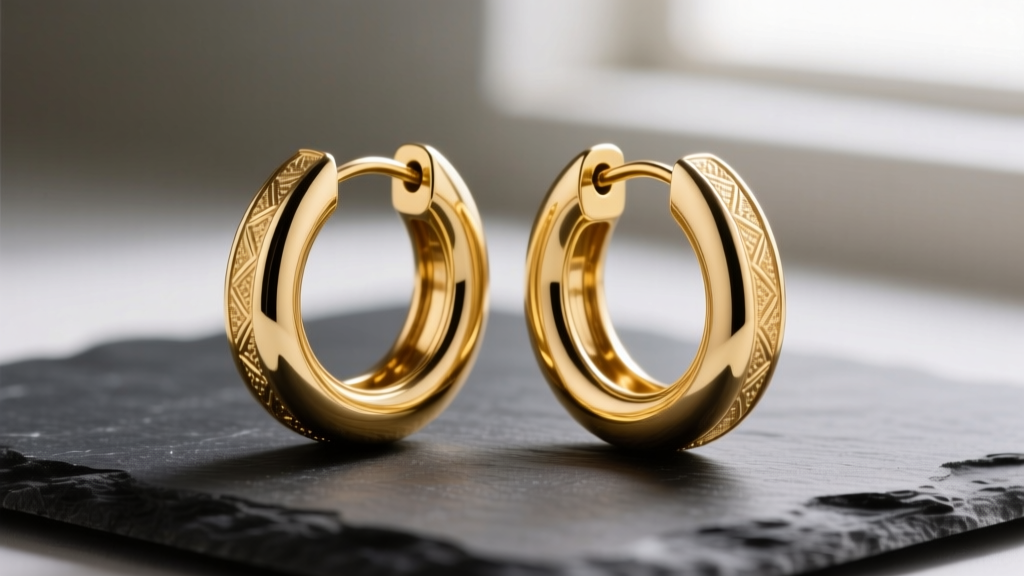
The resurgence of minimalist geometry in body jewelry has cemented small thick hoop earrings—often referred to in the industry as chunky huggies or tube hoops—as a staple in both curated ear projects and standalone lobe piercings. However, beneath their sleek, continuous exterior lies a complex intersection of metallurgy, biomechanics, and precision engineering. Unlike standard wire hoops, thick hoops require specialized manufacturing techniques to balance visual volume with wearable weight. This expert deep dive explores the technical specifications, material grades, and structural failure modes of small thick hoops, providing a definitive framework for collectors, piercers, and jewelry designers.
The Anatomy of Chunky Tube Hoops: Diameter vs. Thickness
When defining small thick hoop earrings, industry standards generally categorize them by an Inner Diameter (ID) ranging from 10mm to 15mm, paired with a wire or tube thickness (gauge) of 3mm to 6mm. The critical engineering challenge here is the volume-to-weight ratio. A solid 5mm wire bent into a 12mm hoop yields a substantial piece of metal that can easily exceed 8 grams per earring, depending on the alloy's density.
Solid Wire vs. Electroformed Hollow Tubing
To mitigate excessive weight, manufacturers utilize two distinct fabrication methods:
- Solid Wire/CNC Machining: Milled from a single block or drawn through a die. These offer superior structural integrity, meaning the clasp mechanisms can be integrated directly into the metal without risking collapse. However, they are heavier and require robust earlobe fistulas to prevent migration.
- Electroformed Hollow Tubing: A wax or resin core is plated with metal (usually gold or silver) in an electrolytic bath, then the core is melted or dissolved away. This creates a tube with a wall thickness of roughly 0.6mm to 1.2mm. While drastically reducing weight, hollow hoops are susceptible to denting if squeezed by pliers during clasp adjustments and can trap moisture inside the tube if not properly sealed.
Metallurgical Deep Dive: What Makes a Hypoallergenic Thick Hoop?
Because small thick hoop earrings sit flush against the skin and often occupy fresh or healing piercings, the metallurgical composition is paramount. The presence of nickel, copper, and zinc in lower-grade alloys can cause severe contact dermatitis, exacerbated by the wide surface area of a thick hoop pressing against the earlobe.
ASTM F136 Titanium vs. Gold Alloys
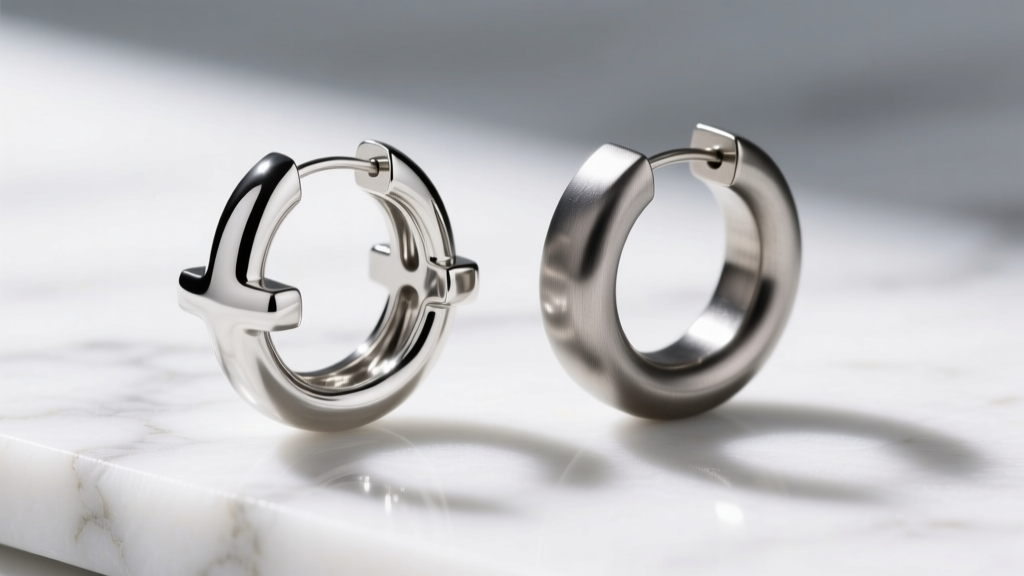
According to the Association of Professional Piercers (APP), only specific grades of titanium and high-karat gold are recommended for long-term wear in sensitive piercings. For thick hoops, ASTM F136 Ti-6Al-4V ELI (Extra Low Interstitial) titanium is the gold standard. It is entirely nickel-free, highly corrosion-resistant, and roughly 45% lighter than steel, making it ideal for solid thick hoops that would otherwise be too heavy.
Conversely, 14k and 18k gold alloys present unique engineering challenges. 18k gold (75% pure gold) is relatively soft, with a Vickers Hardness (HV) of around 130. This softness means that the tiny hinge pins and clicker latches required for thick hoops can deform over time. 14k gold (58.5% pure gold) is harder (approx. 150-170 HV) and holds clasp tension better, but buyers must verify that the alloying metals are nickel-free, often utilizing palladium or silver instead.
| Material Grade | Density (g/cm³) | Vickers Hardness (HV) | Nickel Content | Best Clasp Type |
|---|---|---|---|---|
| ASTM F136 Titanium | 4.43 | 330 | 0% | CNC Machined Clicker |
| 14k Palladium White Gold | 12.6 | 160 | 0% | Hinge & Latch |
| 18k Yellow Gold | 15.6 | 130 | 0% | Threadless/Snap |
| 316L Surgical Steel | 8.00 | 220 | 10-12% | Hinge & Latch |
Clasp Mechanics: Hinge, Clicker, and Saddle Backs
The closure mechanism on small thick hoop earrings is the most common point of structural failure. Because the wire is thick, traditional saddle backs (which require the post to bend through the fistula) are entirely unviable; a 4mm solid post cannot bend without snapping or tearing the earlobe. Therefore, the industry relies on advanced hinge systems.
Failure Modes in Thick Hoop Closures
- The Tolerance Gap: In a clicker closure, the male post must snap into a female receptacle. If the CNC machining tolerance exceeds 0.05mm, the clasp will either fail to close securely (risking loss) or require excessive force to snap shut, which can bend the hinge pin.
- Hair Snagging: Hinged hoops with external latch catches often feature a tiny divot for the fingernail. In thick hoops, this divot is larger and frequently catches fine hair, pulling the earring and stressing the fistula.
- Hinge Pin Shearing: If a hollow electroformed hoop is forced open too wide by the user, the soldered joint connecting the microscopic steel or titanium hinge pin to the soft gold tube can shear, rendering the earring irreparable.
Biomechanics: Weight Distribution and Earlobe Stress
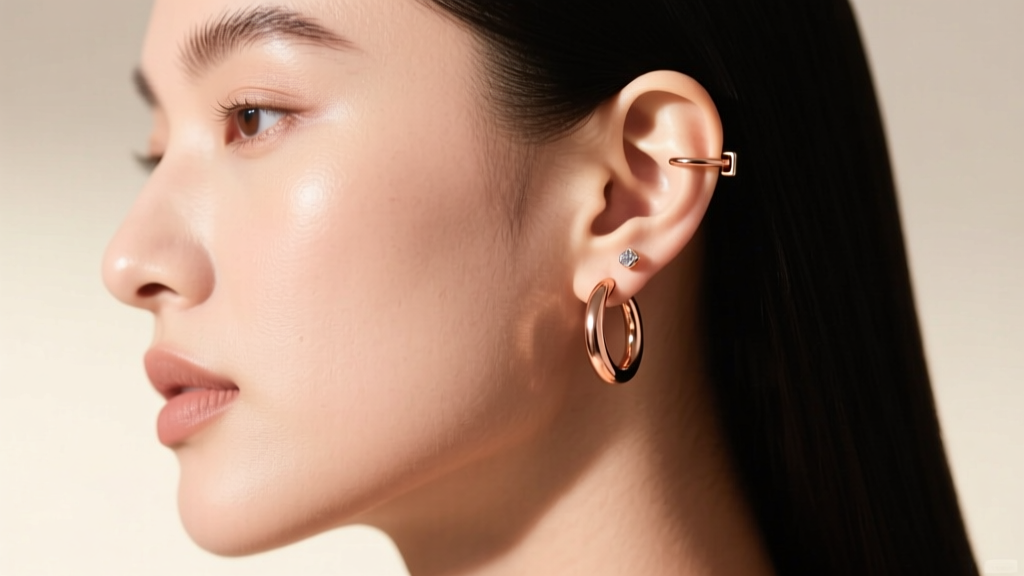
A common misconception is that heavy earrings universally cause earlobe stretching. In reality, the cheese-cutter effect—where jewelry slowly migrates downward through the tissue—is a function of pressure (Force ÷ Area). Standard 20-gauge (0.8mm) wire hoops concentrate the weight of the earring onto a tiny surface area inside the piercing channel.
Small thick hoop earrings actually mitigate this risk. A 4mm thick hoop distributes the same gravitational force across a surface area five times larger than a standard wire. As long as the total weight remains under the 7-10 gram threshold per lobe, a thick hoop is biomechanically safer for long-term wear than a heavy, thin-wire chandelier earring. However, the width of the hoop must match the gauge of the original piercing. Forcing a 4mm hoop into a standard 18g (1.0mm) piercing will cause immediate micro-tearing and blowout. Consumers must ensure their lobes are stretched to at least 8g (3.2mm) or 6g (4.0mm) to accommodate true thick hoops comfortably.
Expert Buying Framework: Pricing and Brand Benchmarks
When evaluating the market for small thick hoop earrings, pricing is strictly dictated by the manufacturing method, material purity, and clasp complexity. Use this framework to assess value:
- Tier 1: Mass-Market Hollow ($30 - $80)
Typically made from sterling silver or gold-plated brass using electroforming. Lightweight but prone to denting. The clasps are often manually soldered, leading to inconsistent tension. Suitable for occasional wear on healed, standard-gauge piercings. - Tier 2: CNC Titanium & Steel ($60 - $150)
Brands utilizing ASTM F136 titanium and 5-axis CNC machining produce incredibly precise clicker closures. These are the go-to options for professional piercers. They offer high durability, zero nickel exposure, and flawless hinge mechanics. - Tier 3: Solid 14k/18k Gold ($180 - $450+)
Premium body jewelry brands cast or machine solid gold thick hoops. The value here lies in the alloy purity (guaranteed nickel-free) and the hand-finishing of the clasp to ensure a seamless, invisible closure line that mimics a continuous ring.
Expert Maintenance Note: Never use ultrasonic cleaners on hollow electroformed thick hoops. If the microscopic seam at the clasp has even a partial breach, the ultrasonic cavitation will force cleaning solution inside the hollow tube. This trapped moisture will eventually cause internal oxidation and a persistent foul odor. Always clean hollow hoops with a soft cloth and mild, non-chemical soap, ensuring they are completely dry before storage.
Ultimately, selecting the perfect pair of small thick hoop earrings requires looking past the aesthetic and examining the engineering. By prioritizing ASTM-certified materials, precision-machined clicker clasps, and an understanding of your own piercing's biomechanical limits, you can secure a piece of jewelry that is as structurally sound as it is visually striking.


