What Is the Smallest Gauge Earring? Sizing & Troubleshooting Guide
Discover what is the smallest gauge earring safe for your piercings. Troubleshoot fitting issues, avoid the cheese-cutter effect, and find your size.

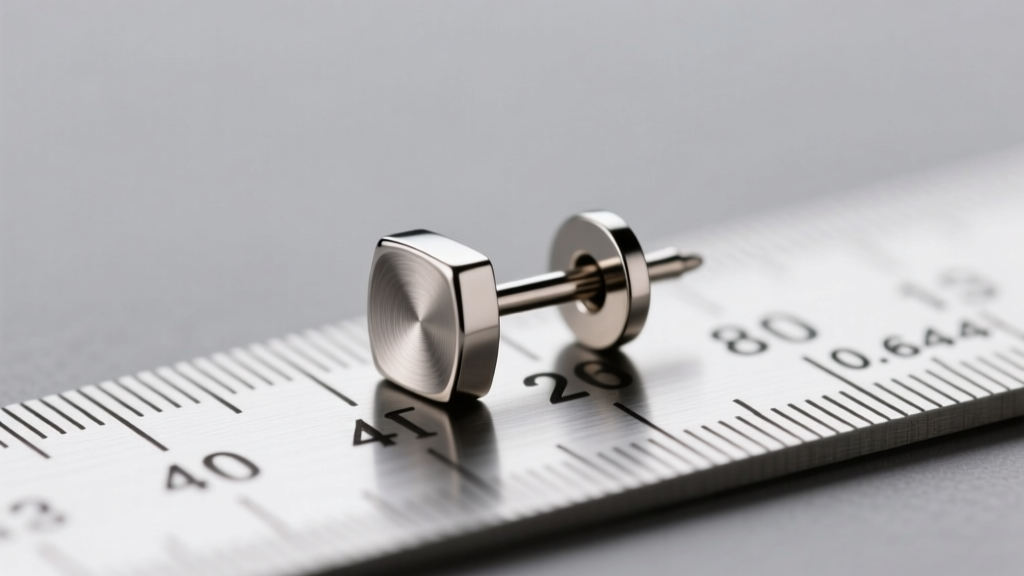
When navigating the intricate world of body jewelry, understanding wire thickness is critical for both comfort and tissue health. A frequent question we receive from clients with delicate placements or sensitive healing fistulas is: what is the smallest gauge earring that can be worn safely? The answer requires untangling the counterintuitive mathematics of the American Wire Gauge (AWG) system and understanding the biomechanics of how metal interacts with human tissue. Whether you are trying to fit a micro-helix, a snug tragus, or simply prefer a barely-there aesthetic, choosing a gauge that is too thin can lead to severe complications, including tissue tearing and piercing migration.
The Counterintuitive Math of Earring Gauges
Unlike standard metric measurements where a larger number equates to a larger size, the AWG system operates inversely. The higher the gauge number, the thinner the wire. This historical manufacturing standard means that a 22-gauge wire is significantly thinner than a 16-gauge wire. For context, a standard earlobe piercing is typically done at 20-gauge or 18-gauge, while most cartilage piercings are performed at 16-gauge to ensure structural stability. When individuals seek out the absolute thinnest options, they are venturing into the 22-gauge and 24-gauge territories, which measure a mere 0.64mm and 0.51mm respectively. According to the Association of Professional Piercers (APP), jewelry below 18-gauge is generally not recommended for fresh piercings due to the high risk of trauma and the 'cheese-cutter' effect.
What Is the Smallest Gauge Earring You Can Safely Wear?
Commercially, the smallest widely available gauge for removable body jewelry is 22-gauge (0.64mm). While 24-gauge (0.51mm) and even 26-gauge wires exist in specialized jewelry manufacturing, they are almost exclusively reserved for permanent welded jewelry, micro-dermal anchors, or highly specific, delicate wire-wrapping techniques. Wearing a removable 24-gauge earring in a standard fistula is highly discouraged. The structural integrity of a 0.51mm wire is so low that normal activities—such as brushing your hair, changing clothes, or sleeping—can easily bend, warp, or snap the metal inside the piercing channel, leading to embedded jewelry and emergency medical extractions.
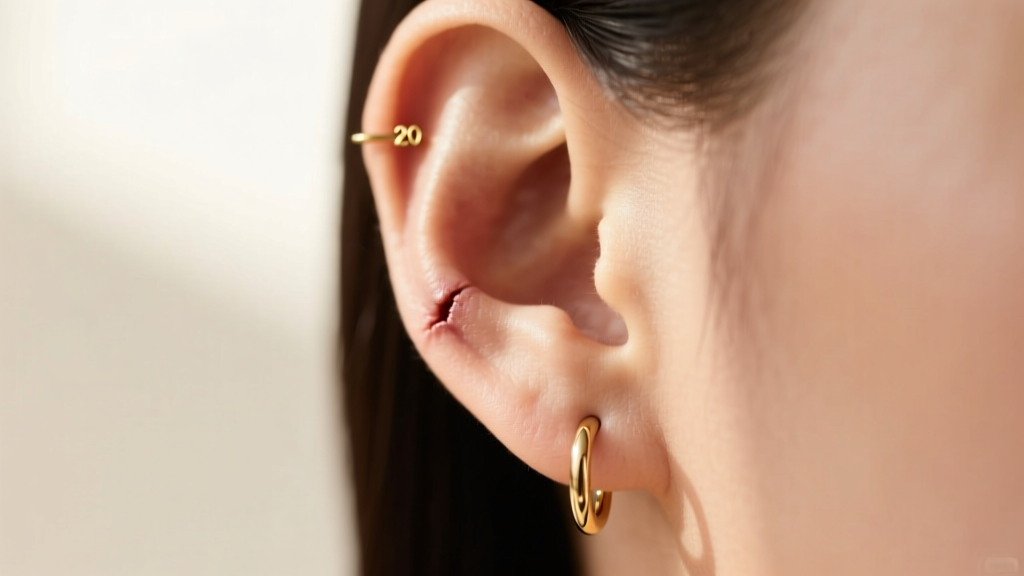
Troubleshooting Small-Gauge Earring Failures
If you are currently wearing 22-gauge or 20-gauge earrings and experiencing discomfort, you are likely dealing with one of three common micro-gauge failure modes. Identifying the exact mechanical issue is the first step toward troubleshooting and resolving the irritation.
1. The 'Cheese Cutter' Effect
The most dangerous complication of wearing the smallest gauge earring is the cheese-cutter effect. This occurs when a thin wire bears the weight of a heavy decorative end or charm. Physics dictates that pressure equals force divided by area. Because a 22-gauge post has a minuscule surface area resting against the bottom of the piercing channel, any downward force from a heavy dangle or hoop concentrates immense pressure on a tiny strip of skin. Over time, this pressure cuts through the tissue exactly like a wire cheese slicer, causing the piercing to migrate downward and eventually split the earlobe or cartilage completely. The Fix: If you want to wear heavy or oversized jewelry, you must upsize your gauge to 16-gauge (1.2mm) or 14-gauge (1.6mm) to distribute the weight across a wider surface area.
2. Post Bending and Sleep Trauma
Ultra-thin posts lack the rigidity required to withstand lateral pressure. If you sleep on a 22-gauge stud, the post will bend at a sharp angle inside the fistula. This bent metal acts as a hook, scraping and tearing the delicate epithelial lining of the healing or healed piercing channel every time you move. This leads to chronic bleeding, hypertrophic scarring, and irritation bumps. The Fix: Switch to a threadless (push-pin) labret post. The internal tension pin of a threadless end adds a secondary layer of structural support inside the hollow shaft, making the overall jewelry significantly more resistant to bending than a traditional threaded wire.
3. Threading Stripping and Fistula Damage
At 22-gauge, there is simply not enough metal to cut durable screw threads. Many cheap, mass-produced micro-gauge earrings use external threading, where the screw pattern is cut into the outside of the post. Pushing an externally threaded 22-gauge post through a piercing is akin to pushing a microscopic file through your tissue; it shreds the fistula lining and frequently strips the threads, making the backing impossible to remove without pliers. The Fix: Never purchase externally threaded micro-jewelry. Only invest in internally threaded (where the screw is on the backing) or threadless jewelry from reputable brands like NeoMetal or BVLA, as detailed in the Body Art Forms Educational Guide.
Micro-Gauge Comparison Chart for Delicate Piercings
Use the following data table to understand the exact dimensions and appropriate use cases for the smallest earring gauges available on the market.
| Gauge Size | Millimeter | Inch | Best Use Case | Tissue Risk Level |
|---|---|---|---|---|
| 24g | 0.51mm | 0.020' | Permanent welded chains, micro-dermals | Extreme (Avoid for removable) |
| 22g | 0.64mm | 0.025' | Healed, delicate nostril or secondary lobes | High (Prone to bending) |
| 20g | 0.81mm | 0.032' | Standard lobes, healed helix, lightweight hoops | Moderate (Safe for most) |
| 18g | 1.02mm | 0.040' | Cartilage, tragus, slightly heavier lobes | Low (Highly stable) |
| 16g | 1.29mm | 0.051' | Standard cartilage, heavy dangles, conch | Very Low (Optimal support) |
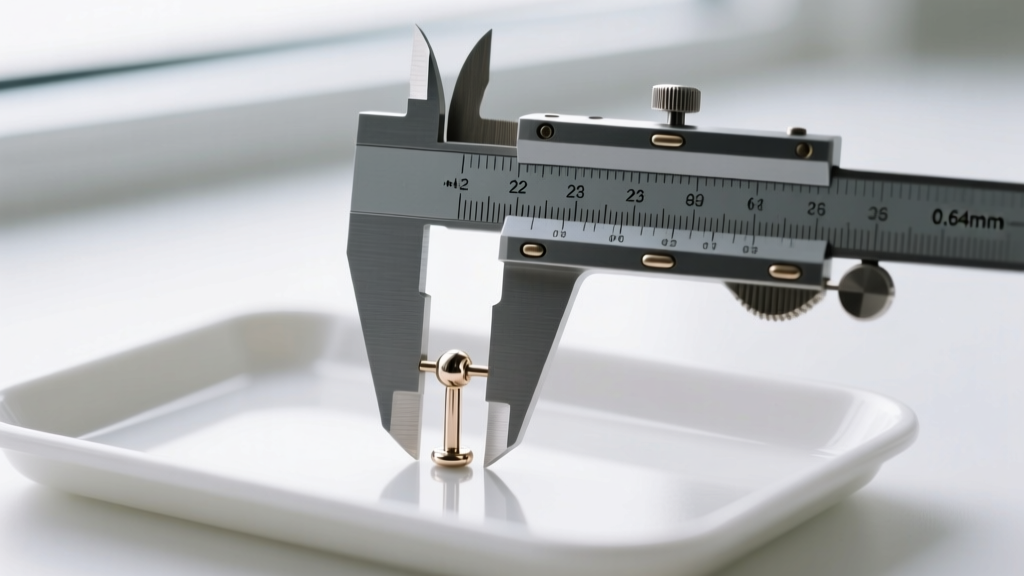
Material Selection for Ultra-Thin Posts
When wearing the smallest gauge earring, the metallurgical composition of the jewelry is just as critical as the physical dimensions. Thin wires have a higher surface-area-to-volume ratio in contact with the skin's moisture and sebum, which accelerates the leaching of reactive alloys. If a 22-gauge post contains even trace amounts of nickel (common in low-karat gold or sterling silver), the resulting contact dermatitis will cause the fistula to swell. Because the post is so thin, the swollen tissue will quickly engulf the metal, leading to embedding. For micro-gauges, you must exclusively wear ASTM F136 Implant-Grade Titanium or Niobium. These materials are entirely biocompatible, non-porous, and will not trigger the inflammatory responses that cause thin posts to become trapped in the ear.
Safely Sizing Up from a Micro-Gauge
If you have realized that your 22-gauge earrings are causing the cheese-cutter effect or chronic irritation, you will need to stretch the fistula to a more stable 18-gauge or 16-gauge. Do not simply force a thicker earring through the hole, as this will cause micro-tears and scar tissue buildup. Instead, purchase a sterile, single-use acrylic or steel insertion taper. Apply a water-based lubricant to the taper, gently slide the 18-gauge end through the 22-gauge fistula, and immediately follow the taper with a high-quality, internally threaded 18-gauge titanium labret stud. Leave the new, thicker jewelry in place for at least four to six weeks to allow the tissue to remodel and stabilize around the wider, safer gauge.


