Expert Guide to Snow Earrings: Gem Cuts, Metals & Settings
Discover the technical anatomy of snow earrings. Explore crushed ice gem cuts, platinum vs. white gold metallurgy, and prong settings for winter designs.

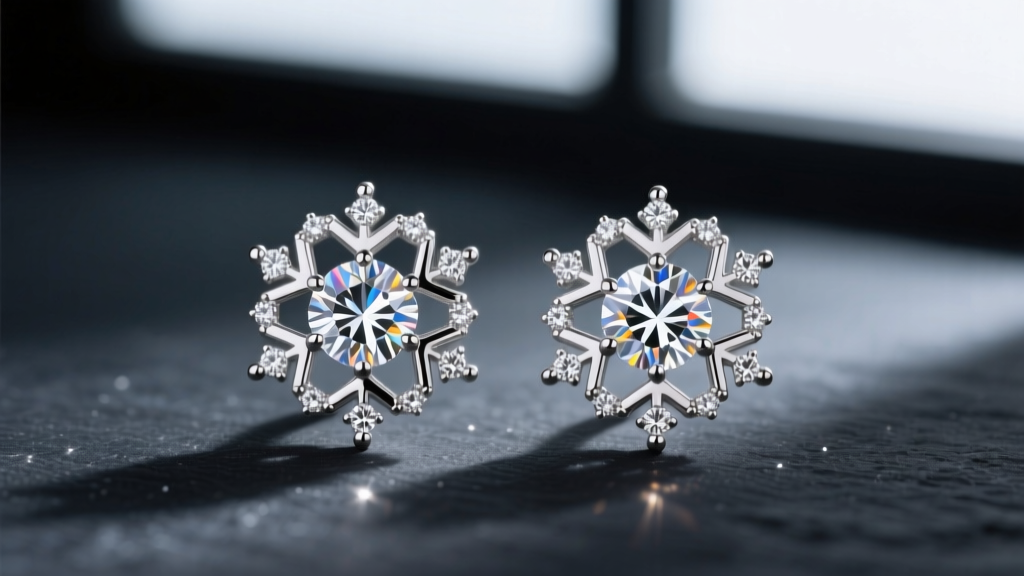
The Engineering of Winter: Defining Snow Earrings
When jewelers and gemologists discuss 'snow earrings,' they are rarely referring to simple novelty shapes. In high jewelry and advanced metallurgical design, snow earrings represent a complex category of radial symmetry, micro-pavé engineering, and specialized light-scattering gemology. Whether mimicking the six-fold crystalline structure of a natural snowflake or capturing the opaque, glittering texture of fresh frost, these designs demand exacting technical tolerances. This guide deconstructs the material science, gemological cuts, and structural frameworks that define premium snow-inspired ear jewelry.
Gemology: The 'Crushed Ice' Phenomenon and Frost Scintillation
The visual hallmark of modern snow earrings is the 'frost' effect—a scattered, high-frequency sparkle that mimics light hitting a bed of crushed ice or fresh snow. This is not achieved through standard brilliant cuts, which produce large, distinct flashes of light (scintillation) and rainbow dispersion (fire). Instead, master cutters utilize specialized facet arrangements to fracture light into thousands of microscopic pinpoints.
Brilliant vs. Crushed Ice Faceting
Standard round brilliant diamonds feature 57 or 58 facets optimized for maximum light return through the crown. In contrast, the 'crushed ice' cut—most commonly applied to cushion and radiant shapes—features a heavily segmented pavilion. The lower half of the stone is cut with numerous short, disconnected facets. When light enters, it bounces unpredictably across these micro-facets before exiting, creating a shattered, frosty appearance. According to the Gemological Institute of America (GIA), while this cut sacrifices some overall brilliance, it maximizes the specific 'glitter' effect required for snow-motif jewelry.
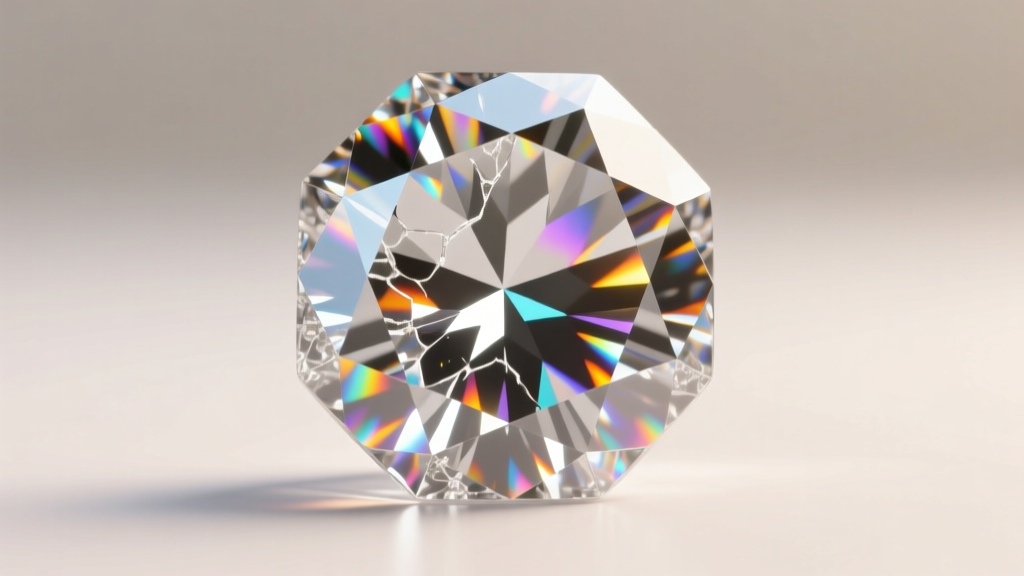
Furthermore, the refractive index (RI) of the chosen material drastically alters the snow effect. Lab-grown diamonds (RI 2.42) offer a crisp, icy white scintillation. Moissanite (RI 2.65 to 2.69), however, possesses higher birefringence and dispersion. When cut in a crushed ice style, moissanite can sometimes exhibit a 'disco ball' effect that may look overly fiery for a pure snow aesthetic. To counter this, expert lapidaries apply anti-reflective coatings or adjust the pavilion angles to suppress the rainbow fire, prioritizing the white-light frost effect essential for authentic-looking snow earrings.
Metallurgical Frameworks: White Gold, Platinum, and Palladium
The metal alloy serves as the structural lattice for snow earrings. Because snow motifs rely on intricate, branch-like arms and micro-prongs, the choice of white metal dictates both the longevity and the maintenance cycle of the piece. The three primary alloys used in 2026 for high-end winter collections are Platinum 950, Palladium 950, and White Gold.
| Metal Alloy | Rhodium Plating | Vickers Hardness (HV) | Wear Characteristics | Best Application |
|---|---|---|---|---|
| Platinum 950 (95% Pt, 5% Ru) | Not Required | 125 - 135 HV | Develops a soft patina; metal is displaced, not lost, when scratched. | Intricate micro-pavé snowflakes; heirloom dangles. |
| 18k White Gold (Palladium-bleached) | Required (0.75 - 1.0 µm) | 130 - 150 HV | Highly rigid; rhodium layer eventually wears to reveal a faint yellow undertone. | Structural hoops with snowflake charms; heavy studs. |
| 14k White Gold (Nickel-bleached) | Required (0.75 - 1.0 µm) | 150 - 170 HV | Very hard and brittle; excellent prong security but higher risk of casting porosity. | Everyday snow studs; budget-friendly lattice drops. |
| Palladium 950 | Not Required | 110 - 120 HV | Naturally white, lightweight, but softer and more prone to bending under stress. | Large, oversized snowflake statement earrings. |
For delicate snowflake lattice work, Platinum 950 is the industry gold standard. Its malleability allows jewelers to push micro-prongs tightly against 1.0mm melee diamonds without the metal snapping—a common failure mode in harder, nickel-bleached 14k white gold. Additionally, platinum does not require rhodium plating. Rhodium layers on white gold earrings typically measure between 0.75 and 1.0 microns; on earring posts and butterfly backs, friction can wear this plating away in months, whereas a platinum snow earring will remain naturally white indefinitely.
Structural Integrity: Radial Symmetry and Micro-Pavé Tolerances
Designing snow earrings involves navigating the complexities of radial symmetry, usually in six-fold or eight-fold geometries. This symmetry places immense stress on the central hub of the earring, especially in drop or dangle styles where kinetic movement is constant.
Casting Porosity and Prong Gauge
Most commercial snow earrings are produced via investment casting. However, the thin, branching arms of a snowflake design are highly susceptible to casting porosity—microscopic gas pockets trapped in the metal as it cools. If a porosity void occurs near a micro-prong, the prong will inevitably snap during setting or wear. To mitigate this, premium manufacturers use vacuum-assisted casting and X-ray inspection to ensure the structural integrity of the lattice.
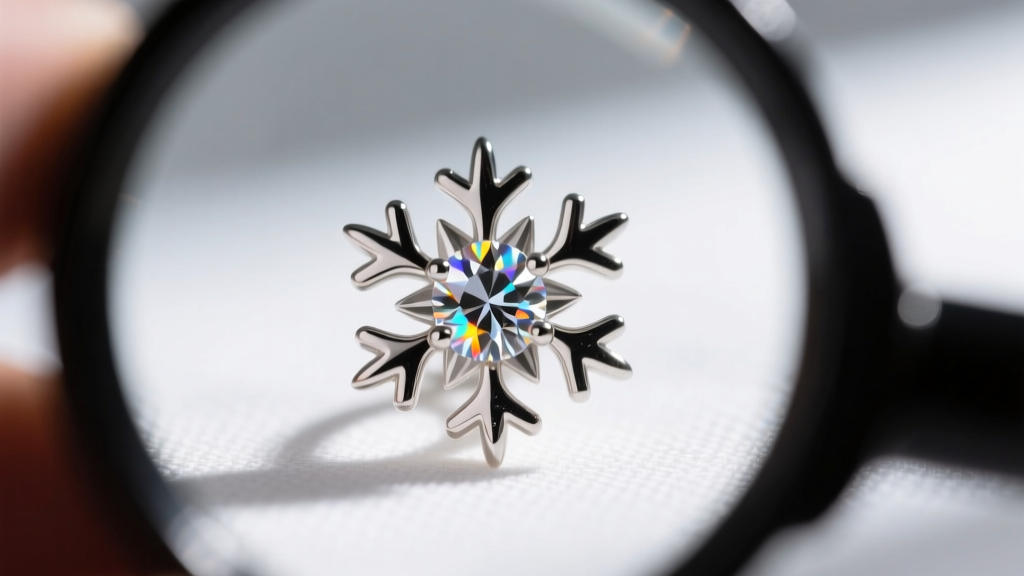
The prongs themselves require precise gauging. In a standard micro-pavé snowflake halo, the melee diamonds range from 0.005 to 0.02 carats (1.0mm to 1.7mm in diameter). The prongs securing these stones are typically drawn down to 0.6mm or 0.8mm in thickness. If the alloy is too soft or the prong is filed too thin during polishing, the stone will dislodge. Jewelers often employ 'bright cutting'—a technique where a graver is used to carve a precise, reflective seat for the stone, pushing a uniform bead of metal over the girdle to secure it without relying on traditional, bulky prongs.
Post Gauge, Friction, and Ergonomic Considerations
The physics of wearing snow earrings requires careful consideration of the earring post. A highly detailed, diamond-encrusted platinum snowflake stud can easily weigh between 4 and 7 grams per ear. Standard 20-gauge (0.81mm) posts are insufficient for this weight; they will bend under the leverage of the heavy head, causing the earring to droop forward on the lobe.
Expert manufacturers utilize 18-gauge (1.02mm) or even 16-gauge (1.29mm) posts for heavy snow earrings. Furthermore, the friction back (butterfly clutch) must feature a high-tension spring mechanism. Standard push-backs will slip off due to the pendulum effect of a heavy snowflake head. Screw-backs or specialized silicone O-ring clutches are recommended for securing high-value, heavy-gauge snow earring drops.
Maintenance Protocols for Intricate Lattice Work
The intricate under-gallery and pavé settings of snow earrings act as magnets for sebum, lotions, and environmental dust, which quickly dull the 'crushed ice' scintillation. However, cleaning them requires caution. The Jewelers of America advises against using ultrasonic cleaners on micro-pavé jewelry if the settings have not been recently inspected. The high-frequency vibrations of an ultrasonic bath can easily shake loose a melee diamond held by a worn 0.6mm prong.
For routine maintenance of snow earrings, utilize a soft-bristled baby toothbrush and a solution of warm distilled water with a single drop of degreasing dish soap. Gently agitate the pavé from the side, never pressing directly down on the stones, and dry with a lint-free microfiber cloth to prevent fibers from snagging on the micro-prongs.
By understanding the metallurgical choices, gemological cuts, and structural tolerances involved, collectors and enthusiasts can properly evaluate the craftsmanship of snow earrings, ensuring their winter-inspired jewelry remains structurally sound and optically brilliant for decades.


