How to Choose the Perfect Gold Button Earrings: A Buyer's Guide
Discover what to look for when buying solid gold button earrings. Learn about karat weights, clasp types, and sizing for everyday comfort.

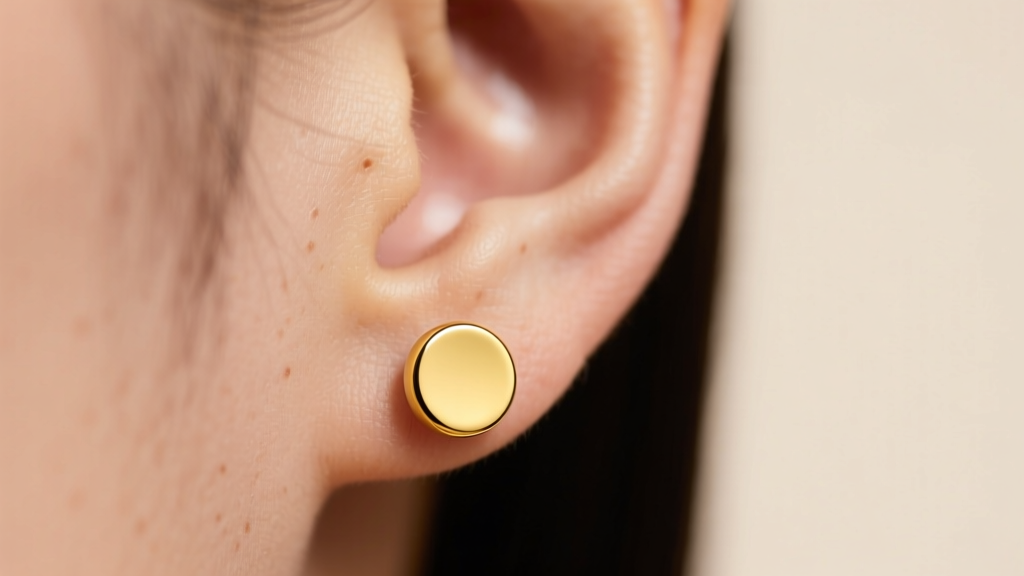
The Anatomy of a Gold Button Earring
Unlike traditional ball studs or delicate drop earrings, gold button earrings are defined by their wider, flatter, or slightly domed profile that sits flush against the earlobe. They mimic the look of a classic suit button or a vintage coin, offering a substantial, timeless aesthetic that bridges the gap between minimalist everyday wear and bold vintage styling. However, because of their larger surface area and increased weight compared to standard studs, buying the right pair requires a deeper understanding of gold metallurgy, post engineering, and secure backing mechanisms.
Decoding Gold Purity: 14K vs. 18K vs. 24K
When shopping for solid gold button earrings, the karat weight dictates not just the color, but the structural integrity of the jewelry. According to the Gemological Institute of America (GIA), pure 24K gold is far too soft for everyday friction and will easily bend or scratch. Therefore, button earrings are almost exclusively crafted in 14K or 18K gold.
14K Gold (58.5% Pure Gold)
14K gold is the undisputed champion for everyday button studs. Alloyed with copper, silver, and zinc, it achieves a Vickers hardness that resists the micro-scratches inevitable from hair brushing, phone use, and sleeping. If you are buying a domed button earring that will catch on sweaters, 14K is your safest bet for longevity.
18K Gold (75% Pure Gold)
18K offers a richer, deeper yellow hue that is highly prized in fine jewelry. However, it is noticeably softer. For a flat-faced button earring with intricate milgrain detailing or an engraved surface, 18K is excellent because the softer metal takes detail beautifully. Just be prepared for a higher price point and a slightly more delicate post.
Proportions and Sizing: Finding Your Millimeter Match
Button earrings are measured by their diameter in millimeters (mm). Because they lack the three-dimensional projection of a gemstone stud, a 6mm button will look significantly wider and flatter than a 6mm round diamond. Choosing the right size depends on your lobe real estate and piercing placement.
| Diameter | Visual Impact | Best Placement | Weight Consideration |
|---|---|---|---|
| 4mm - 5mm | Petite, subtle, minimalist | Upper lobes, helix, second piercings | Very light; standard 20G post is sufficient |
| 6mm - 7mm | Classic everyday proportion | Primary lower lobe piercing | Moderate; requires a sturdy 18G or 16G post |
| 8mm - 10mm | Bold, vintage, statement | Lower lobe, stretched lobes | Heavy; requires 14G+ post and secure screw back |
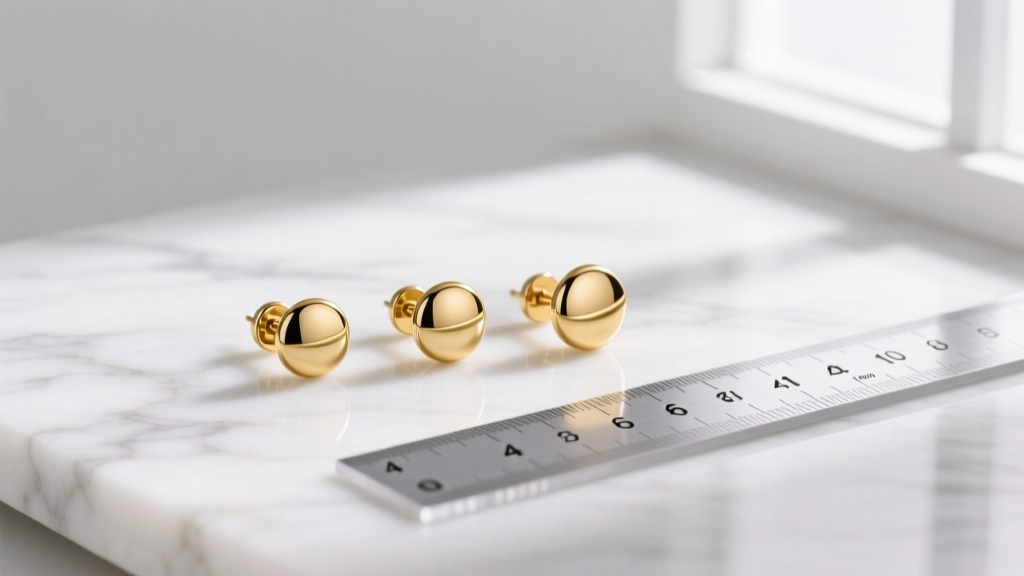
Dome vs. Flat Face: Choosing the Right Silhouette
The term 'button' encompasses two distinct silhouettes, each with unique wear characteristics. Understanding the difference is crucial for matching the earring to your lifestyle.
The Domed Button
Domed buttons feature a convex, rounded surface. This shape is highly practical for everyday wear because the curved surface deflects friction. If you frequently wear over-ear headphones, tight beanies, or scarves, a domed button will glide past fabrics rather than catching on them. Additionally, the convex shape naturally hides micro-scratches and scuffs that accumulate over years of wear.
The Flat-Face Button
Flat-faced buttons (often resembling vintage coins or suit buttons) offer a striking, geometric aesthetic. They frequently feature engraved motifs, milgrain borders, or a brushed matte finish. However, the flat plane is more susceptible to visible scratching. If you choose a flat-faced button, opt for a brushed or hammered finish, which brilliantly masks daily wear and tear while enhancing the vintage aesthetic.
The Hardware: Posts, Gauges, and Secure Backings
The most common failure point in gold button earrings is not the gold itself, but the hardware. A heavy 8mm gold button will easily drag down a thin post, causing the piercing to stretch or the earring to droop forward. The Association of Professional Piercers (APP) emphasizes the importance of appropriate gauge thickness and body-safe backing mechanisms.
Post Gauge Thickness
- 20 Gauge (0.81mm): Standard for lightweight 4mm-5mm buttons. Avoid for heavier styles.
- 18 Gauge (1.02mm): The ideal middle ground for 6mm-7mm buttons, offering structural support without stretching the piercing.
- 16 Gauge (1.29mm): Necessary for 8mm+ buttons or cartilage placements to prevent the 'cheese-cutter effect' where thin metal migrates through the tissue.
Backing Mechanisms
Discard the standard friction 'butterfly' backs. They harbor dead skin and bacteria, and frequently slip off, taking your expensive gold button with them. Instead, look for:
- Screw Backs: The threaded post screws into a secure clutch. Excellent for heavy buttons, though threads can strip over years of use.
- Threadless (Push-Pin) Systems: A slightly bent pin inserts into a hollow post, creating tension. This is the modern gold standard for security and ease of use.
- Flat Back (Labret) Studs: Features a flat disc that rests flush against the back of the ear. Unmatched for sleeping comfort and prevents the heavy button from drooping forward.
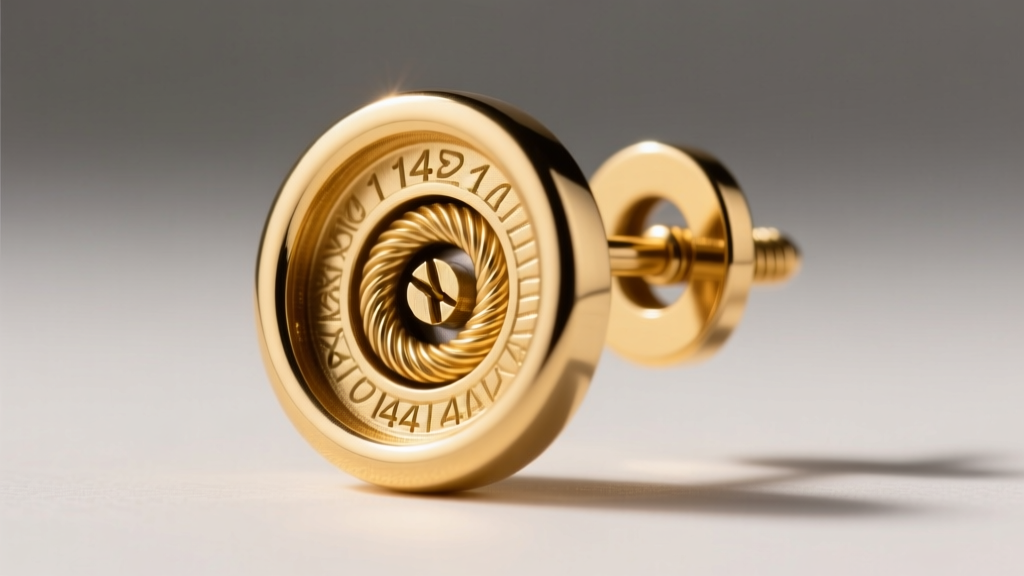
Material Reality: Solid Gold vs. Vermeil vs. Plated
Because button earrings require a larger volume of metal than delicate wire hoops, the material composition drastically affects both price and longevity.
- Solid Gold: Homogenous alloy throughout. Will never flake, tarnish, or cause contact dermatitis (if nickel-free). This is an heirloom investment.
- Gold Vermeil: A thick layer of gold (minimum 2.5 microns) over a sterling silver base. A great budget alternative, but the high-friction post area will eventually wear down to silver, which can oxidize and irritate sensitive piercings.
- Gold Plated / Gold Filled: Plated jewelry uses a brass or copper base with a microscopic flash of gold. Avoid these for button earrings; the wide surface area makes flaking and green skin discoloration highly likely within months.
Troubleshooting Common Button Earring Issues
Even with careful selection, button earrings can present unique mechanical challenges due to their wider center of gravity. Here is how to solve the most common issues:
- The 'Forward Droop': Because the decorative face is wide and heavy, standard butterfly backs often fail to support the weight, causing the button to point toward the floor. Solution: Switch to a flat-back labret post. The wide, flat disc distributes the weight evenly against the back of the earlobe, forcing the button to sit perfectly flush and upright.
- Snagging on Hair: Wide buttons can trap long hair between the earlobe and the metal edge. Solution: Ensure the earring has a 'beveled' or 'softened' edge rather than a sharp, stamped perimeter. Custom jewelers can easily polish the edges to a soft dome profile.
- Post Bending: If your 18K gold button post bends when inserting it, you are using a post that is too thin for the metal's softness. Solution: Have a jeweler swap the post for a thicker 16-gauge steel or titanium post (if allergies permit), or upgrade to a 14K gold post which offers superior tensile strength.
Pricing Expectations and Final Buying Checklist
When budgeting for solid gold button earrings, expect to pay primarily for the metal weight and the craftsmanship of the backing mechanism. A high-quality pair of 6mm 14K solid gold button earrings with threadless flat backs will typically range from $120 to $250. Upgrading to 18K gold or adding hand-engraved milgrain edges can push the price to $350 - $600.
Your Pre-Purchase Checklist:
- Hallmark Verification: Ensure the listing explicitly states 'Solid 14K' or 'Solid 18K'. Look for stamps like 585 (14K) or 750 (18K).
- Nickel-Free Guarantee: White gold button earrings are often alloyed with nickel for whiteness. If you have a nickel allergy, explicitly seek out palladium-alloyed white gold or stick to yellow/rose gold.
- Backing Inclusion: Confirm whether the secure backs (especially threadless or flat backs) are included in the price, as some fine jewelers sell the decorative front and the hardware separately.
- Profile Height: Check the 'profile' or 'rise' measurement. A button with a 4mm rise will sit too high and catch on hair; look for a low-profile dome (1.5mm - 2mm rise) for a sleek, flush fit.
By prioritizing structural integrity, appropriate gauge sizing, and secure hardware over mere aesthetics, you ensure your gold button earrings remain a comfortable, lifelong staple in your jewelry rotation.


