Square Guy Earrings: Technical Guide to Materials, Gauges & Fit
A technical deep dive into square guy earrings, covering ASTM titanium grades, gauge sizing, backing mechanisms, and precise dimensional fit.

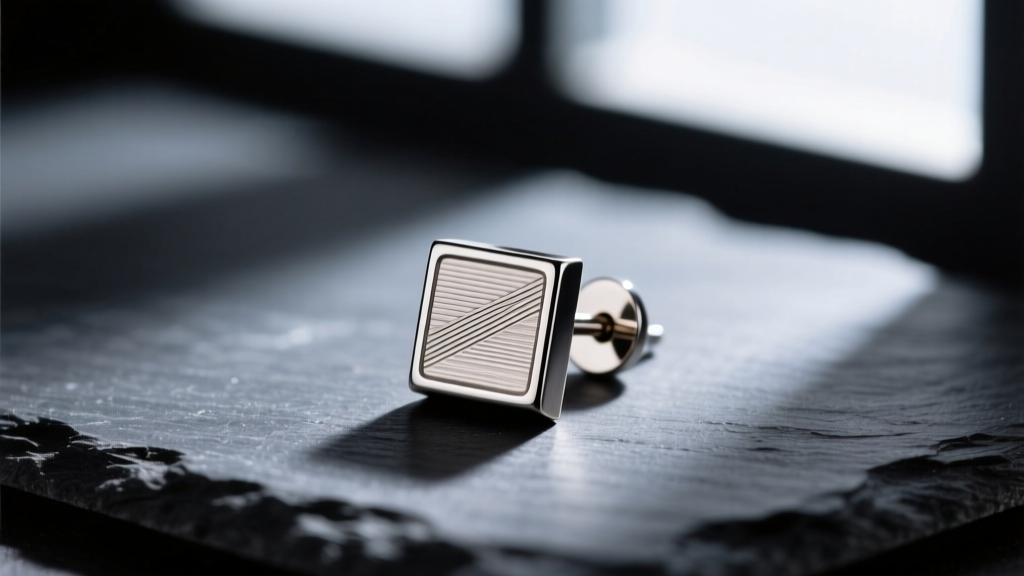
The evolution of men's body jewelry has shifted dramatically from rudimentary wire hoops to precision-machined geometric silhouettes. Among these, the square stud has emerged as a staple of modern masculine adornment, offering a sharp, architectural aesthetic that complements structured streetwear and tailored suiting alike. However, the market is flooded with poorly engineered pieces that fail under daily wear. If you are specifically sourcing guy earrings square silhouettes, understanding the underlying metallurgy, gauge tolerances, and structural failure modes is essential for making an informed purchase.
This technical guide deconstructs the engineering behind high-quality square men's earrings, providing actionable specifications to ensure longevity, biocompatibility, and optimal fit.
The Metallurgy of Square Men's Earrings
The material composition of an earring dictates its biocompatibility, weight, and scratch resistance. Men's earlobes are subject to higher friction from collars, helmets, and physical activity, making material hardness and corrosion resistance critical.
ASTM F136 ELI Titanium vs. 316L Surgical Steel
Many commercial brands market "surgical steel" as a premium option, but 316L stainless steel contains up to 10% nickel. According to the American Academy of Dermatology, nickel is the leading cause of contact dermatitis. For a permanent or frequently worn square stud, ASTM F136 ELI (Extra Low Interstitial) Titanium is the gold standard. It is entirely nickel-free, highly resistant to saline corrosion, and boasts a high strength-to-weight ratio, preventing the earring from sagging and distorting the piercing channel over time.
Tungsten Carbide & Ceramic Alternatives
For those prioritizing scratch resistance, Tungsten Carbide offers a Vickers Hardness (HV) of approximately 1500-2000, compared to titanium's 334 HV. While a tungsten carbide square face will maintain its mirror or brushed finish indefinitely, the material is inherently brittle. A sheer impact—such as a blow to the ear during contact sports—can cause the square face to shatter or the post to snap at the laser-weld joint.
Dimensional Specifications & Gauge Tolerances
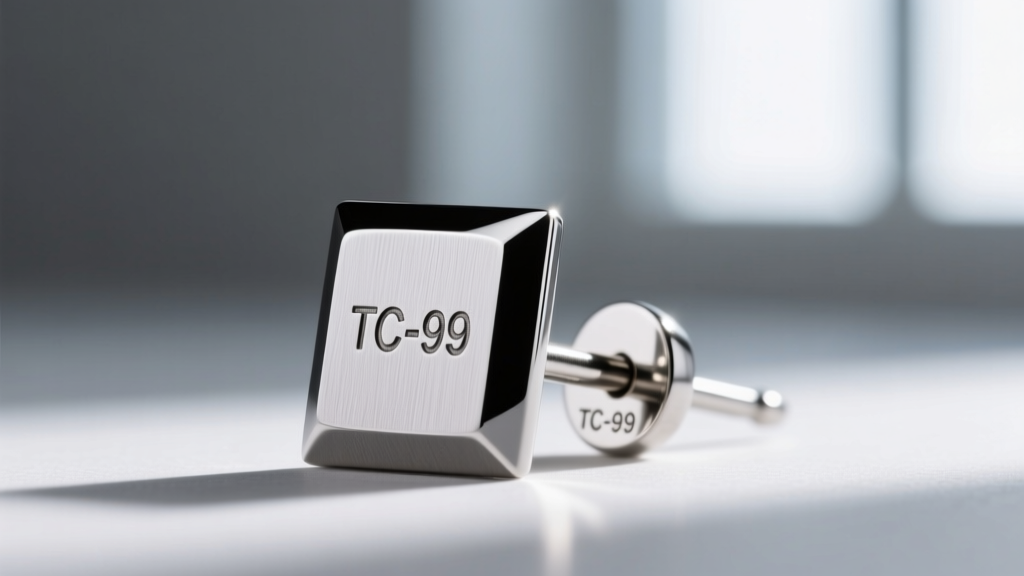
The most common point of failure in men's earrings is an undersized post gauge combined with an oversized face. This creates a pendulum effect that leads to the "cheese-cutter effect," where a thin post slowly migrates through the lobe tissue due to gravitational shear.
Post Gauge Sizing
- 20G (0.81mm): Standard for mass-market women's jewelry. Avoid for men. Too thin to support a dense square face; high risk of tissue migration.
- 18G (1.02mm): Acceptable for small (3mm-4mm) lightweight titanium squares.
- 16G (1.20mm): The ideal baseline for men's square studs. Provides sufficient structural rigidity for 5mm to 8mm faces without causing insertion trauma.
- 14G (1.60mm): Recommended for heavy materials like solid 14k gold or tungsten, or for lobes that have been slightly stretched.
Material Density & Hardness Matrix
When evaluating the weight-to-size ratio of a square earring, refer to the following engineering matrix to predict how a material will behave at a standard 6mm face width:
| Material Grade | Density (g/cm³) | Vickers Hardness (HV) | Biocompatibility Grade | Max Recommended Face Size (16G) |
|---|---|---|---|---|
| ASTM F136 Titanium | 4.43 | 334 | Implant-Grade (Excellent) | 8mm x 8mm |
| 316L Stainless Steel | 8.00 | 150-200 | Fair (Nickel Risk) | 5mm x 5mm |
| 14k Yellow Gold (Alloyed) | 12.9 | 130-150 | Good (Varies by Alloy) | 6mm x 6mm |
| Tungsten Carbide | 15.6 | 1500+ | Good (Hypoallergenic) | 4mm x 4mm |
Backing Mechanisms: Friction vs. Threaded vs. Flat-Back
The backing mechanism dictates both the security of the earring and the comfort of the wearer, particularly during sleep. Men's earlobes are typically thicker than women's, averaging 3mm to 5mm in depth, which renders standard backing systems inadequate.
The Failure of the Butterfly Clutch
Standard friction butterfly clutches rely on tension grooves on the post. On thicker male lobes, the clutch must be pushed tightly against the tissue to prevent the earring from dangling, which restricts blood flow and causes hypertrophic scarring or "piercing bumps." Furthermore, the sharp tip of the post protruding past the clutch frequently scratches the neck and jawline.
Internally Threaded Flat-Backs (Labret Style)
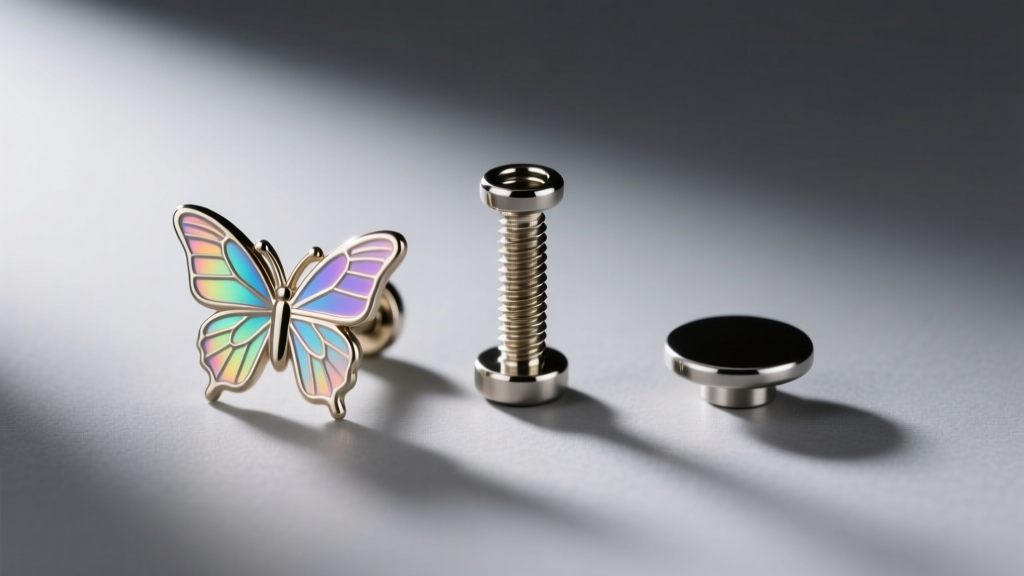
For square studs, the internally threaded flat-back labret is the superior engineering choice. The Association of Professional Piercers (APP) strongly advocates for internally threaded jewelry, as it prevents tissue damage during insertion. The flat disc backing sits flush against the rear of the earlobe, distributing pressure evenly and eliminating the sharp post tip entirely. For a standard male lobe, an 8mm or 10mm post length paired with a flat-back is the optimal configuration.
Geometric Failure Modes & Edge Chamfering
A critical, often overlooked aspect of square earring design is the corner geometry. A true, unmodified 90-degree corner on a metal square presents a severe snag hazard. When a towel, shirt collar, or seatbelt catches a sharp corner, the resulting torque can tear the piercing channel.
CNC Chamfering and Fillet Radii
Premium manufacturers utilize CNC (Computer Numerical Control) milling to apply a micro-chamfer or fillet radius to the edges of the square face.
Engineering Rule of Thumb: A square earring face should feature a minimum 0.2mm chamfer on all anterior edges. This preserves the sharp visual silhouette of the square while rendering the physical edge smooth enough to glide past textiles without catching.
When inspecting a piece, run a cotton swab along the perimeter of the square. If the cotton fibers snag or pull, the edge geometry is poorly finished and poses a long-term risk to your piercing integrity.
Facial Geometry & Proportional Scaling
Selecting the correct square dimension requires an understanding of facial proportions and ear anatomy. Unlike circular studs, which distribute visual weight evenly, squares draw the eye along their horizontal and vertical axes, emphasizing the jawline.
Sizing by Jawline and Lobe Real Estate
- 4mm x 4mm (The Micro Square): Best suited for sharp, angular jawlines and smaller, tighter lobes. Provides a subtle, minimalist accent without overwhelming the ear's natural folds.
- 6mm x 6mm (The Standard): The most versatile dimension. It offers enough surface area to showcase brushed or sandblasted textures while remaining proportional to average male lobe sizes.
- 8mm x 8mm and above (The Statement): Requires a larger, fleshier lobe to prevent the "cheese-cutter" migration effect. Visually, larger squares pair best with broader facial structures and heavier builds, acting as a grounding element in the overall aesthetic.
Surface Finish Considerations
The finish applied to the square face drastically alters its visual weight. A high-polish mirror finish reflects ambient light, making a 5mm square appear larger and more prominent. Conversely, a PVD (Physical Vapor Deposition) black titanium coating or a micro-sandblasted matte finish absorbs light, creating a denser, more understated look that hides micro-scratches acquired during daily wear.
Final Technical Verdict
Investing in high-quality men's geometric jewelry requires looking past the superficial design and scrutinizing the manufacturing specs. When shopping, demand ASTM F136 titanium or solid 14k/18k gold, insist on a minimum 16G post thickness, and prioritize internally threaded flat-back configurations. By adhering to these technical parameters, you ensure that your jewelry remains a permanent, comfortable, and structurally sound fixture of your personal style.