Square Stud Earrings: The 2026 Geometric Jewelry Trend
Discover why square stud earrings are dominating 2026 jewelry trends. Explore geometric styling, material grades, and face-shape pairings for modern looks.

The Architectural Shift: Why Square Studs Define 2026
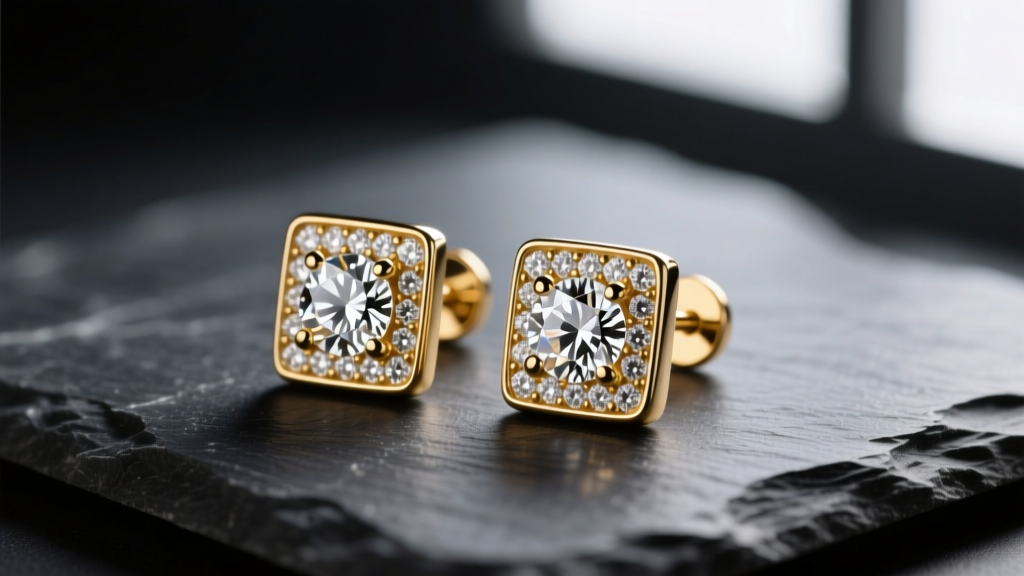
The jewelry landscape of 2026 has decisively pivoted from the soft, rounded silhouettes of the 'quiet luxury' era into a new phase of 'structured minimalism.' At the forefront of this movement are square stud earrings. No longer relegated to vintage jewelry boxes or rigid corporate attire, the modern square stud has been reimagined with beveled edges, mixed-metal inlays, and advanced bezel settings. According to Vogue's jewelry trend forecasting, consumers are increasingly seeking architectural pieces that project assertiveness and precision, making geometric studs the ultimate daily-wear statement.
Unlike traditional round brilliant solitaires that scatter light in a radial pattern, square studs command attention through their sharp, deliberate lines. They anchor the face with a sense of modernity, bridging the gap between fine jewelry and industrial design. Whether crafted from brushed titanium or high-polish recycled gold, the square silhouette offers a canvas for both subtle everyday elegance and bold editorial styling.
'The transition from round to geometric studs reflects a broader cultural desire for structure and clarity in design. Square studs offer a grounded, architectural anchor to the face that round stones simply cannot replicate.' — 2026 Fine Jewelry Trend Report
Material Science and Hardware Mechanics
The geometry of a square stud introduces unique structural challenges. A 6mm square stud has a surface area of 36mm², whereas a 6mm round stud covers only 28.27mm². This 27% increase in surface area means square studs are inherently heavier and exert more leverage on the earlobe. Selecting the correct metal hardness and post gauge is critical to prevent the earring from drooping or bending over time.
| Material | Hardness & Durability | Hypoallergenic Rating | Recommended Post Gauge |
|---|---|---|---|
| 14k Yellow Gold | Moderate (Prone to micro-scratches) | Medium (Contains alloys) | 18g (1.02mm) or 16g (1.29mm) |
| 18k White Gold | High (Rhodium plated for scratch resistance) | Medium (Nickel alloys common) | 18g (1.02mm) |
| Platinum 950 | Very High (Dense, develops a patina) | High (Usually alloyed with ruthenium) | 20g (0.81mm) is sufficient due to tensile strength |
| ASTM F136 Titanium | High (Lightweight, highly scratch-resistant) | Maximum (100% Nickel-free) | 16g (1.29mm) for cartilage, 18g for lobes |
For hypersensitive ears or fresh piercings, commercial-grade titanium is insufficient. You must look for certified ASTM F136 implant-grade titanium, which guarantees the absence of nickel and heavy metal impurities. When purchasing square studs for cartilage piercings like the helix or conch, always opt for flat-back labret posts rather than traditional butterfly friction backs to avoid the 'pike' effect while sleeping.
Dimensional Scaling and Visual Weight
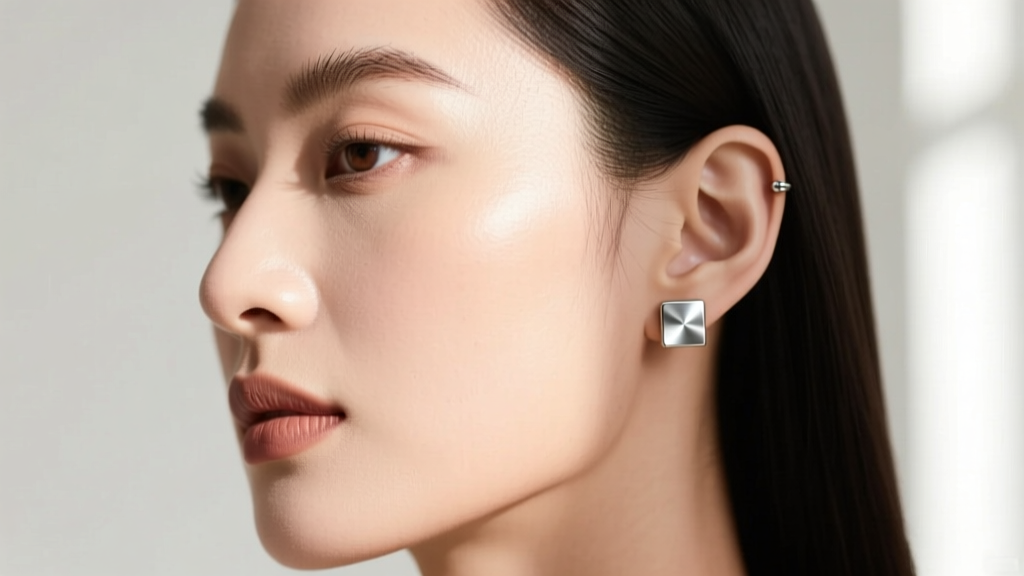
Sizing a square stud requires a different approach than sizing a round one. Because the human eye tracks the sharp corners of a square, the perceived size of the earring is often larger than its millimeter measurement suggests.
- 4mm - 5mm (The Micro-Square): Ideal for secondary lobe piercings, upper helix placements, or those seeking a subtle, understated geometric accent. Pairs beautifully with larger hoops.
- 6mm (The Standard Anchor): The most versatile size for primary lobe piercings. It provides enough surface area to showcase brushed textures or pavé diamond halos without overwhelming the earlobe.
- 8mm (The Statement Block): A bold choice that commands attention. Requires a secure backing system (such as La Poussiere or screw-backs) due to the increased leverage and weight on the earlobe.
- 10mm+ (The Editorial Silhouette): Rarely seen in fine jewelry due to weight constraints, these are typically crafted from lightweight materials like anodized aluminum or hollowed 14k gold for high-fashion, temporary wear.
The Face Shape Pairing Framework
Geometric earrings interact dynamically with facial bone structure. Here is how to strategically deploy square studs based on face shape:
- Round Faces: Square studs are highly recommended. The sharp 90-degree angles provide necessary contrast to soft curves, adding structure and a slimming visual effect to the jawline.
- Square Faces: Proceed with caution. Sharp square studs can exaggerate an already angular jaw. Instead, opt for 'soft squares'—studs with heavily chamfered corners, cushion-cut gemstones, or rounded bezel settings.
- Oval Faces: The universal canvas. Any dimension from 4mm to 8mm works perfectly, though matte-finished metals highlight the balanced proportions of an oval face best.
- Heart-Shaped Faces: Stick to the 4mm to 6mm range. Larger, heavier square studs can draw the eye downward, visually widening the lower half of the face and disrupting the natural heart-shaped taper.
Gemstone Geometry: Light Performance in Square Cuts
When incorporating diamonds or lab-grown alternatives into square studs, the cut of the stone dictates the entire personality of the earring. The Gemological Institute of America (GIA) notes that square cuts interact with light very differently than round brilliants, prioritizing distinct optical phenomena.
Princess Cut: The most popular square cut, featuring 50 to 58 facets. It offers intense brilliance and a modern, icy fire. However, the sharp, unprotected corners of a princess cut are highly susceptible to chipping if struck against a hard surface. In 2026, prong-set princess cuts are being replaced by V-prong or full-bezel settings to mitigate this failure point.
Asscher Cut: A square emerald cut with cropped corners. It features a step-cut facet arrangement that creates a mesmerizing 'hall of mirrors' effect. It sacrifices the chaotic sparkle of a princess cut for deep, elegant flashes of light. Asscher square studs are the preferred choice for black-tie events and minimalist luxury aesthetics.
Cushion Cut: Technically a square with rounded corners. It bridges the gap between geometric structure and vintage softness, offering large, chunky facets that perform exceptionally well in low-light, candlelit environments.
Troubleshooting Common Square Stud Failures
Despite their aesthetic appeal, square studs present specific mechanical vulnerabilities that buyers and designers must address.
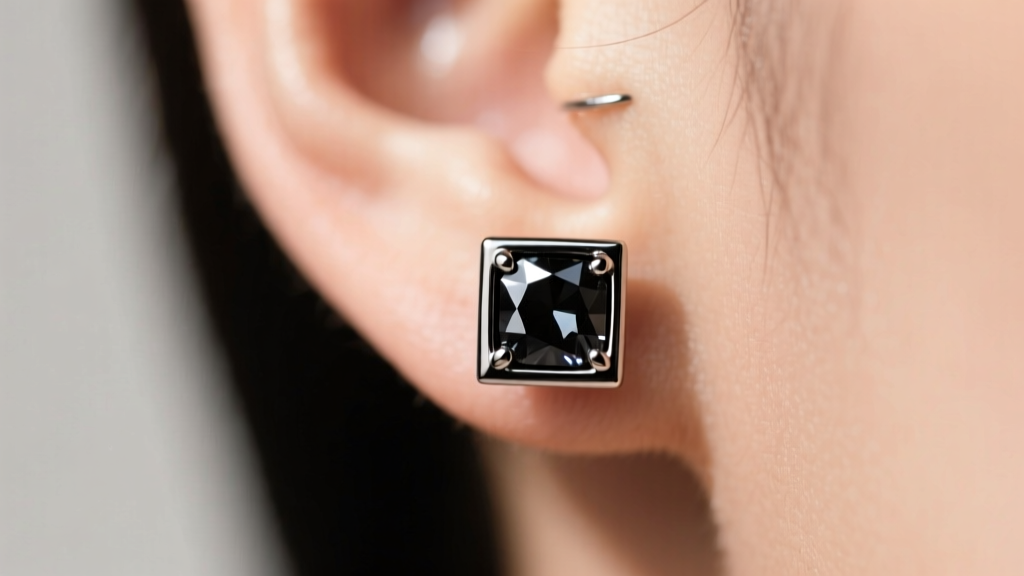
The 'Snag' Factor: The 90-degree corners of a square stud are notorious for catching on knitwear, silk pillowcases, and long hair. If you are an active wearer or frequently wear turtlenecks, avoid sharp-cornered designs. Look for 'chamfered' squares where the corners are slightly shaved down, or opt for octagonal settings that mimic a square profile without the sharp points.
Post Bending and Droop: As mentioned, the surface area of a square stud creates a lever effect. If a heavy 8mm gold square stud is mounted on a thin 20-gauge post, the post will inevitably bend backward, causing the earring to point toward the floor. Always verify the post thickness. For any square stud over 6mm, demand an 18-gauge or 16-gauge post, and pair it with a jumbo friction back or a silicone O-ring back to distribute the weight across a wider area of the earlobe.
Plating Wear on White Gold: Square studs made of 14k or 18k white gold are plated with rhodium to achieve a bright white finish. Because square studs have flat, broad surfaces, the rhodium plating on the high-contact edges will wear away faster than on a rounded surface, revealing the yellowish alloy beneath. If you want a maintenance-free white metal square stud, invest in Platinum 950 or palladium-white gold alloys.
Investment Tiers and Market Pricing
The market for square stud earrings in 2026 is segmented into three distinct tiers, reflecting both material costs and the precision required to craft geometric symmetry.
Entry-Level ($150 - $400): Typically features sterling silver or 10k/14k gold vermeil with lab-grown moissanite or cubic zirconia. Ideal for trend-testing the geometric look without significant capital outlay. Watch out for thin plating that may wear off the sharp edges quickly.
Mid-Tier ($500 - $1,500): The sweet spot for daily wear. Features solid 14k or 18k gold, often utilizing recycled metals, set with high-quality lab-grown diamonds (usually in the VS clarity range). Brands in this tier focus heavily on secure bezel settings and ergonomic flat-back designs for cartilage comfort.
Luxury & Investment ($2,500+): Reserved for natural, earth-mined diamonds with exceptional cut grades, set in Platinum 950 or 18k gold. These pieces often feature complex architectural elements, such as floating tension settings or micro-pavé halos, and come with comprehensive lifetime maintenance warranties to address the inevitable wear on geometric edges.
Ultimately, the rise of the square stud earring is a testament to the modern consumer's desire for jewelry that is both deeply personal and structurally bold. By understanding the mechanics of gauge sizing, the nuances of square gemstone cuts, and the interplay of geometry with facial structure, you can confidently integrate this defining 2026 trend into your permanent rotation.


