Starfish Earring Troubleshooting: Fix Snags, Droops, and Irritation
Solve common starfish earring problems. Learn expert fixes for snagging, forward drooping, cartilage irritation, and moisture trapping.

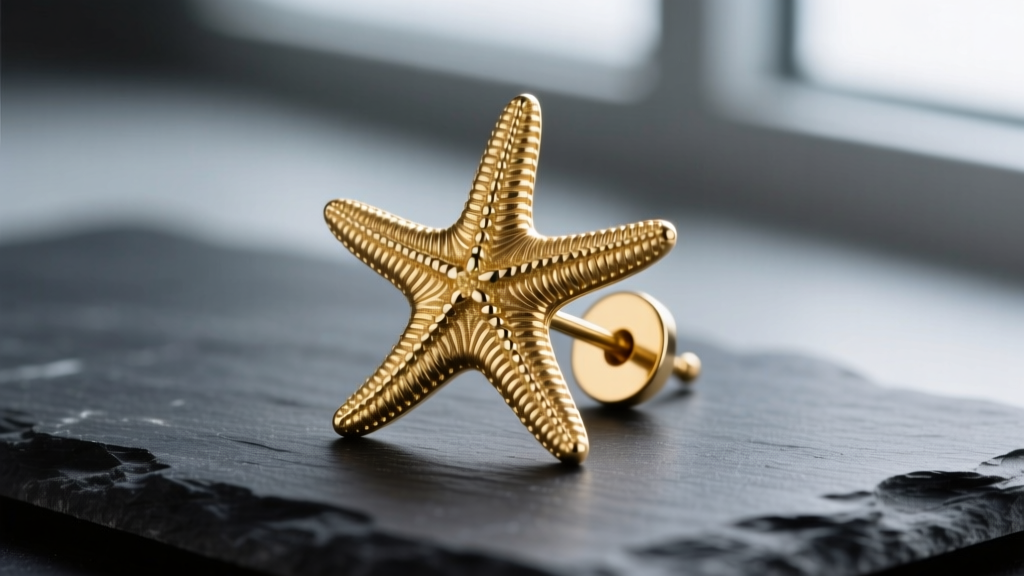
The Hidden Mechanics of Marine Jewelry
Marine-inspired jewelry remains a staple in coastal and everyday wardrobes, but the starfish earring presents a unique set of mechanical and anatomical challenges that simpler geometric studs avoid. Unlike a perfectly symmetrical round or square stud, a starfish motif features an asymmetrical weight distribution, protruding tapered arms, and deep textural crevices. As we navigate the jewelry market in 2026, where consumers are increasingly prioritizing long-term wearability and piercing health, understanding the structural flaws of novelty shapes is essential.
Whether you are dealing with a lobe stud that perpetually tilts forward, a helix piece that causes irritation bumps, or arms that constantly snag your knitwear, the root causes are almost always tied to physics, metallurgy, and improper backing hardware. This guide provides actionable, expert-level troubleshooting for the most common starfish earring failures.
Troubleshooting Snagging and Hair Catching
The most frequent complaint regarding starfish earrings is their tendency to catch on hair, scarves, and loose-weave clothing. This occurs because the five arms of the starfish typically taper to a semi-sharp point. Even if the piece is marketed as "smooth," casting processes often leave microscopic burrs or sharp edges at the extremities.
The 400-Grit Micro-Bevel Fix
If your starfish earring is made of solid gold, platinum, or sterling silver, you can safely blunt the tips at home. Using a 400-grit jeweler's file or a high-density emery board, gently stroke the tip of each arm at a 45-degree angle to create a micro-bevel. Do not use standard nail files, as their coarse grit (often 100-180) will scratch the metal and remove plating. 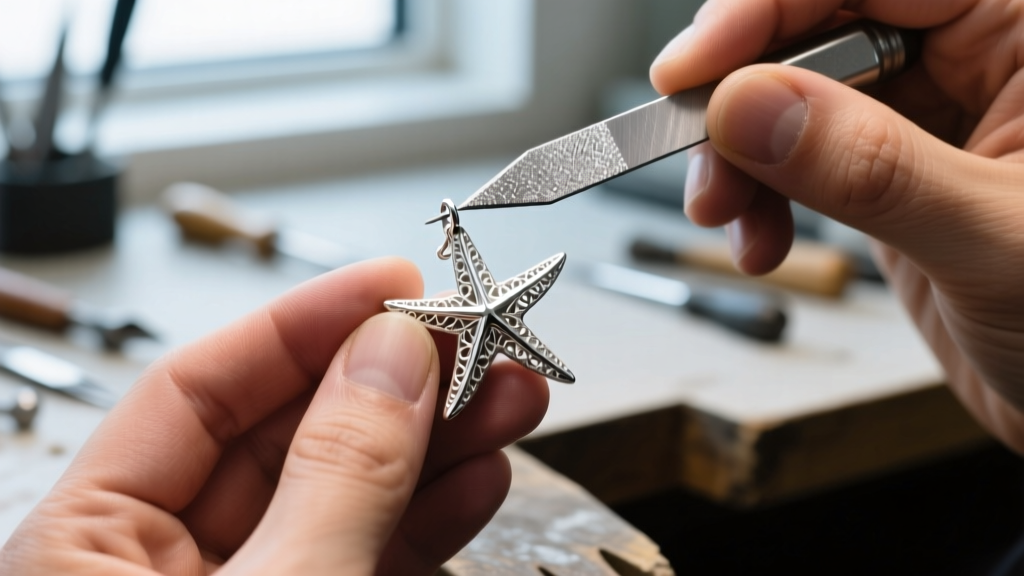
Design Alternatives for High-Snag Environments
If you work in healthcare or with textiles where snagging is a daily hazard, abandon prong-set or tapered-cast starfish designs entirely. Opt for a bezel-set starfish where the metal rim encapsulates the entire perimeter, or a die-struck flat silhouette with uniformly rounded arm tips. Bezel settings eliminate the gap between the gemstone and the metal arm, removing the primary catch-point for fine hair.
Solving the "Forward Droop" on Lobe Studs
A starfish earring is inherently top-heavy or side-heavy depending on how it rotates on the post. When the center of gravity sits outside the direct axis of the earlobe piercing, gravity pulls the face of the earring downward, resulting in an awkward "droop." Standard metal butterfly backs exacerbate this issue by failing to provide adequate surface-area support against the back of the earlobe.
Upgrading Your Backing Hardware
To counteract the asymmetrical weight of a starfish, you must distribute the pressure across a wider area of the earlobe. Below is a comparison of the most effective backings for heavy, asymmetrical studs:
| Backer Type | Material | Best For | Why It Works |
|---|---|---|---|
| Silicone O-Ring (1mm) | Medical-grade silicone | Lightweight to medium starfish | Creates high friction against the post and earlobe, preventing rotation and droop. |
| Locking Disc Back | 14k Gold / Titanium | Heavy, oversized starfish | Features a wide, flat plate that sits flush against the lobe, stabilizing the center of gravity. |
| La Poussiere / Jumbo Back | Plastic / Silicone blend | Thicker earlobes | The oversized dome shape provides a wide anchor point, stopping the starfish from tilting forward. |
For threadless or internally threaded starfish studs, ensure the post is bent at a microscopic 2-degree angle upward by a professional jeweler before insertion. This pre-compensates for the downward pull of the starfish face.
Cartilage Placements: Gauge, Length, and Threading
Starfish motifs are incredibly popular for helix, flat, and tragus piercings. However, placing a complex, multi-pointed shape in cartilage introduces a high risk of embedding and irritation bumps if the hardware specs are incorrect. 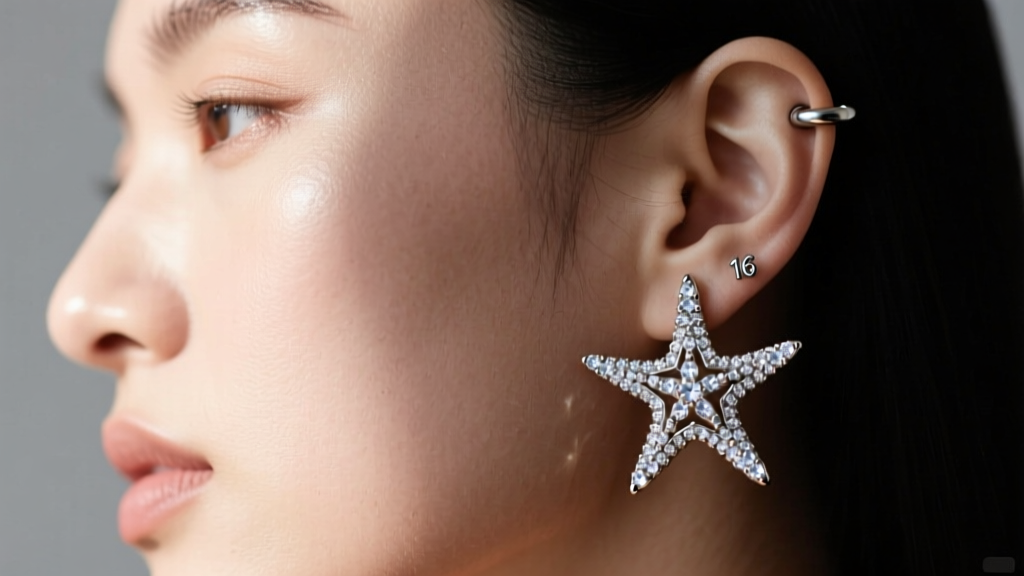
According to the Association of Professional Piercers (APP), cartilage jewelry must meet strict standards for material and finish to avoid rejection. For a starfish cartilage earring, you should strictly adhere to the following specifications:
- Gauge: 16G (1.2mm) or 14G (1.6mm). Avoid 18G or 20G, as the thin posts act like a cheese wire, migrating through the cartilage under the weight of the starfish.
- Post Style: Flat-back labret. Never use a butterfly back or ball-end post in cartilage, as the protruding back will cause pressure necrosis while sleeping.
- Post Length: 6mm (1/4") for healed, thin helixes; 8mm (5/16") for thicker flats or conches. Measure your tissue depth with digital calipers before ordering.
- Threading: Internally threaded or threadless (push-pin). Externally threaded starfish posts will tear the delicate fistula of the cartilage piercing during insertion.
If your starfish earring features a long, protruding arm that rests against the anti-helix of your ear, it will cause friction every time you move your jaw or wear headphones. Have a jeweler shorten the opposing arm to create a custom fit for your specific ear anatomy.
Moisture Traps and Contact Dermatitis
The textured surface of a starfish earring—designed to mimic the porous skin of the marine creature—is a magnet for dead skin cells, sebum, soap residue, and environmental moisture. When this debris accumulates in the deep crevices of the casting, it creates a localized acidic micro-environment against the skin.
If your starfish earring is made of brass, copper, or low-karat gold alloys, this acidic moisture accelerates the leaching of nickel and other reactive metals. This is a primary trigger for allergic contact dermatitis, characterized by itching, flaking, and weeping skin behind the earlobe. The National Health Service (NHS) notes that prolonged exposure to even trace amounts of nickel in trapped moisture can trigger severe localized eczema.
The Ultrasonic Cleaning Protocol
To prevent dermatitis and maintain the structural integrity of the metal, starfish earrings require a more rigorous cleaning protocol than smooth hoops or studs. Once a month, submerge the earrings in an ultrasonic cleaner operating at 40kHz for exactly three minutes using a mild, ammonia-free jewelry solution. The high-frequency cavitation bubbles will penetrate the microscopic pores of the starfish texture, dislodging trapped sebum that a polishing cloth cannot reach. Always upgrade to ASTM F136 implant-grade titanium or solid 14k/18k nickel-free gold to eliminate the chemical reaction entirely.
Metal Fatigue and Structural Failure
Because starfish earrings are often manufactured via lost-wax casting, the junction where the arms meet the central disc or the post is a natural weak point. Repeated snagging on clothing applies lateral torque to these thin solder joints, leading to metal fatigue. If you notice a microscopic hairline crack at the base of one of the starfish arms, or if the arm feels "spongy" when gently pressed, the piece has suffered structural compromise. Do not attempt to bend it back into place; cast alloys are brittle and will snap cleanly off. Take it to a bench jeweler for laser welding, which uses a pinpoint heat source to fuse the metal without melting the surrounding texture or destroying any set gemstones.


