How to Choose the Right Earring Sizes for Guys: A Step-by-Step Guide
Master earring sizes for guys with our step-by-step guide. Learn gauge thickness, stud diameters, and hoop measurements for the perfect fit.


Finding the perfect earring sizes for guys is no longer just about picking a design you like; it is a precise exercise in anatomy, proportion, and material science. As men's jewelry continues to evolve in 2026, the market has shifted from generic, one-size-fits-all fashion accessories to highly tailored, anatomically correct pieces. Whether you are curating a minimalist lobe stack, exploring cartilage placements, or stretching your lobes, understanding the exact metrics of earring sizing is critical for both comfort and aesthetic balance.
This comprehensive, step-by-step guide will walk you through the exact measurements, gauge standards, and proportion frameworks you need to select the ideal earring sizes for your unique ear anatomy and face shape.
The Anatomy of Men's Earring Sizing: Gauge vs. Diameter
The most common mistake men make when shopping for earrings is confusing gauge with diameter. These are two entirely different metrics that dictate how an earring fits and looks.
- Gauge (Thickness): This refers to the thickness of the wire or post that actually passes through your piercing. In the gauge system, the lower the number, the thicker the wire. A 14-gauge wire is significantly thicker than a 20-gauge wire.
- Diameter / Length (Millimeters): This measures the overall visual footprint of the earring. For studs, this is the width of the gemstone or metal face. For hoops, it is the inner or outer diameter of the circle. For dangles, it is the total drop length.
Step 1: Determine Your Gauge Size (Wire Thickness)
Before you look at designs, you must know your piercing's gauge. Forcing a thick earring into a delicate hole can cause tearing, while wearing a thin wire in a stretched hole can lead to the 'cheese-cutter effect,' where the thin wire slowly migrates and slices through the tissue.
| Gauge Size | Millimeter (mm) | Common Placement for Men | Style Notes |
|---|---|---|---|
| 20G | 0.81mm | Standard Lobe (Mall/Clair's piercings) | Very thin; common in cheap fashion jewelry. Not recommended for long-term wear. |
| 18G | 1.02mm | Standard Lobe, Upper Lobe | The most common size for men's standard stud earrings and small sleepers. |
| 16G | 1.29mm | Helix, Tragus, Forward Helix, Thick Lobes | The gold standard for professional cartilage piercings and high-quality men's hoops. |
| 14G | 1.63mm | Industrial, Conch, Daith, Rook | Provides structural integrity for complex cartilage placements and heavier men's jewelry. |
| 12G to 00G | 2.0mm to 10mm | Stretched Lobes (Plugs and Tunnels) | Used exclusively for modified, stretched earlobes. Requires careful taping and sizing. |
Pro Tip: If you are unsure of your gauge, visit a professional piercer to have them measure your current jewelry with a digital caliper. The Association of Professional Piercers (APP) strongly recommends avoiding guessing, as even a 0.2mm difference can cause severe irritation.
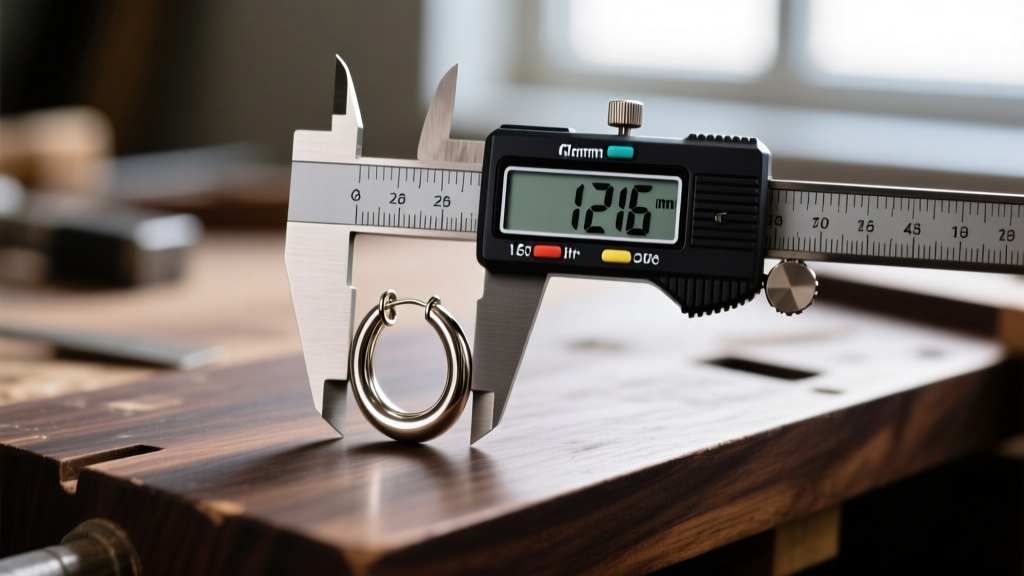
Step 2: Select the Right Diameter and Drop Length
Once your gauge is confirmed, you must choose the visual size of the earring. The ideal earring sizes for guys depend heavily on the specific style you are aiming for.
Studs: Millimeter Guidelines for Men
Studs are the cornerstone of men's ear curation. Because men's earlobes are generally thicker and wider than women's, proportions must be scaled accordingly.
- 3mm - 4mm (The Subtle Minimalist): Perfect for a discreet, everyday look. A 3mm black onyx or diamond stud sits flush and doesn't overwhelm the lobe. Ideal for professional environments.
- 5mm - 6mm (The Standard Statement): The most versatile size for men. A 5mm bezel-set gemstone or textured metal disc provides noticeable presence without looking like you are wearing someone else's jewelry.
- 7mm - 10mm (The Bold Focal Point): Best reserved for singular, statement pieces. Large signet studs or geometric metal plates in this range demand attention and pair well with streetwear or high-fashion aesthetics.
Hoops and Huggies: Finding the Sweet Spot
Hoop sizing is where most men struggle. A hoop that is too small will pinch the lobe, while one that is too large can catch on clothing and tear the piercing.
- 8mm - 10mm (Huggies / Sleepers): These hug the earlobe tightly. They are excellent for active men, athletes, or those who wear over-ear headphones frequently, as they rarely snag.
- 12mm - 15mm (The Classic Hoop): The quintessential men's hoop size. A 12mm or 14mm hoop in 16-gauge or 14-gauge thickness offers a masculine, structured look that hangs just below the lobe without excessive swinging.
- 20mm+ (The Statement Drop): Larger hoops enter dangle territory. If opting for 20mm or larger, ensure the wire is thick (14G or 12G) to prevent the metal from bending out of shape under its own weight.
Step 3: Match Earring Proportions to Face Shape and Ear Anatomy
Earring sizes for guys should not be chosen in a vacuum; they must harmonize with your facial structure and ear dimensions.

Framework for Face Shapes
- Square / Angular Jawlines: Avoid sharp, geometric dangles that mimic your jawline. Instead, opt for 12mm-15mm round hoops or 5mm circular studs to soften the facial angles.
- Round Faces: Introduce structure. Angular studs (like 6mm square or hexagonal bezels) or slightly elongated drop earrings (15mm-20mm) help create the illusion of a more defined jawline.
- Oval Faces: The most versatile shape. You can pull off almost any earring size, from tight 8mm huggies to bold 8mm statement studs.
Accounting for Lobe Thickness and Post Length
An often-overlooked metric in earring sizing is post length. Men typically have thicker earlobes than women. A standard 4mm or 5mm post length will often dig into the back of a man's lobe, causing swelling and infection. When buying stud earrings, always look for a 6mm to 8mm post length to accommodate thicker tissue and allow room for initial swelling or daily movement.
Step 4: Choose Hypoallergenic Materials for Long-Term Wear
Sizing means nothing if the material causes your ear to reject the jewelry. Men's skin is highly susceptible to contact dermatitis from cheap alloys. According to the Mayo Clinic, nickel allergy is one of the most common causes of allergic contact dermatitis, frequently triggered by low-grade fashion jewelry.
When investing in properly sized men's earrings, restrict your choices to these three material grades:
- ASTM F-136 Implant-Grade Titanium: The absolute best choice for sensitive ears, fresh piercings, and daily wear. It is completely nickel-free, lightweight, and will not tarnish.
- 14K or 18K Solid Gold (Nickel-Free Alloyed): Ensure it is solid gold, not gold-plated or gold vermeil. Plating wears off over time, exposing the base metal (often brass or copper) to your skin.
- Niobium: A highly reactive metal that is anodized to create vibrant colors without using dyes or plating. Excellent for cartilage hoops and custom-sized pieces.
The Threadless Advantage: For men's cartilage and lobe studs, seek out 'threadless' (push-pin) or 'internally threaded' jewelry. Externally threaded jewelry (where the screw is on the post) damages the piercing channel every time you insert it, leading to scar tissue buildup that alters your effective gauge size over time.
Common Sizing Mistakes Men Make (And How to Fix Them)
- The 'Snag' Hazard: Wearing 20mm+ hoops or long dangles to the gym or while sleeping. Fix: Keep a pair of 10mm titanium sleepers on hand to swap into when active or resting.
- Ignoring theBacking Footprint: A 4mm stud looks great from the front, but if it uses a massive, cheap 'butterfly' friction back, it will trap sweat and bacteria against the neck. Fix: Upgrade to flat-back labret studs or secure silicone O-rings.
- Mismatched Stacks: Wearing a 6mm stud in the lobe and a 6mm stud in the helix. Fix: Scale down as you move up the ear. Use a 5mm or 6mm stud for the lobe, a 3mm or 4mm stud for the mid-helix, and a 2mm or 3mm piece for the forward helix to create a visually pleasing gradient.
Final Thoughts on Proportion and Fit
Mastering earring sizes for guys is about balancing physical comfort with visual weight. By prioritizing correct gauge thickness, scaling millimeters to your specific lobe size, and strictly adhering to implant-grade materials, you elevate your style from an afterthought to a deliberate, curated aesthetic. Measure twice, buy quality once, and let the proportions speak for themselves.


