How to Style and Care for Gold Leaf Dangle Earrings
Learn how to style, clean, and repair gold leaf dangle earrings. Expert tips on face shapes, wire gauges, and safe cleaning for delicate textures.

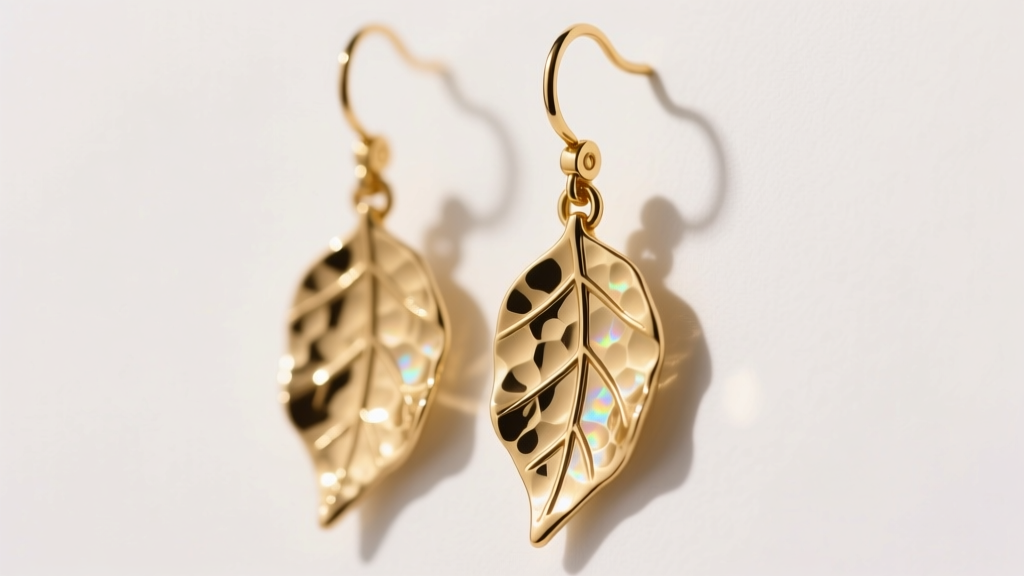
Understanding Your Gold Leaf Dangle Earrings
Gold leaf dangle earrings are a staple in fine and artisan jewelry, offering a blend of organic movement and metallic warmth. However, the term 'gold leaf' in the jewelry industry refers to two distinctly different manufacturing techniques, and knowing which type you own is critical for proper care and repair. As we navigate the 2026 jewelry landscape, sustainable and artisan-crafted pieces are dominating the market, making proper maintenance more important than ever.
Type 1: Solid Gold Hammered Leaf Motifs
These are carved or cast from solid 14k or 18k gold and then hammered to mimic the delicate, veined texture of a real leaf. They are highly durable, can withstand standard jewelry cleaning solutions, and typically retail between $80 and $300 depending on the gold weight and artisan craftsmanship.
Type 2: 24k Gold Leaf Appliqué
This technique involves applying genuine, ultra-thin 24k gold leaf (the same material used in gilding and culinary arts) onto a base metal, resin, or silver substrate, which is then sealed with a protective lacquer or epoxy. These earrings are incredibly fragile, cost significantly less (usually $30 to $75), and require highly specialized cleaning methods to prevent the gold layer from flaking or dissolving.
Step-by-Step Face Shape Styling Guide
The beauty of dangle earrings lies in their ability to manipulate visual proportions. Because gold leaf designs are inherently textured and catch the light, they draw the eye directly to the jawline and neck. Use the framework below to select the ideal dimensions for your facial structure.
| Face Shape | Ideal Dangle Length | Leaf Width & Proportion | Styling Objective |
|---|---|---|---|
| Round | 2.0 to 3.0 inches | Narrow, elongated leaf shapes | Create vertical lines to elongate the jawline and neck. |
| Square | 1.5 to 2.5 inches | Medium width, rounded leaf edges | Soften angular jawlines with organic, curved silhouettes. |
| Heart | 1.0 to 1.5 inches | Wider at the bottom (teardrop leaf) | Add visual weight to the lower half of the face to balance a narrow chin. |
| Oval | Any length (1.0 to 3.0) | Any proportion | Maintain natural balance; experiment with dramatic, oversized botanical styles. |

How to Clean Textured Gold Leaf Safely
The crevices in hammered or textured gold leaf designs easily trap sebum, dead skin cells, and cosmetic residues. However, the cleaning method you choose must match your earring's metallurgical composition.
Cleaning Solid 14k/18k Hammered Gold
- Prepare a Surfactant Bath: Mix three drops of mild, phosphate-free dish soap (like Dawn) into a bowl of warm distilled water. Avoid tap water, as dissolved minerals can leave micro-deposits in the textured veins of the leaf.
- Soak and Agitate: Submerge the earrings for 5 to 10 minutes. Gently agitate the water with your fingers to force the surfactant into the hammered crevices.
- Soft Brushing: Use an extra-soft baby toothbrush to lightly sweep the textured veins. Never use stiff bristles, as 18k gold is relatively soft and can scratch.
- Rinse and Dry: Rinse under lukewarm distilled water and pat dry with a lint-free microfiber cloth. Air drying can cause water spots.
Note: While ultrasonic cleaners are generally safe for solid gold, the high-frequency vibrations can loosen the jump rings or ear wire wraps on delicate dangle designs. Hand washing is always the safer route.
Cleaning 24k Gold Leaf Appliqué
Warning: Never use ultrasonic cleaners, steamers, alcohol, or ammonia-based solutions on gold leaf appliqué. These will strip the protective sealant and dissolve the delicate 24k layer. According to the Gemological Institute of America (GIA), pure 24k gold is highly malleable and susceptible to chemical and physical degradation when unsupported. Simply wipe these earrings gently with a barely damp microfiber cloth and dry immediately.
Repairing Bent Ear Wires and Dangle Links
Dangle earrings are prone to catching on hair and clothing, frequently resulting in bent ear wires or distorted jump rings. Standard french hooks are typically crafted from 20-gauge (0.81mm) or 22-gauge (0.64mm) wire, as noted by jewelry supply standards at Rio Grande. Here is how to reshape them without causing metal fatigue or snapping the wire.
Tools Required
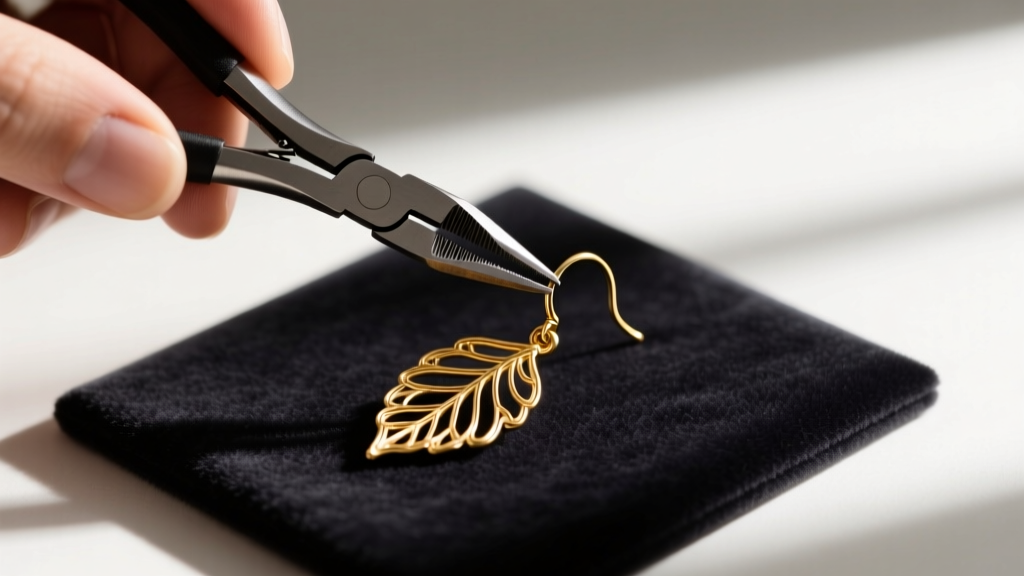
- Nylon-jaw pliers (metal pliers will mar and scratch the gold)
- Round-nose pliers (for re-forming loops)
- A clean, soft velvet jewelry mat
Step-by-Step Wire Reshaping
- Assess the Damage: Lay the earring on the velvet mat. Identify whether the bend is in the ear wire itself or the jump ring connecting the leaf to the wire.
- Secure the Base: Hold the base of the ear wire firmly with your non-dominant hand. If the bend is near the loop that holds the leaf dangle, use the nylon-jaw pliers to grip the wire just below the bend to prevent stress from transferring to the delicate leaf motif.
- Apply Gradual Pressure: Using your fingers or the nylon-jaw pliers, gently coax the wire back into its original curve. Never bend the wire back and forth; this causes work-hardening and will snap the gold alloy. Apply slow, continuous pressure in one direction.
- Re-round the Loop: If the connecting loop has been pulled open, use round-nose pliers to gently twist it closed. Always twist loops open and closed laterally (like a spiral) rather than pulling them apart outward, which weakens the structural integrity of the circle.
Proper Storage to Prevent Tangles and Oxidation
The intricate veins of gold leaf designs and the swinging nature of dangles make them a nightmare to store if simply tossed into a jewelry box. Tangled chains and bent leaves are the most common reasons these pieces end up in the repair pile.
The Hanging Organizer Method
For dangles longer than 1.5 inches, gravity is your best storage tool. Use a multi-tiered hanging jewelry organizer with individual fabric pockets. Hanging the earrings by their ear wires allows the dangles to rest straight, preventing the wire from warping under its own weight over time.
The Anti-Tarnish Polybag Strategy
If you must store them in a drawer or travel case, use individual 2x3 inch ziplock polybags made from anti-tarnish polyethylene. Before sealing the bag, press out as much air as possible to minimize oxidation. For 14k and 18k gold alloys, the copper and silver mixed with the gold can react with atmospheric sulfur, leading to dullness. Adding a small 3M anti-tarnish strip to your storage drawer or travel roll will absorb these sulfur compounds, keeping the textured gold leaf bright and reflective for years to come.


