How to Style and Secure Drop Stud Earrings for Ear Stacks
Master the art of wearing drop stud earrings. Learn step-by-step how to select gauges, secure backings, and style drops for your face shape.

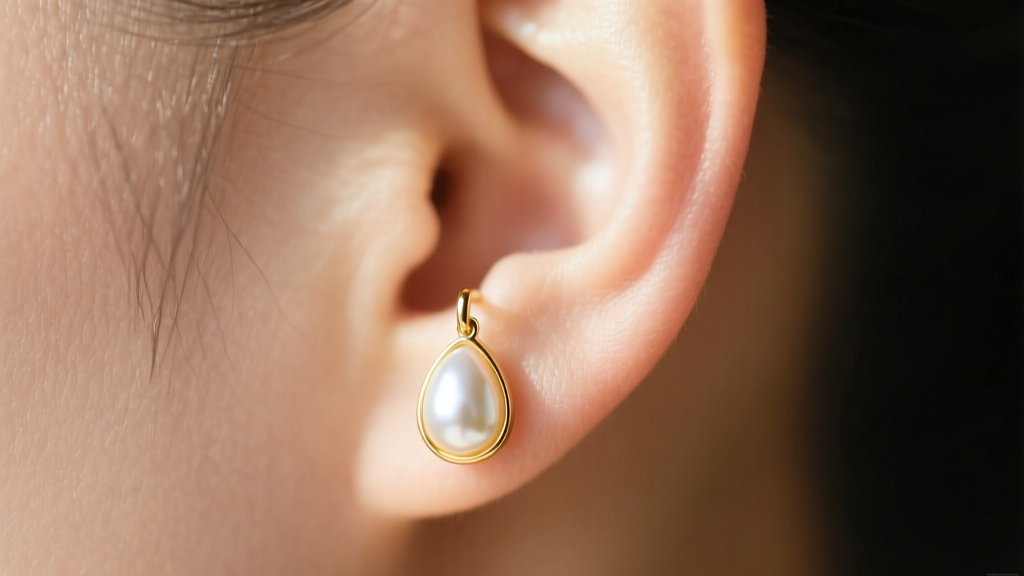
The Anatomy of a Drop Stud Earring
Before building your ear stack, it is crucial to understand the structural difference between drop earrings and dangle earrings. While often used interchangeably in retail, true drop stud earrings hang just below the earlobe and swing from a single, fixed point (like a bail or a jump ring attached directly to the stud post). Dangles, conversely, feature multiple articulation points that allow for wilder, more complex movement. This lack of articulation in a drop stud means the center of gravity sits closer to the piercing. While this reduces chaotic swinging, the concentrated weight requires precise post sizing and secure backings to prevent lobe migration and tearing over time.
High-quality drop studs are typically crafted from implant-grade titanium (ASTM F-136) or solid 14k/18k gold. Avoid gold-plated brass or nickel-containing white gold alloys, as the friction caused by the pendulum motion of the drop can quickly wear away plating, leading to severe contact dermatitis.
Step 1: Match the Gauge and Post Length to Your Piercing
The most common failure mode for drop earrings is using a post that is too thin to support the drop's weight, resulting in a bent post or a stretched piercing fistula. Standard mall-kiosk piercings are often done at 20-gauge (0.81mm), which is generally too fragile for heavy gemstone drops. For optimal support, you should size up your jewelry.
Standard Sizing Chart for Drop Studs
| Gauge Size | Millimeter (mm) | Best For | Max Recommended Drop Weight |
|---|---|---|---|
| 20g | 0.81mm | Delicate, lightweight chain drops | Under 2 grams |
| 18g | 1.02mm | Standard gemstone drops, small pearls | 2 to 4 grams |
| 16g | 1.29mm | Heavy statement drops, cartilage drops | 4 to 7 grams |
Post length is equally critical. A standard healed lobe requires a 6mm post length. However, if you are wearing a heavier drop stud, the added leverage can cause a 6mm post to tilt. Sizing up to an 8mm post provides a wider base of support inside the fistula, keeping the earring perfectly upright. For cartilage placements like the helix or flat, always use 16g titanium with a 6mm to 8mm post to accommodate the denser tissue.
Step 2: Choose the Right Backing to Prevent Migration
The 'pendulum effect' is the enemy of traditional friction butterfly backs. Every time your drop stud swings, it creates micro-movements that slowly push the butterfly back down the post groove. Eventually, the backing slips off, and you lose your earring. Furthermore, the narrow surface area of a butterfly back concentrates the weight of the drop onto a tiny point of your earlobe, leading to 'cheese-cutter' migration.
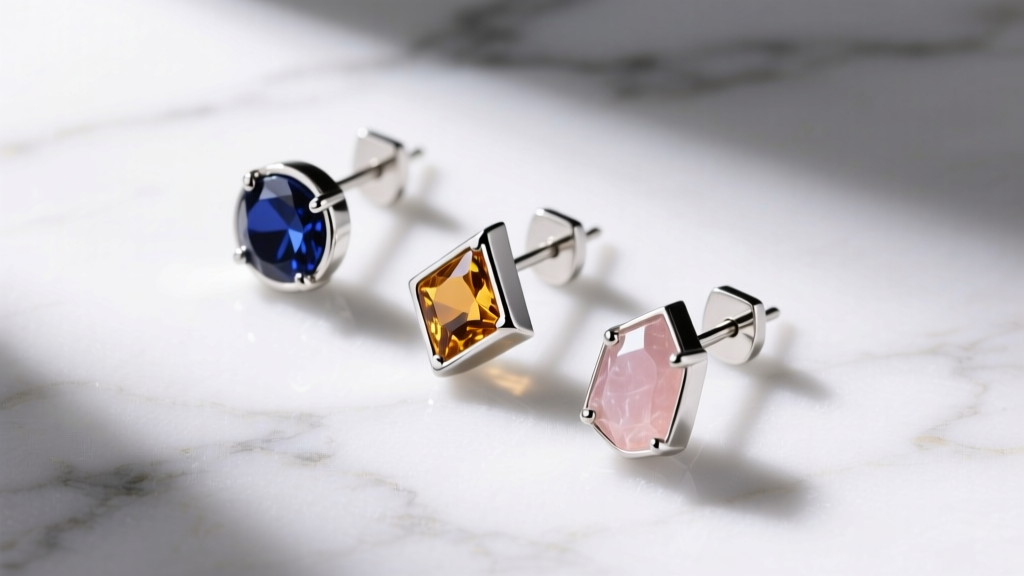
To secure drop stud earrings properly, transition to threadless (push-pin) or internally threaded flat-back labrets. Brands like BVLA and Maria Tash specialize in these mechanisms. A flat-back disc (usually 3mm to 5mm in diameter) distributes the weight of the drop evenly across the back of the earlobe. The threadless tension-fit or internal threading ensures the decorative drop end will never unscrew or fall off, no matter how much the earring swings. According to the Association of Professional Piercers, internally threaded and threadless jewelry is the gold standard for both healing and long-term piercing health due to the smooth insertion and secure fit.
Step 3: Style Drop Stud Earrings for Your Face Shape
Because drop studs draw the eye vertically, they are an excellent tool for balancing facial proportions. Use this framework to select the silhouette of your drop:
- Round Faces: Opt for angular, geometric drop studs (e.g., rectangular baguette diamonds or sharp metallic chevrons). The sharp lines contrast with and elongate the soft curves of a round face. Avoid circular or wide teardrop shapes.
- Square Faces: Choose curved, fluid silhouettes like oval cabochons, teardrop pearls, or winding vine motifs. These soften a strong jawline and add visual length without adding harsh angles.
- Heart-Shaped Faces: Look for drops that are wider at the bottom, such as chandelier-style drops or inverted triangle gemstones. This adds visual weight to the lower half of the face, balancing a narrower chin.
- Oval Faces: The universal shape. You can wear any drop stud style, but mid-length drops (hanging 0.5 to 1 inch below the lobe) offer the most elegant proportion without overwhelming your natural symmetry.
Step 4: Integrate Drops into a Curated Ear Stack
When building an ear stack, treat your drop stud earrings as the 'Anchor' piece. The anchor is the largest, most dynamic piece of jewelry in your ear, and it should always occupy the primary lobe piercing. Because the drop moves and catches the light, it will naturally dominate the visual hierarchy.
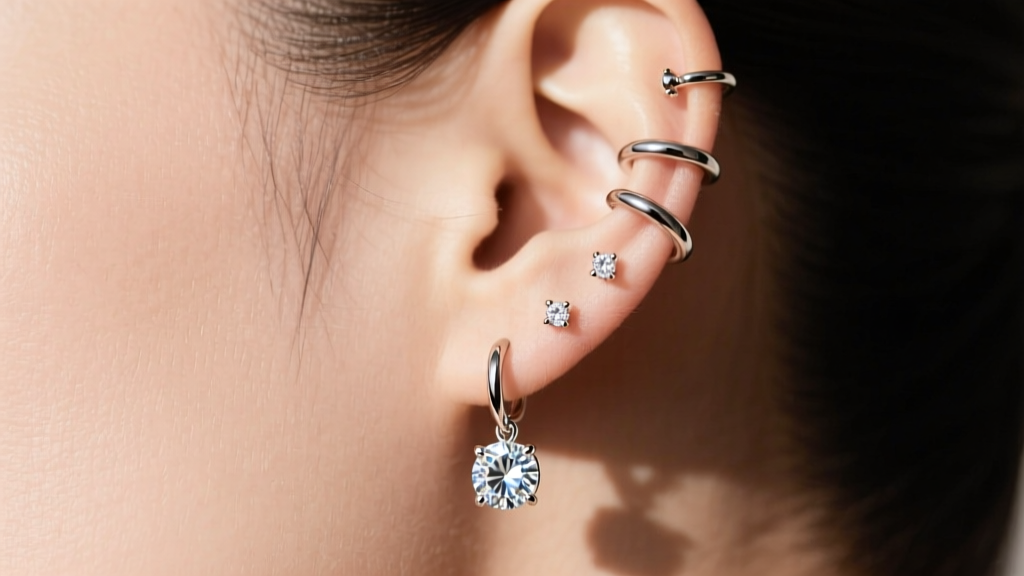
Surround your anchor with 'Satellite' pieces. If your drop stud is a 14k yellow gold pearl drop, pair it with a 16g yellow gold huggie in the second lobe hole, and a simple 3mm diamond threadless stud in the helix. Keep the satellite pieces static and minimalist. If you put a dangle or a large hoop in the cartilage alongside a drop stud in the lobe, the ear stack will look cluttered and chaotic. The Gemological Institute of America notes that mixing metal colors is acceptable, but keeping the gemstone cuts consistent (e.g., all brilliant round cuts or all step cuts) maintains a cohesive, high-end aesthetic across the stack.
Common Failure Modes and Troubleshooting
Expert Insight: Never sleep in drop stud earrings, even if they are on a flat-back post. The leverage of the drop catching on a pillowcase can easily tear a healed fistula or bend a 16g titanium post beyond repair.
Issue: The Drop Stud Tilts Forward
Cause: The post is too short, or the lobe tissue is too thin to support the leverage of the drop.
Solution: Switch to a longer post (e.g., from 6mm to 8mm) to increase the surface area inside the piercing, or add a 2mm silicone O-ring between the earlobe and the backing to provide extra cushioning and grip.
Issue: Green or Black Discoloration on the Lobe
Cause: The drop mechanism or post contains copper or nickel, which oxidizes when exposed to sweat and the friction of the swinging drop.
Solution: Discard the jewelry. Purchase a certified ASTM F-136 implant-grade titanium post and a solid 14k or 18k gold drop end. Nickel allergies are incredibly common; always verify the alloy composition with the jeweler before purchasing white gold drops.


