How to Style and Wear Huge Diamond Hoop Earrings Safely
Learn how to style, secure, and maintain huge diamond hoop earrings. Expert tips on lobe support, face shapes, and heavy-carat weight distribution.

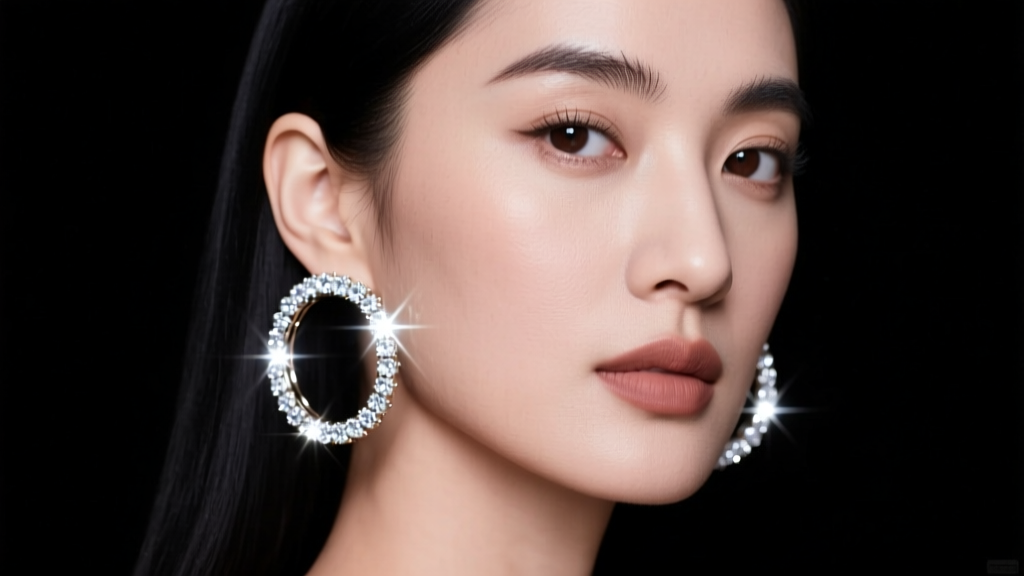
The Engineering and Appeal of Oversized Diamond Hoops
When you transition from standard 20mm everyday hoops to huge diamond hoop earrings (typically defined as 50mm to 80mm in diameter), you are no longer just choosing a piece of jewelry; you are managing a structural engineering project for your earlobes. A 60mm hoop paved with 8.00 total carat weight (TCW) of VS-clarity diamonds set in 18k gold can weigh between 18 and 24 grams per ear. While the visual impact is undeniably breathtaking—catching light from every angle and framing the face with unmatched brilliance—the sheer mass requires a strategic approach to styling, wearing, and maintenance.
In this comprehensive guide, we break down the exact steps to confidently wear oversized diamond hoops without compromising your earlobe health, your wardrobe harmony, or the structural integrity of the jewelry itself.
Step 1: Match the Carat Weight and Scale to Your Face Shape
The diameter and diamond setting style of your hoops should act as a counterbalance to your natural facial geometry. Wearing huge diamond hoop earrings is an exercise in proportion. If the hoops are too wide for a narrow face, they will overwhelm your features; if they are too small for a broad face, they lose their intended statement-making impact.
| Face Shape | Ideal Hoop Diameter | Recommended Diamond Setting | Visual Effect |
|---|---|---|---|
| Round | 60mm - 75mm (Elongated/Oval) | Vertical Pavé or Baguette Accents | Lengthens the face and adds structural angles. |
| Square | 50mm - 60mm (Perfect Circle) | Round Brilliant Prong-Set Pavé | Softens a strong jawline with continuous curves. |
| Heart | 55mm - 65mm (Teardrop/Bottom-Heavy) | Graduated Pavé (larger stones at bottom) | Balances a wider forehead with lower-face volume. |
| Oval | 45mm - 60mm (Classic Round) | Bezel or Channel Set | Maintains natural symmetry with bold framing. |
Pro Tip: For heart-shaped faces, avoid perfectly circular huge hoops that end exactly at the jawline, as this emphasizes the narrowness of the chin. Opt for an oval drop-hoop that extends slightly past the lobe.
Step 2: Reinforce the Earlobe (Crucial for Heavy Carats)
The most common failure point when wearing heavy diamond hoops is lobe stretching or tearing. Standard ear piercings are done at 20-gauge (0.81mm) or 18-gauge (1.02mm). However, a 20-gram diamond hoop acting as a pendulum will slowly pull the piercing downward, creating the dreaded 'cheese-cutter' effect.
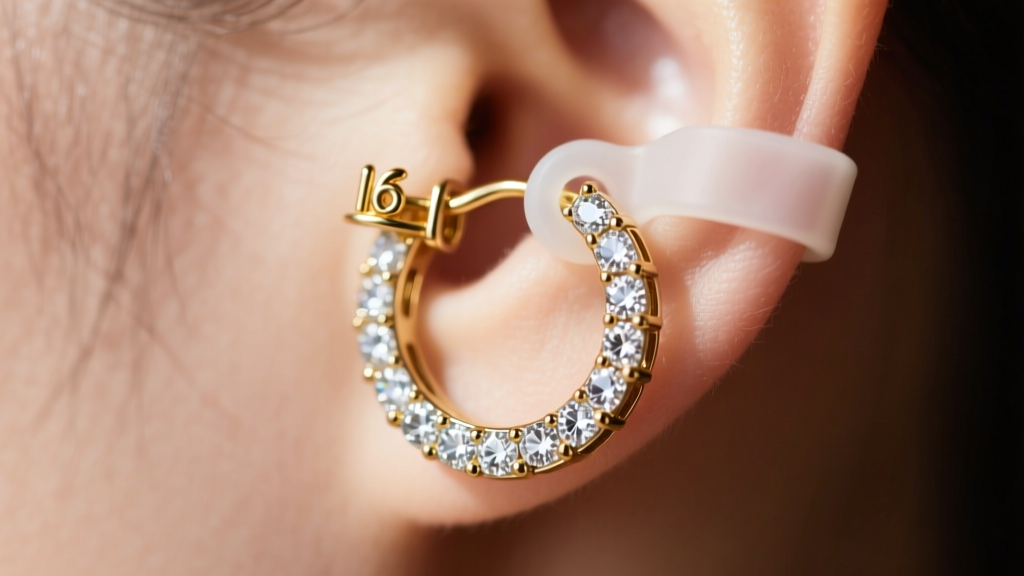
How to Secure Heavy Hoops:
- Upgrade the Wire Gauge: When commissioning or purchasing huge diamond hoop earrings, ensure the post or wire is at least 16-gauge (1.29mm) or 14-gauge (1.63mm). This distributes the weight over a wider surface area inside the fistula.
- Use Silicone Support Patches: Products like Lobe Wonder patches are non-negotiable for hoops exceeding 15 grams. Apply the adhesive patch to the back of the earlobe, push the earring post through the pre-punched hole, and secure it with a tight friction back or a locking omega clip.
- Choose the Right Clasp: Avoid standard butterfly backs. For huge hoops, you need a hinged saddleback (which rests flat against the lobe to distribute weight) or a French wire with a locking latch and an omega clip backing for secondary support.
Step 3: Coordinate with Necklines and Hairstyles
Styling huge diamond hoop earrings requires adhering to the 'Rule of Exposure.' Because these earrings command immense visual real estate, they need physical space to breathe. Competing visual elements will make your overall look appear cluttered rather than luxurious.
The Neckline Matrix
- The Halter Neck: The ultimate pairing. A halter top pulls the fabric away from the collarbone, creating a bare canvas that allows 60mm+ diamond hoops to dangle freely without catching on silk or wool.
- The Deep V-Neck: Elongates the neck and mirrors the vertical drop of oval or teardrop diamond hoops.
- Off-the-Shoulder: As noted by Vogue's historical style archives, exposing the décolletage and neck provides the perfect minimalist backdrop for maximalist ear styling.
- Avoid: High ruffled collars, bulky turtlenecks, or elaborate statement necklaces. If you are wearing huge diamond hoops, your neck should remain entirely bare of other jewelry.
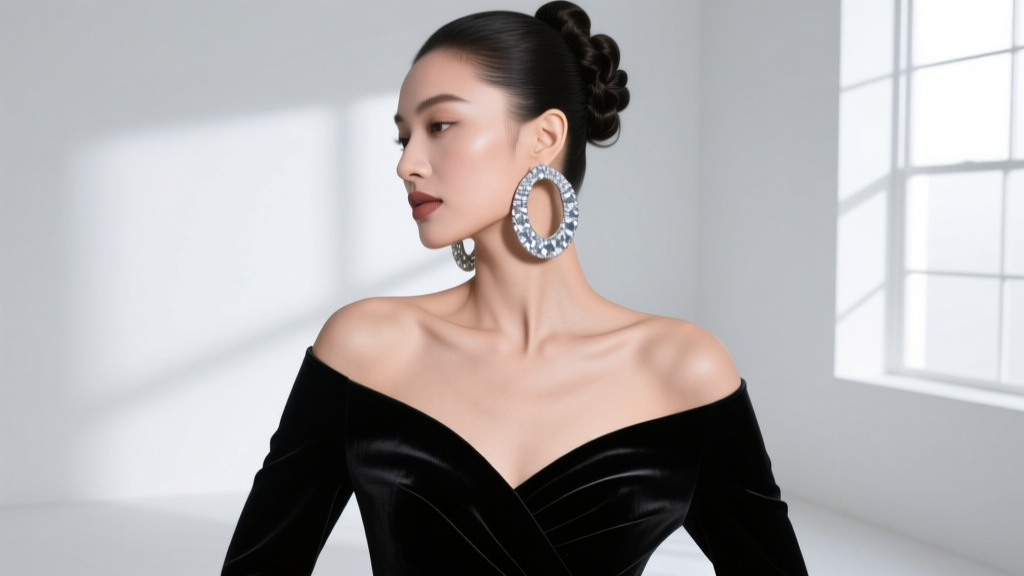
Hair Mapping
Wear your hair in a sleek chignon, a tight French twist, or a slicked-back ponytail. If you prefer wearing your hair down, tuck the front sections behind your ears and secure them with hidden bobby pins. The diamonds must catch direct light; hiding them behind cascading curls defeats the purpose of investing in high-carat hoops.
Step 4: Sizing, Sourcing, and Market Realities
The market for oversized diamond jewelry has shifted dramatically. Sourcing huge diamond hoop earrings with 5.00 to 10.00 TCW in natural, earth-mined diamonds can easily push prices into the $30,000 to $80,000 range, depending on color and clarity. However, the advent of high-quality lab-grown diamonds has democratized this look.
According to the Gemological Institute of America (GIA), lab-grown diamonds possess the exact same optical, physical, and chemical properties as mined diamonds. For large surface-area pavé settings, CVD (Chemical Vapor Deposition) lab diamonds offer identical brilliance at a fraction of the cost, allowing buyers to prioritize larger diameters and higher clarity grades (VVS1/VS1) without compromising their budget.
2026 Sourcing Checklist:
- Demand a grading report for the center stones or the primary pavé diamonds to ensure color consistency (avoid mixing G-color and J-color stones in the same hoop, as the mismatch is highly visible in large formats).
- Verify the metal alloy. 18k yellow gold is standard, but for massive hoops, Platinum 950 or 14k White Gold offers superior tensile strength, reducing the risk of the hoop warping or bending out of its perfect circle over time.
Step 5: Maintenance and Prong Tightening
A 60mm hoop with 150 individual diamond prongs has 150 individual failure points. If one prong snags on a cashmere sweater and lifts, you risk losing a stone. Proper maintenance is a mandatory step in owning huge diamond hoop earrings.
The Weekly Inspection Protocol
Once a week, use a 10x jeweler's loupe to inspect the prongs, particularly on the bottom third of the hoop where friction against clothing and hair is highest. Run a soft, lint-free microfiber cloth over the stones; if the cloth snags, a prong has lifted and the earring must be taken to a bench jeweler immediately.
Cleaning Warnings
While the GIA recommends mild degreasing solutions and a soft toothbrush for routine diamond care, you must be incredibly cautious with ultrasonic cleaners. If your huge hoops feature fracture-filled diamonds, tension settings, or secondary gemstone accents (like emeralds or opals), the high-frequency vibrations of an ultrasonic bath will shatter the stones or strip the filler. Stick to a warm bath of distilled water and a few drops of ammonia-free dish soap, gently brushing the pavé from the back to push dirt out of the gallery wire.
Final Thoughts on Wearing Heavy Luxury
Wearing huge diamond hoop earrings is a masterclass in confident styling. By respecting the physics of heavy jewelry, reinforcing your lobes, and strategically mapping your wardrobe to highlight the stones, you transform a heavy accessory into a seamless extension of your personal elegance. Invest in the right gauge, maintain your prongs, and let the diamonds do the talking.


