Korean Earrings Men Love: A Technical Guide to Fit & Metals
Discover technical specs behind Korean earrings men prefer. Explore gauge sizes, 925 silver metallurgy, clasp types, and cartilage fit guides.

The Metallurgy of K-Fashion Earwear
The global surge in K-pop and Korean streetwear has fundamentally shifted men's jewelry trends, moving away from heavy, oversized pieces toward refined, minimalist aesthetics. When analyzing the technical specifications of Korean earrings men favor, the metallurgy is the most critical differentiator. The vast majority of high-end K-fashion brands utilize S925 sterling silver as their base metal. By definition, S925 contains 92.5% pure silver and 7.5% alloy—usually copper. While copper provides necessary structural hardness, it is highly reactive to sulfur and moisture, leading to rapid oxidation (tarnish).
To combat this, premium Korean jewelers employ advanced rhodium plating. Unlike standard Western fashion jewelry that might use a mere 0.05-micron flash coating, top-tier Korean manufacturers apply between 0.5 to 1.0 microns of rhodium over a nickel-free palladium barrier layer. According to the Gemological Institute of America (GIA), rhodium is a platinum-group metal that provides a brilliant, highly reflective white finish and exceptional tarnish resistance. This specific thickness ensures the earring can withstand daily wear, friction from hoodies, and exposure to urban humidity without the underlying copper oxidizing and turning the earlobe green.
For men with severe contact dermatitis or nickel allergies, Korean indie brands are increasingly adopting ASTM F136 implant-grade titanium. This specific alloy (Ti-6Al-4V ELI) is completely nickel-free and biocompatible, making it the gold standard for fresh piercings and sensitive cartilage, as endorsed by the Association of Professional Piercers (APP).
Gauge Sizing and Post Dimensions
A defining characteristic of the Korean men's earring aesthetic is the deliberate use of thinner, more delicate posts compared to traditional Western standards. While a standard American lobe piercing is often done at 16G (1.2mm) or 14G (1.6mm), Korean minimalist studs heavily favor 18G (1.0mm) and 20G (0.8mm). This reduction in gauge creates a sleek, unobtrusive profile that aligns with the 'soft masculinity' and refined streetwear aesthetics prevalent in Seoul.
| Piercing Placement | K-Fashion Gauge Standard | Post Length / Inner Diameter | Technical Rationale |
|---|---|---|---|
| Standard Lobe | 18G (1.0mm) or 20G (0.8mm) | 6mm - 8mm Post | Shorter posts sit flush against the earlobe, preventing snagging on collars and maintaining a streamlined silhouette. |
| Upper Lobe / Flat | 18G (1.0mm) | 6mm Flat-Back Labret | Flat-backs eliminate the protruding post and butterfly clutch, crucial for comfort when wearing headphones or beanies. |
| Helix / Cartilage | 16G (1.2mm) | 6mm - 8mm Post | Cartilage requires slightly thicker metal for structural integrity and to prevent the 'cheese-cutter' effect in thin tissue. |
| Huggies (Lobe) | 18G (1.0mm) | 8mm - 9mm Inner Diameter | A tighter inner diameter ensures the hoop hugs the lobe closely, avoiding the dangling look of traditional 10mm+ hoops. |
Clasp Mechanics and Security Protocols
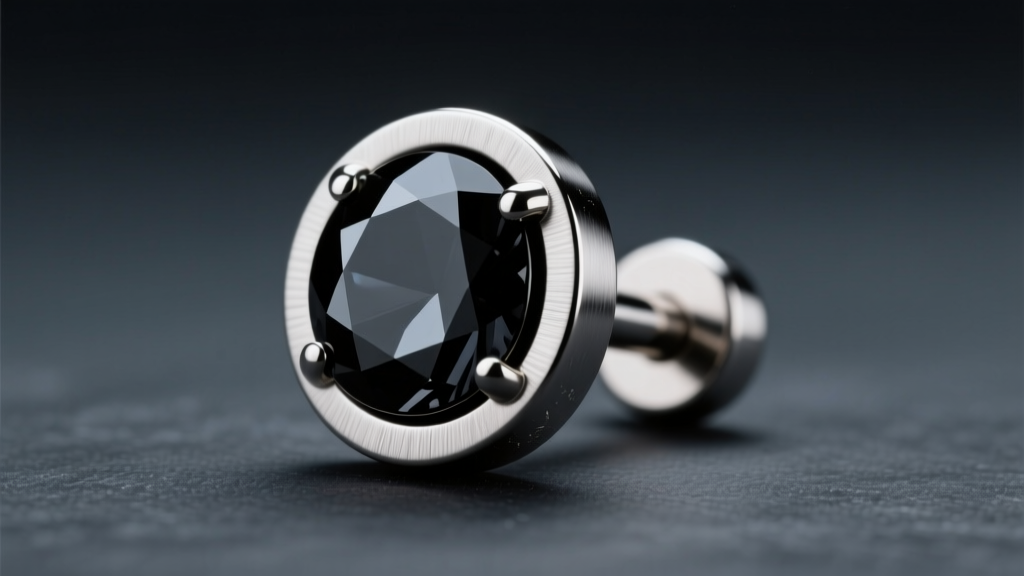
The hardware securing the earring is just as vital as the decorative front. Traditional friction backs (butterfly clasps) are increasingly being phased out in premium Korean men's collections due to their tendency to harbor bacteria in the crevices and their high loss rate during active streetwear styling. Instead, technical deep dives into K-fashion hardware reveal a strong preference for two advanced mechanisms:
1. Threadless Push-Pin (Labret) Systems
For cartilage and upper lobe placements, threadless systems are the superior choice. The decorative front features a slightly bent pin that inserts into a hollow post. The tension created by the bent pin against the inner wall of the post creates a secure, friction-based lock. This eliminates the need for screwing tiny components together, which can be frustrating and risks cross-threading. Furthermore, the seamless transition between the front and post prevents irritation inside the fistula (the piercing channel).
2. Internally Threaded Screw-Backs
When threading is necessary, high-end Korean brands utilize internal threading. Unlike external threading—where the screw ridges are on the post and can tear the delicate tissue of the fistula upon insertion—internal threading places the screw mechanism inside the decorative end. The post remains completely smooth, allowing for atraumatic insertion and removal. This is particularly critical for helix and tragus piercings, which are prone to irritation bumps.
Asymmetry and Cartilage Stacking Architecture
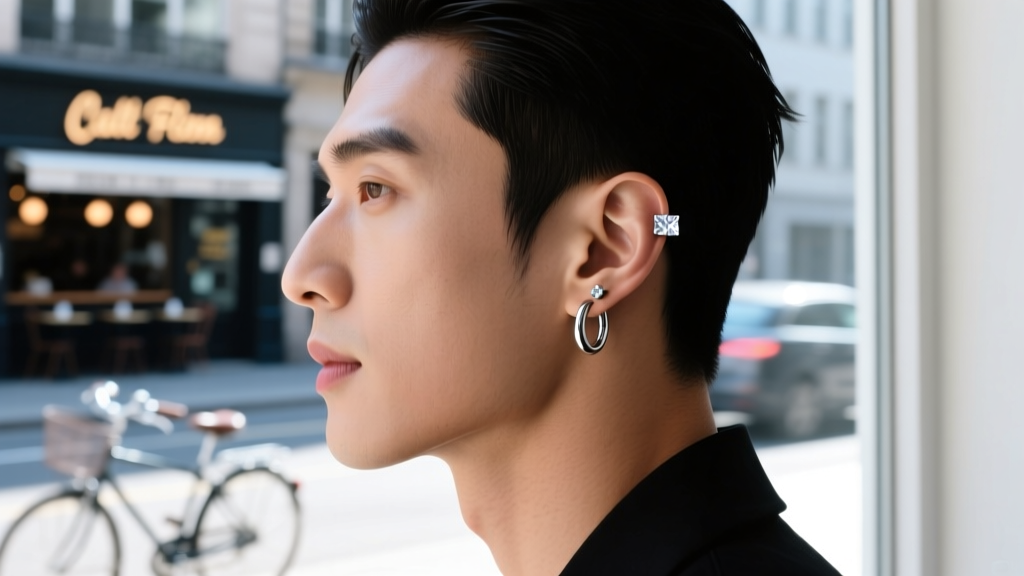
The modern Korean men's ear stack is rarely symmetrical. It relies on a deliberate architectural gradient, often concentrating visual weight on one ear while leaving the other bare or featuring a single, understated stud. When engineering a multi-pierce stack, weight distribution and anatomical spacing are paramount.
- The Helix-to-Lobe Gradient: Stacks typically begin with larger, heavier pieces at the lobe (e.g., a 4mm cubic zirconia or a textured silver sphere) and graduate to micro-studs (1mm to 2mm) as they move up the helix. This prevents the upper ear from looking visually cluttered.
- Tragus Integration: The tragus is a thick, dense piece of cartilage. Korean styling often incorporates a tiny, flush-fitting bezel-set gem here. Because the tragus moves when chewing or talking, a flat-back labret with a low-profile bezel is mandatory to avoid audio interference with earbuds.
- Spacing Metrics: Professional piercers recommend a minimum of 6mm to 8mm of space between adjacent cartilage piercings to accommodate swelling and the physical footprint of the jewelry bases. Korean micro-studs are specifically designed with 2.5mm to 3mm bases to allow for tighter, yet safe, clustering.
Maintenance and Tarnish Prevention
Even with premium rhodium plating, the maintenance of S925 silver requires specific protocols to ensure longevity. The American Academy of Dermatology (AAD) notes that prolonged exposure to certain chemicals can degrade metal finishes and trigger skin reactions. To maintain the pristine condition of Korean minimalist earrings, adhere to the following technical maintenance framework:
- Avoid Sulfur and Chlorine: Sulfur (found in hard water, hot springs, and some soaps) rapidly penetrates microscopic scratches in rhodium plating to react with the underlying copper. Chlorine in swimming pools can permanently pit and discolor sterling silver alloys.
- Ultrasonic vs. Chemical Cleaning: Never use harsh chemical silver dips on rhodium-plated jewelry; the acids will strip the plating entirely. Instead, use a mild, phosphate-free dish soap and a soft-bristled baby toothbrush to mechanically remove sebum and dead skin cells from the clasp mechanisms.
- Storage Environment: Store earrings in an airtight, anti-tarnish ziplock bag with a silica gel desiccant packet. This reduces ambient humidity and slows the oxidation process to a near halt.
Expert Procurement Tip: When shopping for Korean men's earrings online, always check the product specifications for the exact phrase 'Nickel-Free Rhodium Plated' or 'ASTM F136 Titanium'. If a vendor simply lists 'Silver Plated' without specifying the base metal or plating thickness, the underlying alloy is likely brass or copper, which will degrade within weeks of daily wear.
Understanding the precise metallurgy, gauge dimensions, and clasp mechanics behind these pieces transforms earring shopping from a superficial fashion choice into an exercise in anatomical engineering and material science. By prioritizing these technical specifications, you ensure your earwear is not only aesthetically aligned with contemporary K-fashion but also structurally optimized for long-term, comfortable wear.


