How to Style Mismatched Sun and Moon Earrings: A Beginner Guide
Learn how to style mismatched sun and moon earrings with our beginner guide. Discover material tips, gauge sizes, and face-shape balancing tricks.

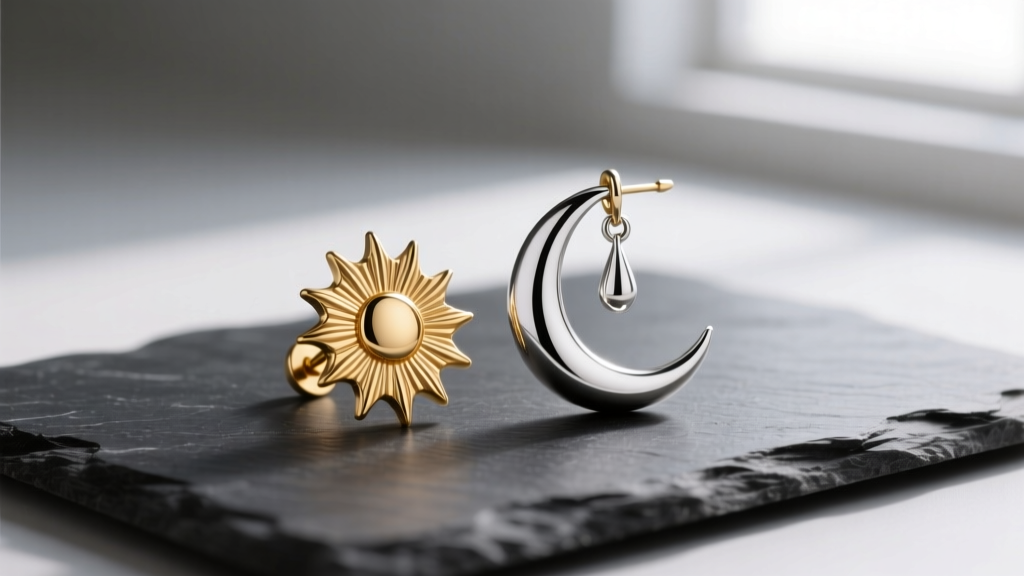
The jewelry world has fully embraced the art of asymmetry, and perhaps no motif captures this trend quite like celestial themes. If you are looking to break away from perfectly symmetrical pairs, mismatched sun and moon earrings offer a sophisticated yet playful way to curate your ear stack. However, pulling off an asymmetrical look requires more than just buying two different earrings and hoping for the best. It requires an understanding of visual weight, metal grades, and piercing anatomy.
This beginner-friendly explainer will walk you through the exact specifications, material grades, and styling frameworks you need to master the celestial mismatched look without compromising your ear health or aesthetic balance.
The Appeal of Asymmetry: Why Celestial Mismatching Works
Historically, matching earrings were the standard, signaling uniformity and tradition. Today, ear curation is treated as a localized art form. Mismatched sun and moon earrings work because they represent duality—the bold, radiant expansion of the sun contrasting with the sleek, elongated mystery of the moon. When placed on opposite ears, or even staggered within the same ear stack, they create a dynamic visual tension that draws the eye across the face. Unlike random asymmetrical pairings, celestial motifs share a cohesive thematic link, ensuring your look feels intentional rather than accidental.
Material Grades and Hypoallergenic Needs
When shopping for mismatched sets, you will often find them sold as a single package, but you must scrutinize the metal composition. The ear is highly susceptible to contact dermatitis, and cheap alloys are a primary culprit.
- Gold-Plated Brass (Avoid): Often found in fast-fashion sets ($10–$25). The brass base contains copper and zinc, which oxidizes with skin acidity, leaving a green stain. Furthermore, the thin gold flash (usually under 0.5 microns) wears off quickly, exposing the porous base metal to your piercing fistula.
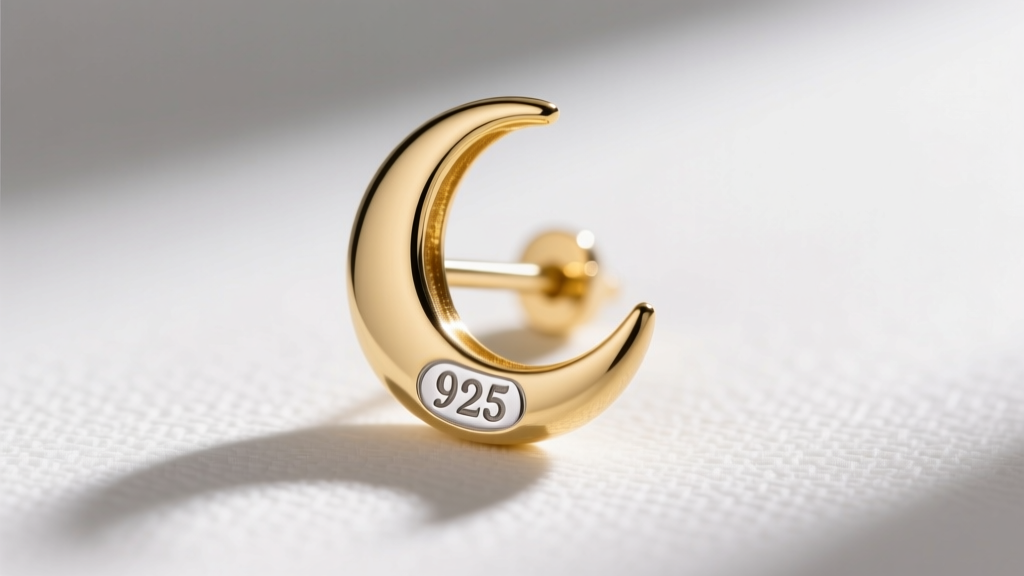
- 925 Sterling Silver (Proceed with Caution): While 92.5% pure silver is generally safe, the remaining 7.5% is usually copper. For unhealed or sensitive piercings, copper can cause irritation. According to the Gemological Institute of America (GIA), silver also tarnishes rapidly when exposed to sulfur in the air and skin oils, requiring frequent polishing.
- Gold Vermeil (Good): Vermeil is a step up. By legal definition, it must be a base of 925 sterling silver plated with at least 2.5 microns of 10k, 14k, or 18k gold. This thickness provides durability, though it will eventually wear down over a few years of daily use.
- Implant-Grade Titanium ASTM F-136 (Best): If you have a history of nickel allergies or irritation bumps, seek out independent jewelers who craft celestial motifs from ASTM F-136 titanium. This is the exact medical-grade metal recommended by the Association of Professional Piercers (APP) for initial piercings and sensitive ears.
Gauge Sizes and Piercing Placement
A common beginner mistake is ignoring the post thickness (gauge) of mismatched earrings. If you buy a sun-and-moon set where one is a standard lobe earring and the other is designed for a cartilage piercing, the posts will likely differ in thickness. Forcing a thicker post into a smaller hole causes micro-tears, leading to scar tissue buildup and irritation bumps.
| Piercing Location | Standard Gauge | Post Diameter (mm) | Best Celestial Style |
|---|---|---|---|
| Standard Earlobe | 20g or 18g | 0.81mm - 1.02mm | Sunburst Stud / Moon Drop |
| Helix / Cartilage | 16g | 1.29mm | Small Sun Huggie / Crescent Cuff |
| Tragus | 16g | 1.29mm | Tiny Moon Threadless End |
| Conch | 14g or 16g | 1.62mm - 1.29mm | Large Sun Shield / Moon Hoop |
Pro Tip: If you are buying a mismatched set online, always check the product description for the gauge size. If it simply says 'standard post,' assume it is 20g or 18g and reserve it strictly for your earlobes.
Balancing Asymmetry with Face Shapes
Asymmetrical jewelry is a powerful tool for balancing facial features. Because the sun and moon motifs naturally possess different visual weights, you can use them to your advantage based on your face shape.
- Round Faces: Round faces benefit from vertical elongation. Wear a longer, dangling crescent moon earring on one side to draw the eye downward, creating the illusion of a longer jawline. Pair it with a smaller, tighter sunburst stud on the opposite ear to prevent adding horizontal width.
- Angular / Square Faces: Strong jawlines and prominent cheekbones can be softened by wider, more radiant shapes. A textured, medium-sized sunburst hoop adds a softening halo effect, while a curved, hugging moon crawler on the opposite ear complements the bone structure without harsh lines.
- Heart-Shaped Faces: With a wider forehead and narrower chin, you want to add visual weight to the lower half of the face. Opt for a chunky, bottom-heavy moon drop earring and a medium sun stud to balance the lower jaw.
Styling Framework: The 'Anchor and Orbit' Method
When styling mismatched sun and moon earrings across both ears, beginners often make the mistake of wearing two massive, heavy statement pieces, which overwhelms the face. Instead, use the Anchor and Orbit method.
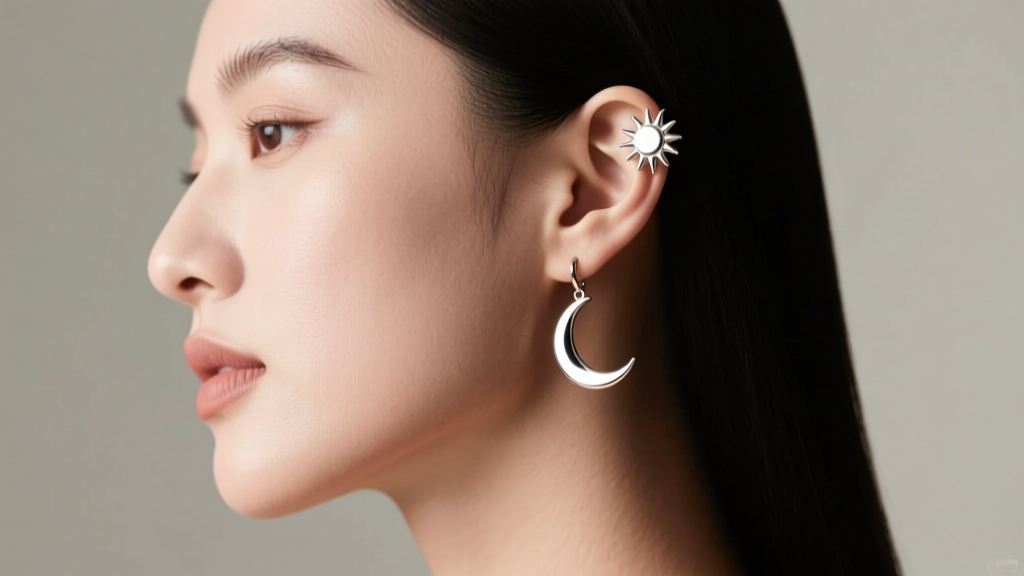
The Anchor: This is your grounding piece. It should be relatively small, close to the ear, and visually quiet. A simple 8mm gold sunburst stud or a tiny diamond-accented moon huggie serves as the anchor. Place this on the side of your face where your hair is tucked behind your ear, or on your upper cartilage (helix).
The Orbit: This is your statement piece. It has movement, length, or heavy texture. A 2-inch crescent moon chain drop or a heavily textured sun shield earring acts as the orbit. Place this on your primary display ear (the side you part your hair away from). This method ensures your look remains balanced and sophisticated rather than chaotic.
Where to Buy and Pricing Tiers
Understanding what you should pay for celestial mismatched sets prevents you from overpaying for cheap materials or underestimating fine jewelry. Here is a realistic breakdown of the market:
- Fast Fashion ($12 – $30): Brands like H&M or SHEIN. Materials are almost exclusively zinc alloy or brass with a microscopic gold wash. Verdict: Avoid for pierced ears; use only for clip-ons or temporary fashion shoots.
- Mid-Tier Demi-Fine ($45 – $95): Brands like Mejuri, Catbird, or Astrid & Miyu. You will find high-quality 14k gold vermeil over 925 sterling silver. The casting details on the sun rays and moon craters will be sharp and well-defined. Verdict: The sweet spot for everyday wear and gifting.
- Fine Jewelry ($250 – $800+): Independent goldsmiths and fine jewelers using solid 14k or 18k gold, often incorporating ethically sourced diamond chips or sapphires into the moon's craters. Verdict: An investment piece that will never tarnish and can be worn in the shower or ocean without fear of degradation.
By paying attention to metal grades, respecting your piercing gauges, and utilizing the Anchor and Orbit styling method, you can confidently rock mismatched sun and moon earrings that look intentional, elevated, and entirely your own.


