Exploring the Design of Gold Earrings with Latest Design Tech (2026)
Explore the design of gold earrings with latest design tech. Deep dive into CAD/CAM, 18k alloys, structural integrity, and 2026 pricing frameworks.

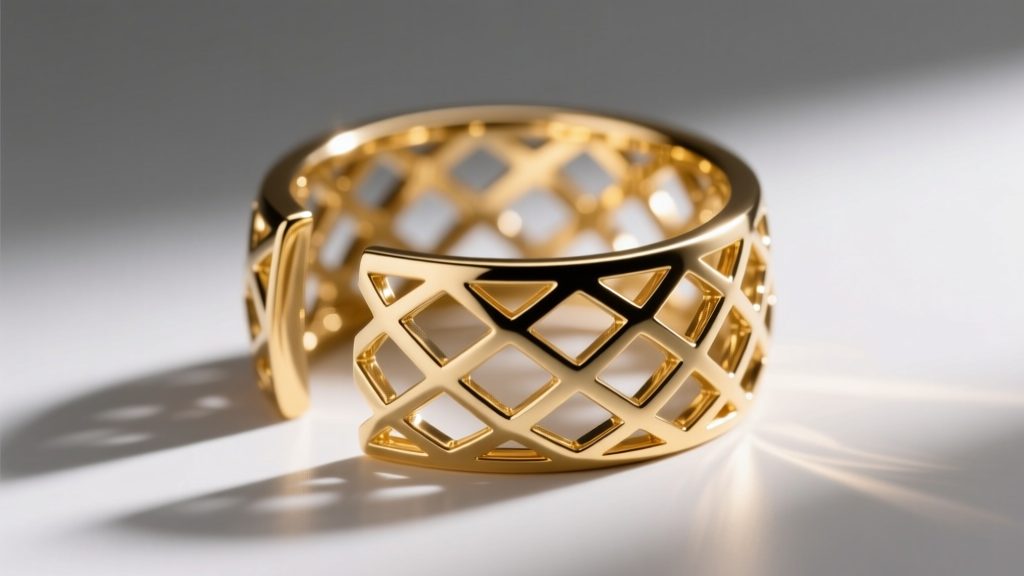
The modern jewelry landscape has undergone a seismic shift. When evaluating the design of gold earrings with latest design methodologies, we are no longer just looking at aesthetic trends; we are examining a convergence of advanced metallurgy, parametric CAD modeling, and precision micro-casting. For jewelers, collectors, and informed consumers in 2026, understanding the technical architecture behind contemporary gold earrings is essential for assessing quality, durability, and true market value.
The Metallurgical Foundation: Alloy Engineering for Complex Structures
Gold in its pure 24-karat state (99.9% Au) is far too malleable for the intricate, gravity-defying structures seen in modern earring design. To achieve the necessary tensile strength and Vickers hardness (HV), master alloyers blend pure gold with specific ratios of silver, copper, zinc, and occasionally palladium. According to the World Gold Council, the precise manipulation of these trace elements dictates not only the color but the structural viability of the final piece.
For complex CAD-designed earrings, 18-karat yellow gold remains the industry benchmark. Comprising 75% gold, 12.5% silver, and 12.5% copper, this specific alloy yields a Vickers hardness of approximately 125-135 HV when properly annealed, and up to 230 HV when work-hardened. This provides the perfect balance: it is soft enough to allow for prong-setting and micro-pavé work, yet rigid enough to hold the delicate lattice structures generated by parametric software.
| Alloy Type | Au % | Ag % | Cu % | Hardness (HV) | Best Earring Application |
|---|---|---|---|---|---|
| 18k Yellow Gold | 75.0% | 12.5% | 12.5% | 125 - 230 | Intricate CAD drops, pavé studs |
| 14k Rose Gold | 58.3% | 9.2% | 32.5% | 150 - 250 | High-tension huggies, ear cuffs |
| 18k White Gold (Pd) | 75.0% | 0.0% | 0.0% (Pd 25%) | 130 - 240 | Heavy diamond drop earrings |
Parametric Modeling and CAD/CAM Workflows
The latest design innovations in 2026 are driven by parametric modeling. Unlike traditional polygon-based CAD, parametric software (utilizing Grasshopper for Rhino or advanced MatrixGold algorithms) allows designers to input mathematical rules that generate complex, organic geometries. This is particularly evident in the design of gold earrings with latest design trends, where biomimetic patterns—such as Voronoi cells or fractal branching—are computationally generated to maximize visual volume while minimizing precious metal weight.
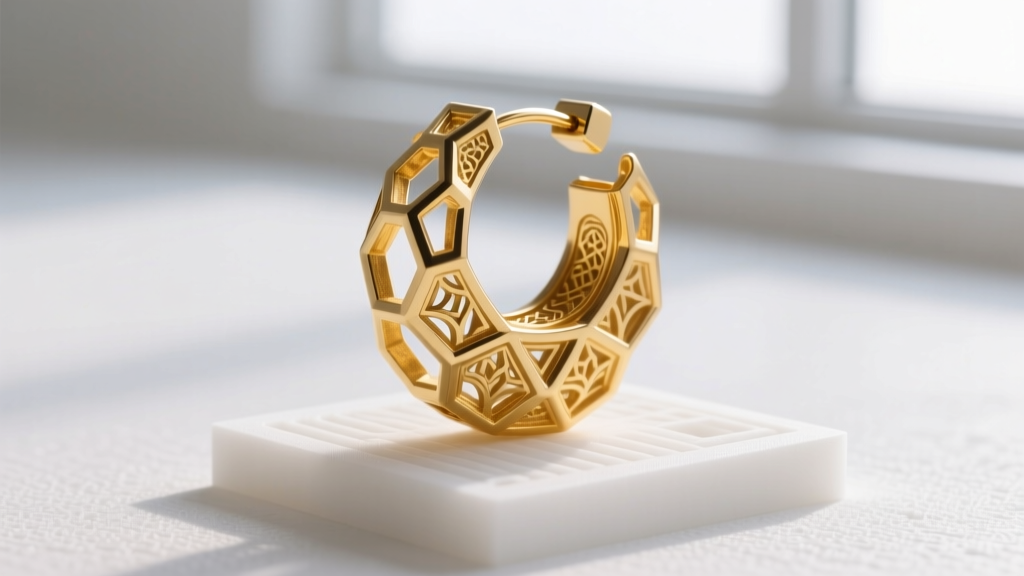
Once the digital model is finalized, it is exported as an STL file and sent to high-resolution DLP (Digital Light Processing) or SLA (Stereolithography) 3D printers. In 2026, the standard for jewelry casting is Formlabs Castable Wax 40 or Siraya Tech Cast resins, which offer dimensional accuracy down to 25 microns (0.025mm). This level of precision ensures that micro-hinges, snap-fits, and interlocking articulation joints print cleanly, eliminating the need for extensive post-casting hand-filing, which can compromise structural tolerances.
Optimizing Spruing and Casting Temperatures
A flawless 3D print is only half the battle. The spruing process—attaching the wax model to the central stem for the investment flask—requires deep technical knowledge. For lightweight, intricate gold earrings, jewelers utilize a 'tree' spruing system with micro-capillaries (as thin as 0.8mm) to ensure smooth molten metal flow without causing turbulence or porosity. 18k gold alloys are typically cast at flask temperatures between 1150°F and 1250°F, with the gold itself heated to roughly 1850°F. Deviating by even 50 degrees can result in incomplete fills or severe surface pitting.
Structural Engineering: Hinges, Tension, and Articulation
As the Gemological Institute of America (GIA) frequently notes in their manufacturing analyses, the failure point of most fine earrings is not the metal itself, but the mechanical findings. When designing heavy gold drop earrings or articulating chandeliers, engineers must account for dynamic load and metal fatigue.
- Laser-Welded Articulation: Traditional rivets can loosen over time. Modern designs utilize pulsed Nd:YAG laser welders to fuse 0.2mm gold wire joints, creating seamless pivots that rotate 360 degrees without mechanical degradation.
- Omega Backs and Tension Calibration: For heavy 18k gold drops, standard friction posts are insufficient. Engineers design custom omega-back clips with precise spring-steel inserts or work-hardened gold tension bands calibrated to exert exactly 1.5 to 2.0 Newtons of clamping force—secure enough to prevent loss, but comfortable enough to avoid lobe pinching.
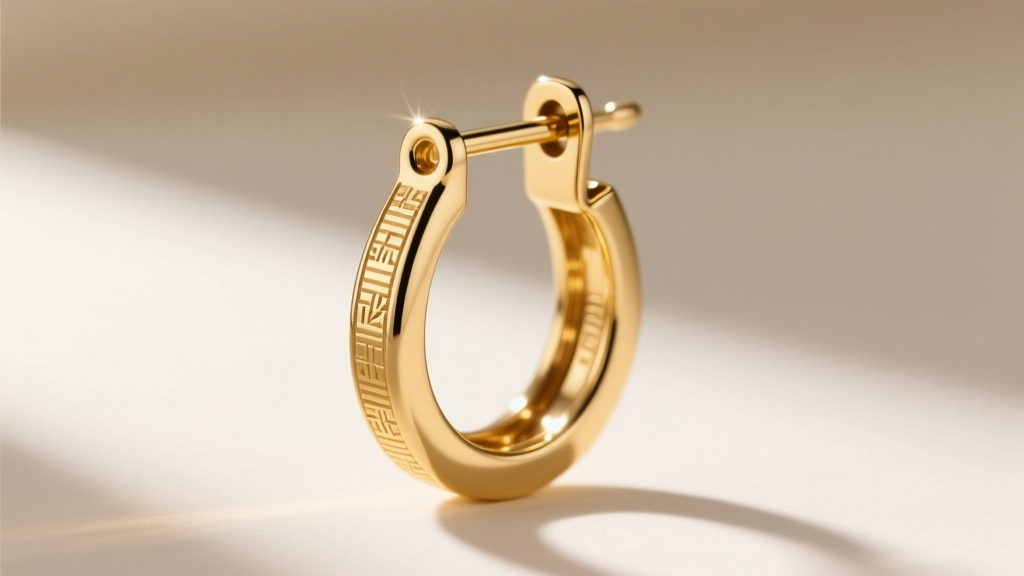
- Huggie Hinge Tolerances: The latest huggie designs feature hidden, self-lubricating micro-hinges. The male and female components are machined to a tolerance of 0.05mm, allowing the earring to snap shut with an audible, satisfying click without the need for soldered hinge pins that can melt during the final polishing stages.
Advanced Surface Finishing Technologies
The surface finish of a gold earring drastically alters its light reflectivity and perceived color depth. While high-polish finishes utilizing traditional tripoli and rouge remain popular, 2026 has seen a surge in advanced texturing techniques. Micro-sandblasting using 50-micron aluminum oxide particles creates a uniform, satin-matte finish that hides micro-scratches and emphasizes the geometric lines of parametric designs. Furthermore, selective electrochemical etching is being used to create high-contrast two-tone finishes on a single 18k gold component, eliminating the need for complex rhodium plating masks.
2026 Pricing Frameworks and Value Assessment
Understanding the technical depth of modern earring manufacturing is crucial for accurate pricing. A pair of 18k gold parametric drop earrings (weighing 8 grams) will not simply be priced at the spot value of gold plus a standard markup. The pricing framework in 2026 is heavily weighted toward engineering and computational design time.
Consumers should expect to pay a premium of 300% to 500% over the raw melt value for pieces utilizing advanced CAD/CAM workflows, micro-casting, and laser-welded articulation. Conversely, buyers should be wary of 'hollow-formed' or electroformed gold earrings that mimic the volume of solid CAD designs but lack the structural integrity, often failing under the sheer weight of their own clasps. True luxury in modern earring design is defined by the invisible engineering—the microscopic tolerances, the exact alloy hardness, and the flawless articulation that allows a piece of gold to move as fluidly as fabric.


