2026 Vanity Trends: Styling Your Stack With a Small Earring Holder
Discover how the 2026 micro-jewelry trend elevates the small earring holder from mere storage to a vanity centerpiece for curated ear stacks.

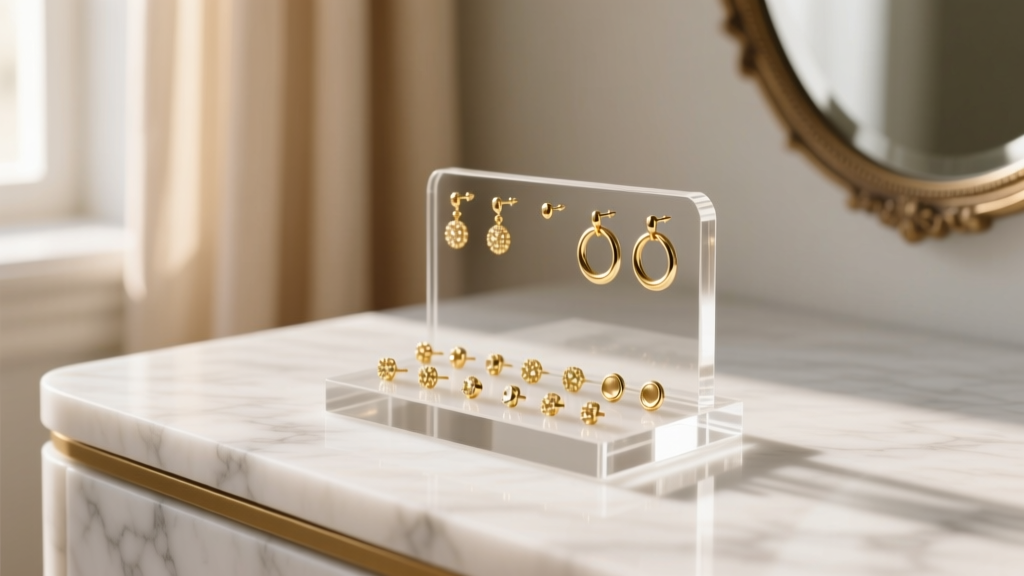
The Shift from Hidden Storage to Vanity Centerpiece
In the evolving landscape of jewelry aesthetics, the way we display our collections has become just as critical as the pieces themselves. As we navigate the style trends of 2026, the "curated ear" movement has transitioned from a niche piercing trend to a mainstream staple. With the average jewelry enthusiast now owning upwards of fifteen to twenty individual pieces of micro-jewelry—ranging from 20-gauge diamond studs to intricate 16-gauge ear cuffs—the humble small earring holder has been elevated from a hidden drawer insert to a prominent vanity centerpiece. This shift represents a broader design philosophy where organization meets high-end aesthetic display.
No longer satisfied with tangled chains and lost butterfly backs, style-conscious collectors are demanding display solutions that honor the precision engineering of their earrings. The modern small earring holder is now a vital component of the bedroom or dressing room aesthetic, designed to showcase the delicate interplay of light on solid 14k gold and ASTM F136 titanium. Understanding the intersection of earring anatomy and display mechanics is essential for anyone looking to curate a visually stunning and highly functional jewelry station.
Anatomy of the Micro-Stack: Matching Earrings to Holders
The fundamental flaw of mass-produced, generic jewelry boxes is their failure to account for the specific gauge sizes and structural nuances of modern earrings. To properly style and protect your collection, you must match the holder's architecture to the earring's anatomy.
20-Gauge and 18-Gauge Micro Studs
Micro studs, typically featuring ultra-thin posts, are the foundation of any ear stack. According to the Association of Professional Piercers (APP), standard lobe earrings are usually 18-gauge (1.02mm) or 20-gauge (0.81mm). Cheap acrylic or wooden holders often feature laser-cut holes measuring 2.0mm or wider. When a 20-gauge post is inserted into a 2.0mm hole, the stud droops at a severe 45-degree angle, causing the gemstone to face downward and the post to scratch the display surface.
The 2026 standard for premium small earring holders involves precision-drilled holes measuring exactly 1.0mm to 1.2mm. This tight tolerance ensures that micro studs stand perfectly perpendicular to the display block, allowing the facets of the gemstone to catch ambient light. For flat-back labrets (commonly used in helix and tragus piercings), holders with specialized recessed channels are required to accommodate the 3mm to 5mm flat disc without forcing the post upward.
Huggies, Seamless Hoops, and Tension Cuffs
Unlike straight-post studs, hoops and cuffs require an entirely different approach to display and storage. Huggies, which typically feature a 10mm to 12mm diameter and a delicate hinged clasp, can easily suffer from hinge warping if stored flat in a crowded compartment. Furthermore, non-piercing ear cuffs rely on precise tension to grip the cartilage; compressing them into tight spaces can permanently alter their C-shape.
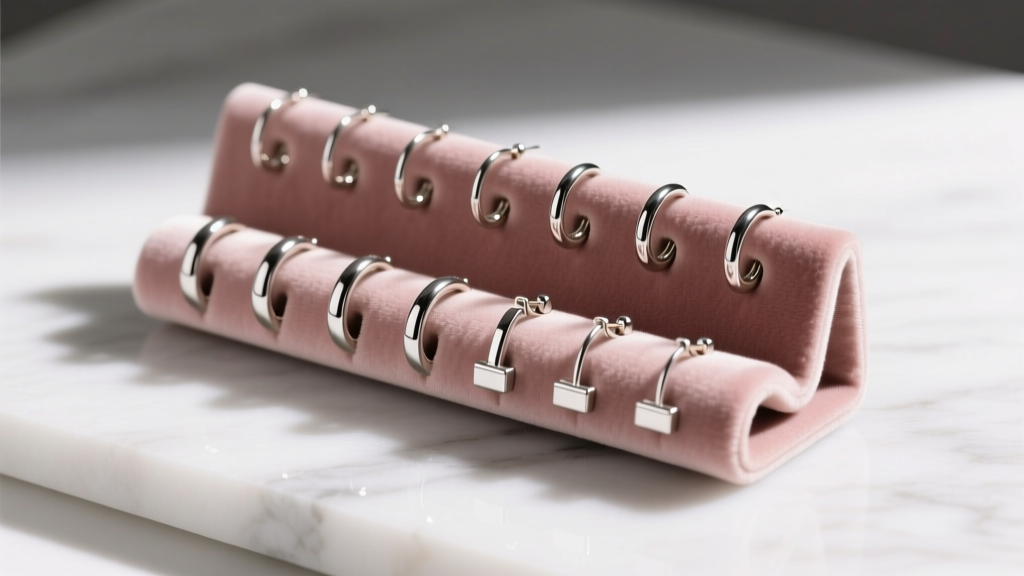
For these structural types, the velvet slit small earring holder remains the undisputed champion. However, not all slits are created equal. A high-quality holder utilizes slits that are exactly 1.5mm wide and 5mm deep. This specific dimension allows the 16-gauge (1.29mm) wire of a seamless hoop to slide in snugly, keeping the hoop suspended in its natural circular shape while preventing the velvet fibers from snagging on the microscopic seam of the closure. Ear cuffs are best displayed on the tapered edges of these velvet blocks, allowing them to maintain their open tension without resting on their sides.
Material Science: Anti-Tarnish and Display Aesthetics
The visual appeal of a small earring holder is only half the equation; the chemical interaction between the display material and the jewelry is equally vital. Sterling silver (925) is highly susceptible to tarnishing when exposed to sulfur compounds and ambient humidity. The Gemological Institute of America (GIA) emphasizes that proper storage is the first line of defense against silver sulfide formation, which causes that dreaded blackish film on delicate silver studs.
In 2026, the most sought-after small earring holders integrate advanced material science to combat tarnish. We are seeing a surge in holders lined with Pacific Silvercloth or infused with activated carbon micro-particles within the velvet base. These materials actively absorb airborne sulfur and moisture, creating a localized microclimate that keeps sterling silver and white gold brilliantly polished for months, even in humid environments.
2026 Material Comparison Chart
| Holder Material | Best Earring Compatibility | Anti-Tarnish Properties | 2026 Avg. Price Range |
|---|---|---|---|
| Optic-Clear Acrylic | 20g/18g Micro Studs, Diamond Solitaires | None (Inert, but traps humidity if enclosed) | $35 - $65 |
| Activated Carbon Velvet | Sterling Silver Hoops, 16g Huggies, Cuffs | High (Absorbs sulfur and moisture) | $45 - $85 |
| Sustainable Walnut Wood | Pearl Studs, 14k Solid Gold Drops | Low (Requires separate anti-tarnish strips) | $50 - $95 |
| Glazed Ceramic | Statement Dangles, Heavy Drop Earrings | None (Excellent for heavy pieces, no scratching) | $40 - $75 |
Troubleshooting Common Display Failures
Even with the best intentions, jewelry enthusiasts often encounter functional failures with their display setups. Recognizing these failure modes is key to maintaining a pristine collection.
- The "Cloudy Acrylic" Effect: Over time, cheap acrylic holders develop micro-scratches from the friction of metal posts, causing the material to look cloudy. Solution: Invest in cast acrylic (PMMA) rather than extruded acrylic, and polish it monthly with a microfiber cloth and a specialized plastic polish to maintain optical clarity.
- Velvet Compression and Tearing: Repeatedly forcing thick 14-gauge cartilage hoops into slits designed for 18-gauge wire will tear the velvet and ruin the block's structural integrity. Solution: Always verify the gauge of your jewelry. Use dedicated wooden or ceramic slotted holders for heavier, thicker-gauge cartilage jewelry.
- Friction Back Loss: The tiny metal or silicone butterfly backs of stud earrings are notoriously easy to lose on a flat vanity. Solution: The best small earring holders for studs feature a secondary lower tier or a recessed catch-tray specifically designed to hold friction backs securely beneath the posts.
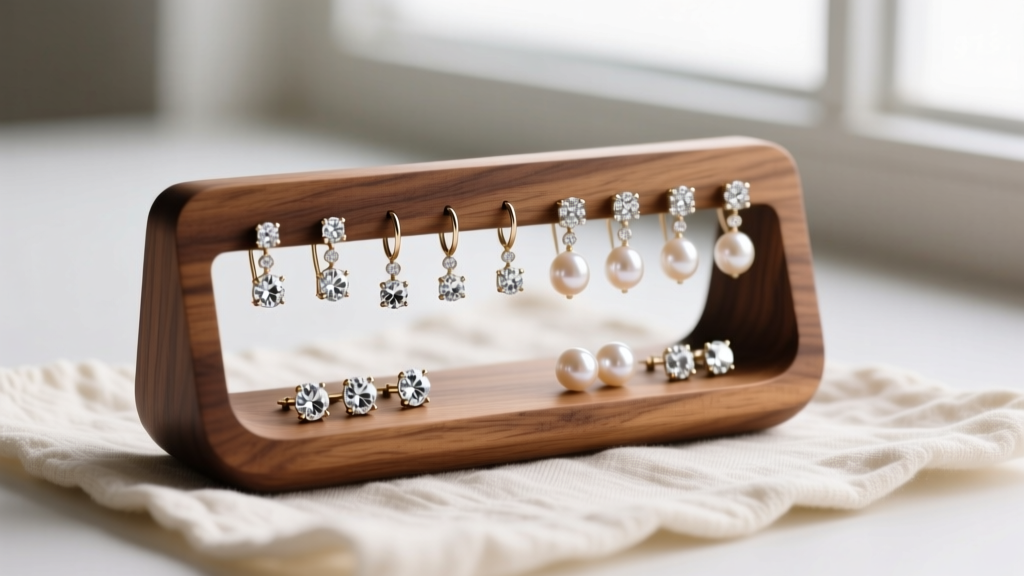
Expert Verdict: Building Your Curated Display
The curation of your ear stack should not end when you take your jewelry off for the night. The 2026 approach to jewelry care views the small earring holder as an integral part of the styling process. By selecting a holder that respects the precise gauge sizes of your micro studs, supports the structural integrity of your huggies, and actively fights environmental tarnish, you elevate your daily routine into a ritual of luxury.
For the ultimate vanity setup, we recommend a modular approach: pair a precision-drilled optic-clear acrylic block for your diamond and gold micro-studs with an activated carbon velvet tray for your silver hoops and ear cuffs. This hybrid setup not only provides the optimal physical support for varying earring anatomies but also creates a striking visual contrast of textures on your dresser. As noted by conservation experts at the Victoria and Albert Museum (V&A), the environment in which jewelry rests is just as critical to its longevity as the way it is worn. Treat your small earring holder not as an afterthought, but as the foundational stage for your most prized micro-jewelry.


