Technical Guide to Beading Designs for Earrings: Wire & Tension
Master the engineering behind beading designs for earrings. Explore wire gauges, stringing materials, and tension mechanics for durable jewelry.

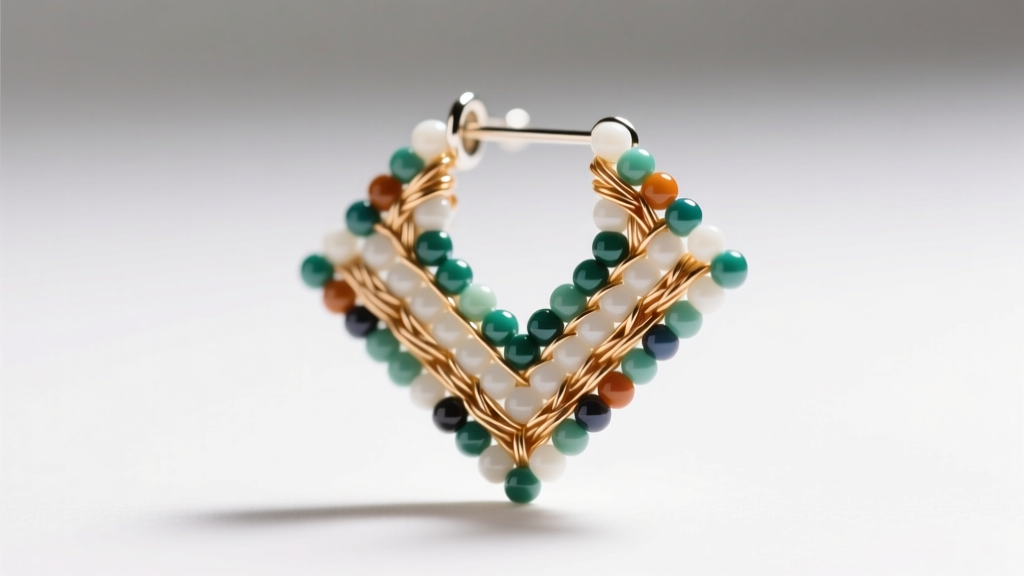
The Physics of Beaded Drops: Why Earrings Fail
When executing complex beading designs for earrings, aesthetic vision must be subordinate to structural physics. Unlike a static necklace that rests against the clavicle, a beaded dangle earring operates as a pendulum. Every step the wearer takes generates kinetic energy, transferring inertial load directly to the topmost connection point—the ear wire loop and the first structural bead. Over time, this cyclical stress causes metal fatigue in wire components and shear failure in stringing threads. To engineer beading designs for earrings that survive daily wear, jewelers must meticulously calculate wire hardness, thread tensile strength, and geometric load distribution.
Wire Gauges and Hardness: The Structural Skeleton
The foundation of any beaded earring is the ear wire and the internal armature. Selecting the correct wire requires understanding both gauge (diameter) and temper (hardness). According to Fire Mountain Gems' metallurgical guides, wire temper dictates how the metal behaves under stress. Dead-soft wire is fully annealed, making it ideal for weaving and wrapping, but it will deform under the weight of heavy glass beads. Half-hard wire has been drawn and partially stress-relieved, offering the perfect balance of malleability and shape retention for ear wires.
| Wire Gauge | Diameter (mm) | Temper | Best Application in Earrings |
|---|---|---|---|
| 20-Gauge | 0.81 mm | Half-Hard | Standard French hooks, shepherd ear wires |
| 22-Gauge | 0.64 mm | Half-Hard | Leverback ear wires, lightweight dangles |
| 24-Gauge | 0.51 mm | Dead-Soft | Wire-wrapping briolettes, securing bead caps |
| 26-Gauge | 0.40 mm | Dead-Soft | Coiling, intricate wire-weaving accents |
For the primary ear wire, 20-gauge half-hard sterling silver (.925) or 14/20 gold-filled wire is the industry standard. Anything thinner than 22-gauge risks permanent deformation when the wearer removes the earring, while 18-gauge is often too thick for standard ear piercings (which typically heal at 20g or 18g).
Stringing Materials: Polymer Chemistry and Tensile Strength
The internal threading of beaded designs for earrings dictates the piece's lifespan. Traditional silk thread, while excellent for pearl knotting, is entirely unsuitable for seed bead weaving due to its high elasticity and poor abrasion resistance. Modern beading relies on advanced synthetic polymers.
- Gel-Spun Polyethylene (GSP): Marketed under brands like FireLine, GSP threads are created by spinning polyethylene gel into ultra-high-molecular-weight fibers. A 6-lb test FireLine (0.006 in / 0.15 mm diameter) offers immense tensile strength with zero memory, allowing seed beads to sit flush against one another.
- Thermally Fused Polyethylene: WildFire threads feature a thermally fused coating that provides a smooth, wax-like finish. This coating significantly reduces friction when passing through beads multiple times and offers superior shear resistance compared to uncoated GSP.
- Nylon (Nymo): A flat, multi-filament nylon thread. While it requires conditioning with beeswax to prevent tangling, Nymo provides a softer drape, making it ideal for flexible peyote stitch earrings that need to move like fabric.
Bead Selection: Mohs Hardness and Drill Hole Friction
A common failure mode in beaded earrings is the internal severing of the thread by the bead itself. The Gemological Institute of America (GIA) notes that different materials possess vastly different hardness levels on the Mohs scale, which directly impacts the sharpness of the drill hole edges.
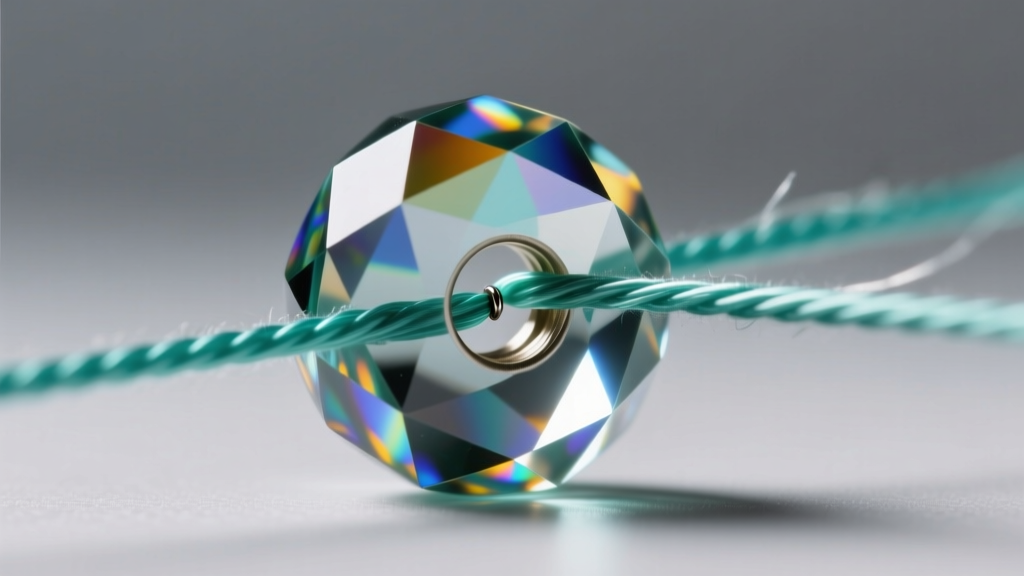
Czech glass beads typically sit at 5.5 to 6 on the Mohs scale. Their drill holes are relatively soft and often fire-polished, posing minimal threat to GSP threads. Conversely, precision-cut crystal beads (like Preciosa or Swarovski) contain lead or barium oxide, pushing their hardness to 6.5 or 7. The drill holes in these crystals can be microscopically sharp. When designing crystal-heavy beaded earrings, experts recommend a 'double-pass' technique—running the thread through the bead twice to distribute the shear load—or applying a microscopic drop of flexible cyanoacrylate adhesive to the thread inside the bead.
Advanced Joinery: Right-Angle Weave vs. Tubular Peyote
The geometric pattern you choose fundamentally alters how kinetic energy dissipates through the earring. Tubular peyote stitch relies on a single vertical zig-zag tension line. If one bead cracks or one thread segment snaps, the entire vertical column can unzip.
For structural integrity in heavy beaded dangles, Right-Angle Weave (RAW) is vastly superior. RAW creates a three-dimensional lattice where each bead unit is secured on four distinct axes. This cross-linked geometry distributes the pendulum stress across the entire matrix rather than concentrating it on a single thread path. When executing RAW for earrings, maintaining strict, high tension with a size 10 or 12 John James beading needle is critical; loose tension results in a 'spongy' dangle that lacks the premium weight and movement expected in fine beaded jewelry.
Finishing Hardware and Center of Gravity
"The success of a beaded earring is ultimately judged by how it hangs. If the center of gravity is miscalculated, even the most intricate beadwork will twist backward against the earlobe."
To prevent twisting, the connection point between the beadwork and the ear wire must be perfectly aligned with the vertical axis of the design. When using French hooks, incorporate a 3mm to 4mm soldered jump ring between the ear wire loop and the beadwork. This allows the earring to articulate freely on two planes, accommodating the natural curvature of the earlobe. For heavy, oversized beaded chandeliers, upgrade to a leverback ear wire. Leverbacks feature a secure, closed loop that prevents the earring from dislodging during high-kinetic activities, while the hinged back provides the necessary articulation for the beadwork to swing without torquing the piercing.
Mastering these technical parameters—wire temper, polymer thread selection, Mohs friction, and geometric joinery—elevates beading designs for earrings from fragile crafts to enduring, professional-grade jewelry. For further exploration of structural beadwork, resources like Beadaholique's technical tutorials offer excellent visual breakdowns of tension management in advanced stitches.


