Pretzel Earrings: Technical Design, Gauges & Enamel Guide
Master the technical design of pretzel earrings. Explore wire gauges, enamel firing methods, structural soldering, and lobe weight distribution.

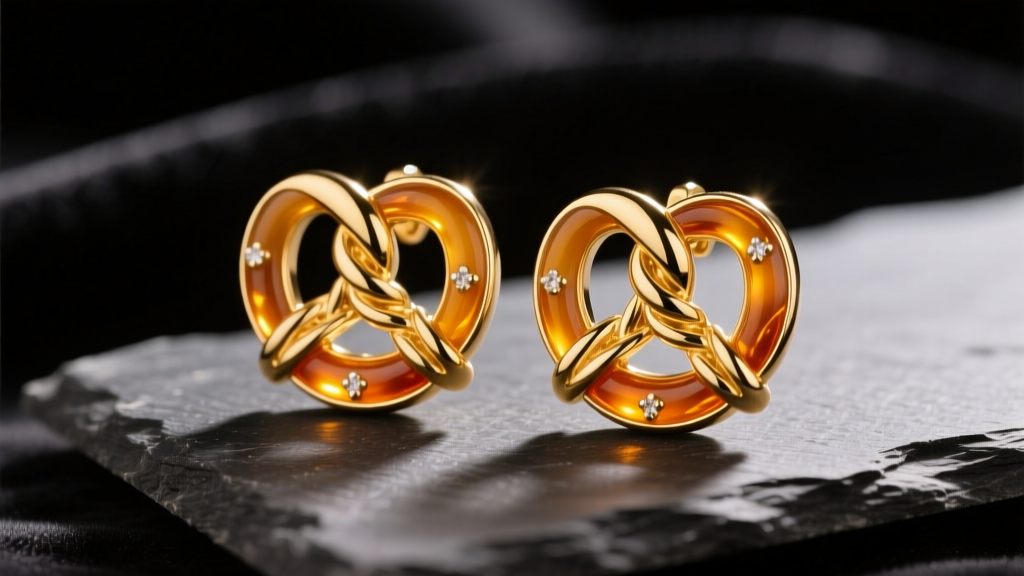
The Architecture of the Pretzel Motif in Fine Jewelry
While often dismissed as mere novelty or whimsical food-themed accessories, pretzel earrings represent a fascinating topological challenge in fine jewelry fabrication. Unlike simple geometric hoops or linear bar studs, the classic pretzel shape is a continuous, overlapping knot. This geometry requires the jeweler to navigate complex three-dimensional wire bending, precise structural soldering, and meticulous weight distribution. In 2026, as maximalist and hyper-textured jewelry trends continue to dominate, the pretzel motif has evolved from a kitschy souvenir into a sophisticated canvas for advanced metallurgical techniques, particularly vitreous enameling and micro-pave stone setting.
Designing a structurally sound pretzel earring demands a deep understanding of shear stress and tensile strength. The overlapping loops create natural undercuts that can easily snag on hair or clothing if not properly engineered. Furthermore, the visual success of the design relies entirely on the uniformity of the wire curvature and the seamless integration of the solder joints. This expert deep dive explores the precise technical specifications, material grades, and fabrication methodologies required to produce high-end, durable pretzel earrings that transcend fast-fashion fragility.
Wire Gauges and Structural Integrity
The foundation of any wire-formed pretzel earring is the gauge of the metal. Selecting the incorrect wire diameter is the most common failure point in independent jewelry design, leading to either warped loops that lose their shape or overly heavy earrings that cause earlobe trauma. For a standard pretzel silhouette measuring between 15mm and 25mm in diameter, the optimal wire gauge ranges from 14-gauge to 16-gauge.
Using 18-gauge (1.0mm) or 20-gauge (0.8mm) wire might seem economical and easier to manipulate by hand, but it lacks the rigidity to withstand daily wear. The overlapping center of the pretzel acts as a fulcrum; if the wire is too thin, lateral pressure will permanently distort the knot. Conversely, utilizing 12-gauge (2.0mm) wire provides immense durability but introduces severe weight issues, particularly when cast or formed in dense metals like 18k yellow gold or platinum.
| Wire Gauge | Diameter (mm) | Best Application | Structural Risk |
|---|---|---|---|
| 18-Gauge | 1.02mm | Micro-studs (<10mm), delicate layering pieces | High risk of loop warping and snagging |
| 16-Gauge | 1.29mm | Standard studs (15-20mm), enamel bases | Optimal balance of weight and rigidity |
| 14-Gauge | 1.63mm | Large dangles (25mm+), heavy pavé settings | Heavy; requires reinforced ear nuts |
| 12-Gauge | 2.05mm | Statement cuffs, structural ear climber bases | Excessive lobe droop; difficult to bend |
Enamel Application and Thermal Dynamics
To mimic the golden-brown crust of a baked pretzel or to introduce vibrant, modern colorways, jewelers frequently turn to enameling. However, the topological knot of a pretzel makes enameling exceptionally difficult. The application of vitreous (glass) enamel requires kiln firing at temperatures hovering around 1450°F (788°C). The metal base must possess a compatible coefficient of thermal expansion (CTE) to prevent the glass from cracking upon cooling. Fine silver and specific copper alloys are the preferred bases for vitreous enamel, as noted in technical guidelines by the Gemological Institute of America (GIA).
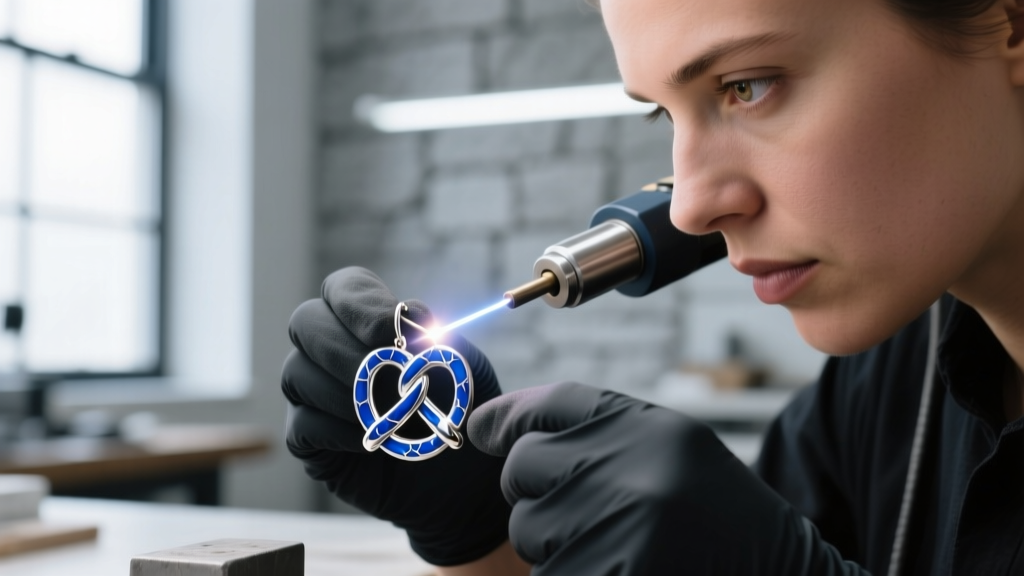
Preventing Enamel Fracture at Solder Joints
The most critical technical hurdle in crafting enameled pretzel earrings is the final closure of the overlapping loops. In traditional jewelry fabrication, a jeweler would use a butane or oxy-acetylene torch to solder the final joint. However, applying torch heat to a piece that has already been enameled will instantly melt the glass, ruin the finish, and potentially cause thermal shock fractures.
To circumvent this, master jewelers employ laser welding technology. Laser welders concentrate a microscopic beam of light to fuse the metal at the exact point of the overlapping joint without transferring ambient heat to the surrounding enameled surface. This allows the jeweler to complete the pretzel knot post-firing. According to fabrication standards discussed by the Society of North American Goldsmiths (SNAG), laser ablation and precision welding are now mandatory for high-end enameled topological jewelry, ensuring the structural integrity of the knot without sacrificing the vitreous finish.
Weight Distribution and Clasp Mechanics
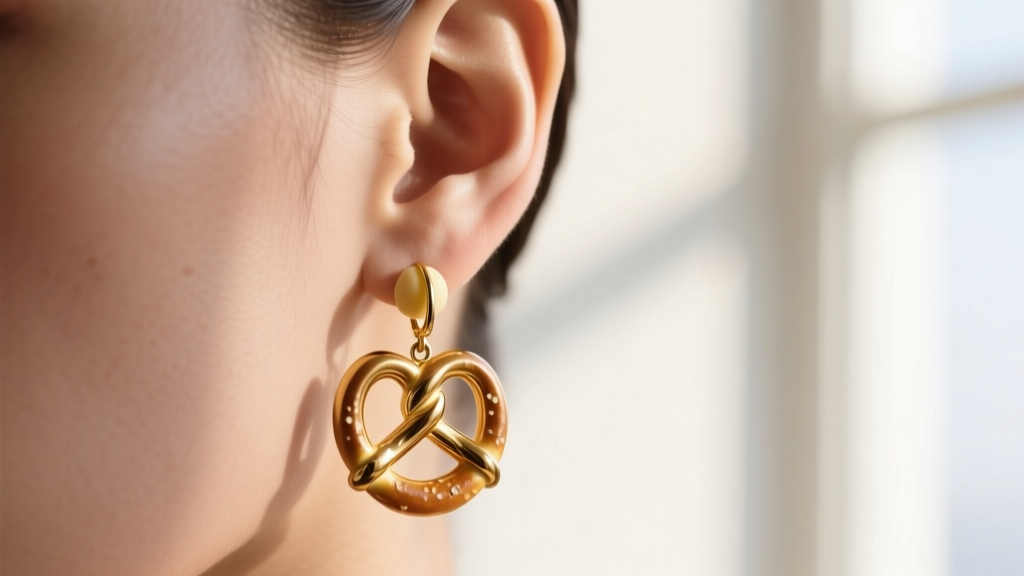
A solid 14k gold pretzel earring crafted from 16-gauge wire can easily weigh between 3.5 and 5.5 grams per ear. While this is not exceptionally heavy in the grand scheme of statement jewelry, the concentrated center of gravity in a pretzel's knotted core creates a pendulum effect. If mounted on a standard friction post with a cheap butterfly back, the earring will tilt forward, causing the post to dig into the ear canal and the lobe to stretch over time.
For stud variations, technical jewelers bypass standard backs in favor of La Pousette clutch backs or heavy-duty silicone friction discs. La Pousette backs utilize a spring-loaded internal mechanism that locks onto a notched post, distributing the weight across a wider surface area of the earlobe. For dangle pretzel earrings, the jump ring connecting the pretzel knot to the ear wire must be forged from a thicker gauge (typically 14-gauge) and soldered shut. An unsoldered jump ring will inevitably pull apart under the kinetic shear stress of the swinging pretzel motif.
Pricing Tiers and Material Grades
Understanding the pricing architecture of pretzel earrings requires analyzing the fabrication method. The market is sharply divided between mass-produced cast pieces and hand-fabricated artisan jewelry.
- Tier 1: Die-Cast Base Metal ($15 - $45) Typically made from nickel-free brass or zinc alloys, plated with thin gold vermeil. The 'pretzel' shape is cast as a single solid piece, meaning there are no actual overlapping wires, just the visual illusion of a knot. These lack structural nuance and the plating will eventually wear away at the high-friction overlapping points.
- Tier 2: Cast Sterling Silver & Cold Enamel ($60 - $120) Cast in solid 925 sterling silver and filled with cold (epoxy-based) enamel. Cold enamel does not require kiln firing, making it cheaper to produce, but it lacks the depth, refractive index, and scratch resistance of true vitreous glass.
- Tier 3: Hand-Fabricated Gold & Vitreous Enamel ($250 - $600+) Hand-bent from 16-gauge 14k or 18k gold wire, kiln-fired with lead-free vitreous enamel, and laser-welded at the joints. These are heirloom-quality pieces that justify their premium pricing through intense labor and specialized equipment.
Maintenance and Real-World Troubleshooting
The primary complaint from consumers wearing wire-formed pretzel earrings is hair snagging. The undercuts created where the wire crosses over itself act as microscopic traps for loose hair strands. To mitigate this, expert fabricators utilize a multi-stage finishing process. After the initial polishing, the earrings are placed in a rotary tumbler with stainless steel shot and a mild burnishing compound. This tumbling process peens the metal slightly, hardening the wire while simultaneously smoothing out any internal burrs or microscopic sharp edges left by the saw blade or laser welder.
For cleaning, enameled pretzel earrings must never be subjected to ultrasonic cleaners. The high-frequency acoustic cavitation can shatter the vitreous enamel, especially at the stress points near the solder joints. Instead, they should be cleaned using a soft-bristled brush, warm water, and a mild, non-abrasive dish soap, followed by drying with a microfiber cloth to prevent water spots on the glass enamel surface.
The intersection of playful design and rigorous metallurgical engineering is what separates a disposable trend accessory from a permanent fixture in a curated jewelry wardrobe. The pretzel earring, when executed with precision, is a masterclass in structural jewelry design.
Conclusion
Evaluating pretzel earrings through a technical lens reveals a complex interplay of geometry, thermal dynamics, and biomechanics. Whether you are a collector seeking a masterfully enameled artisan piece or a jeweler looking to refine your wire-bending and laser-welding techniques, respecting the structural demands of the overlapping knot is paramount. By prioritizing correct wire gauges, advanced thermal joining methods, and ergonomic weight distribution, the pretzel motif transcends its novelty origins to become a triumph of modern jewelry engineering.


