Flat Back Moissanite Earrings Hypoallergenic: Technical Buyer Guide
Discover the technical specs of flat back moissanite earrings hypoallergenic designs. Learn about implant-grade titanium, DEF stones, and gauge sizing.

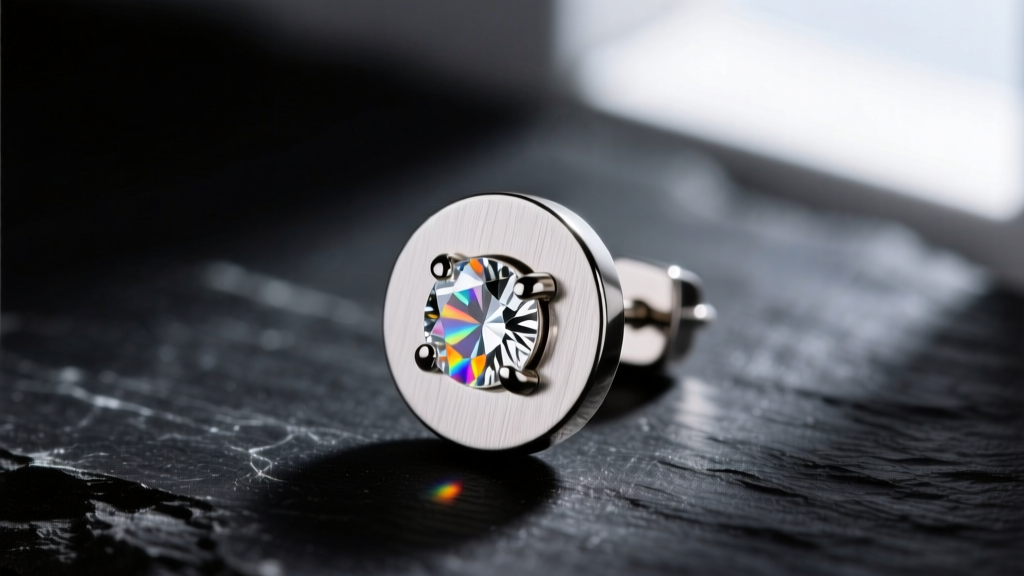
When navigating the contemporary body jewelry market, finding genuinely safe options for sensitive cartilage and lobe piercings requires looking past marketing buzzwords. The search for flat back moissanite earrings hypoallergenic models often leads consumers into a maze of misleading metallurgical claims and ambiguous gemstone grading. As we move through 2026, the intersection of advanced lab-grown silicon carbide (moissanite) and biocompatible metals has set a new standard for fine body jewelry. This technical deep dive strips away the fluff, examining the exact material grades, mechanical tolerances, and gemological specifications you need to make an informed, tissue-safe purchase.
The Metallurgy of True Hypoallergenic Claims
The term 'hypoallergenic' is largely unregulated in the jewelry industry, meaning it is frequently applied to alloys that still contain trace sensitizers. For flat back earrings intended for long-term wear in cartilage piercings (such as the helix, conch, or tragus), the gold standard is ASTM F-136 compliant Ti-6Al-4V ELI (Extra Low Interstitial) titanium. This is the exact same implant-grade alloy used in aerospace and medical joint replacements.
Unlike standard commercial titanium, the ELI designation means the interstitial elements (like oxygen, nitrogen, and carbon) are strictly limited, resulting in a metal that is highly resistant to corrosion from human sebum and saline. According to the Association of Professional Piercers (APP), implant-grade titanium boasts a mirror-polish capability that prevents bacterial adhesion, a critical factor for healing or easily irritated fistulas.
The Surgical Steel Deception
Many brands market 'surgical stainless steel' (typically 316L or 316LVM) as hypoallergenic. While 316L is safe for short-term wear in fully healed, robust lobe piercings, it contains between 8% and 10% nickel. When exposed to the slightly acidic environment of a piercing channel, 316L can release nickel ions, triggering contact dermatitis, localized swelling, and hypertrophic scarring in sensitized individuals. If your primary requirement is a truly hypoallergenic flat back, 316L must be entirely excluded from your purchasing criteria.
Moissanite Gemology: Grading the Sparkle
Moissanite (silicon carbide, SiC) is not a diamond simulant; it is a distinct gemstone with superior optical properties. It possesses a refractive index (RI) of 2.65 (compared to diamond's 2.42) and a dispersion rating of 0.104, resulting in the intense 'fire' or rainbow flashes characteristic of the stone. However, in micro-sizes typical for flat back earrings (2mm to 5mm), the cut precision dictates whether the stone will exhibit brilliant light return or a muddy, 'crushed ice' appearance.
Leading manufacturers like Charles & Colvard and specialized body jewelry gem cutters utilize precision faceting to ensure that even a 2.5mm moissanite retains its optical symmetry. When evaluating moissanite for cartilage jewelry, you must look beyond carat weight and focus on color grading and clarity.
Color and Clarity Matrix for Micro-Stones
| Grade | Color Description | Visual Impact (Under 4mm) | Price Premium |
|---|---|---|---|
| D-E-F | Colorless | Icy white, maximum brilliance, no warmth | High (+30-40%) |
| G-H-I | Near Colorless | Faint warmth in direct sunlight, excellent value | Baseline |
| J-K | Faint Yellow/Green | Noticeable tint, often avoided in fine jewelry | Discounted |
For flat back settings, VVS1 (Very Very Slightly Included) is the baseline expectation. Because moissanite is lab-created via thermal decomposition, inclusions are rare. Any stone with visible carbon spots or needle-like inclusions under 10x magnification should be rejected, as internal flaws can compromise the stone's structural integrity when subjected to the pressure of a bezel or prong setting.
Post Mechanics: Gauge, Length, and Threading
The mechanical interface between the earring post and your tissue is just as critical as the materials used. Cartilage piercings are typically performed at 16 gauge (1.2mm) or 14 gauge (1.6mm), while standard lobe piercings often sit at 18 gauge (1.0mm) or 16 gauge. Wearing a post that is too thin for the fistula (e.g., an 18g post in a 14g hole) creates the 'cheese-cutter effect,' where the thin metal migrates through the tissue under the weight of the jewelry.
Furthermore, flat back disc diameter matters. A 2.5mm to 3.0mm disc is ideal for most helix and conch piercings, providing enough surface area to distribute pressure without embedding into the posterior cartilage. Discs larger than 4.0mm can cause pressure necrosis in shallow anatomical folds.
Threadless vs. Internal Threading
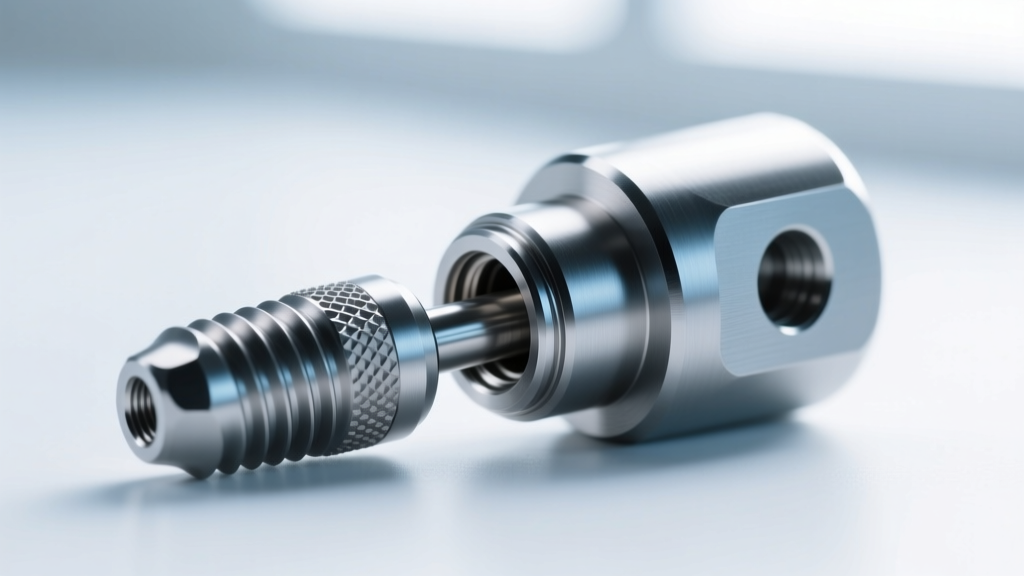
Never purchase externally threaded body jewelry. The threads on the outside of the post act like a file, tearing the delicate epithelial lining of the piercing channel during insertion. High-end hypoallergenic flat backs utilize one of two superior mechanical joints:
- Internal Threading: The threads are located on the inside of the decorative end (the moissanite setting), and the post is completely smooth. This requires a post wall thickness of at least 0.9mm to maintain structural integrity.
- Threadless (Push-Pin): The decorative end features a slightly bent pin that inserts into the hollow, smooth titanium post. The tension created by the bend holds the jewelry securely in place. This is widely considered the safest and most secure mechanism for cartilage jewelry in 2026.
Real-World Pricing Benchmarks
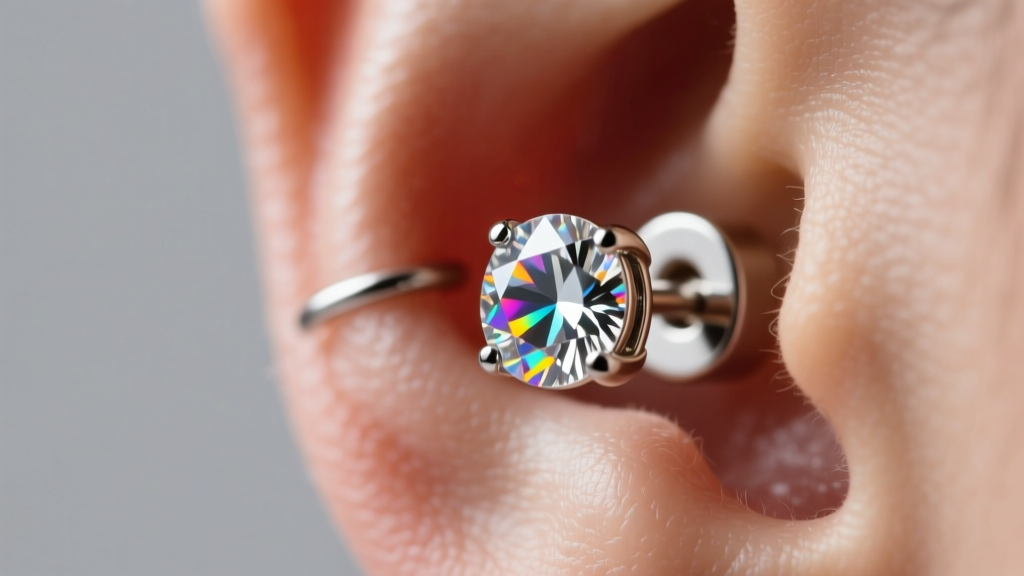
Understanding the cost breakdown prevents you from overpaying for brand prestige or underpaying for potentially hazardous materials. A genuine implant-grade titanium flat back featuring a 3mm DEF/VVS moissanite stone requires precision CNC machining and expert stone setting.
Market Pricing Tiers (2026 Estimates):
Budget ($20 - $45): Usually 316L steel with lower-grade (G-H) moissanite and external threading. Avoid for sensitive ears.
Mid-Tier ($60 - $110): ASTM F-136 titanium, internal threading or threadless, D-E-F color moissanite. The sweet spot for quality and value.
Premium/Designer ($140 - $250+): Brands like BVLA or Maria Tash. You are paying for proprietary setting techniques (like invisible prong settings), brand heritage, and guaranteed stone sourcing.
Troubleshooting Cartilage Irritation
Even with perfect hypoallergenic materials, improper fit can cause irritation bumps (localized granulomas). The most common culprit is post length mismatch. A fresh or easily irritated helix piercing requires a longer post (e.g., 8mm or 10mm) to accommodate swelling and the natural angle of the piercing channel. Once healed, downsizing to a 5mm or 6mm post is mandatory to prevent the jewelry from snagging on hair and clothing.
Additionally, piercing channels are rarely drilled at a perfect 90-degree angle to the cartilage plane. If your piercing has a slight slope, a rigid flat back disc may not sit flush against the skin, creating localized torque. In these cases, consult a professional piercer who can bend the threadless pin to accommodate your unique anatomy, or recommend a ball-back alternative that pivots slightly to match the tissue angle. By prioritizing ASTM-certified metals, precision-cut moissanite, and correct mechanical tolerances, you ensure your jewelry remains both biologically safe and optically stunning for a lifetime.


