2026 Piercing Trends: Best Earrings for Beginners
Discover the best earrings for beginners in 2026. Expert analysis on implant-grade materials, gauge sizes, and trending flat-back styles for new piercings.

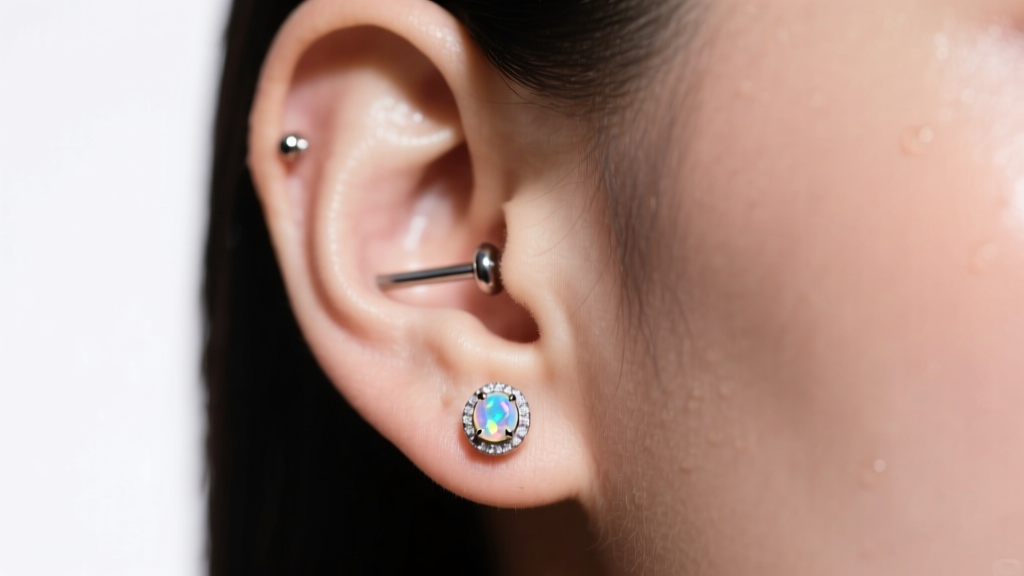
The 2026 Shift: Why 'Beginner' No Longer Means 'Basic'
The landscape of ear piercing has undergone a massive transformation over the last decade, and the 2026 aesthetic has completely redefined what we consider 'starter jewelry.' Gone are the days when getting your ears pierced meant enduring a mall kiosk piercing gun and being sent home with itchy, nickel-laden surgical steel butterfly studs. Today, beginners are stepping directly into professional, needle-based piercing studios, armed with an understanding of curated ear aesthetics and biocompatible materials.
For the modern beginner, the first piece of jewelry isn't just a placeholder for healing; it is the foundational anchor of a long-term ear curation project. The 2026 style radar shows a definitive pivot toward 'Quiet Luxury' and 'Organic Minimalism' in body jewelry. This means beginners are now opting for high-polish, bezel-set gemstones and anatomically correct flat-back labrets from day one. Understanding the intersection of fresh wound care and high-end style is critical for anyone looking to build a curated ear without compromising their healing fistula.
Material Science: What to Actually Put in a Fresh Piercing
The most critical decision a beginner will make is the material of their initial jewelry. A fresh piercing is an open wound, and the immune system is highly reactive to foreign metals. The biggest trap for beginners is the marketing term 'surgical steel.' While 316L stainless steel is widely used in medical tools, it contains between 8% and 10.5% nickel. When worn in a healing, moist environment, nickel leaches into the tissue, causing contact dermatitis that beginners frequently—and incorrectly—mistake for an infection.
According to the Association of Professional Piercers (APP), the gold standard for initial piercings is implant-grade titanium. Specifically, you want to look for ASTM F-136 certified titanium. This specific alloy is entirely nickel-free, highly polished to a mirror finish to prevent bacterial adhesion, and lightweight enough not to drag on a healing lobe.
| Material | Standard / Grade | Nickel Content | Price Range (Per Stud) | Best Use Case |
|---|---|---|---|---|
| Implant-Grade Titanium | ASTM F-136 | 0% (Nickel-Free) | $35 - $85 | Fresh piercings, sensitive skin, daily wear |
| Niobium | Unalloyed / Reactive | 0% (Nickel-Free) | $30 - $60 | Anodized color jewelry for healing lobes |
| Solid Gold | 14k or 18k (Nickel-Free Alloy) | Varies (Must verify) | $120 - $400+ | Healed piercings, luxury upgrades |
| 'Surgical' Steel | 316L Stainless | 8% - 10.5% | $10 - $25 | Avoid for fresh piercings; high allergy risk |
Trend Analysis: Top 3 Beginner-Friendly Styles Dominating 2026
Once you have selected a biocompatible material, the next step is choosing a style that aligns with current trends while respecting the biology of a healing ear. The 2026 trend report highlights three specific earring styles that perfectly bridge the gap between high fashion and piercing aftercare.
1. The Chunky Flat-Back Labret
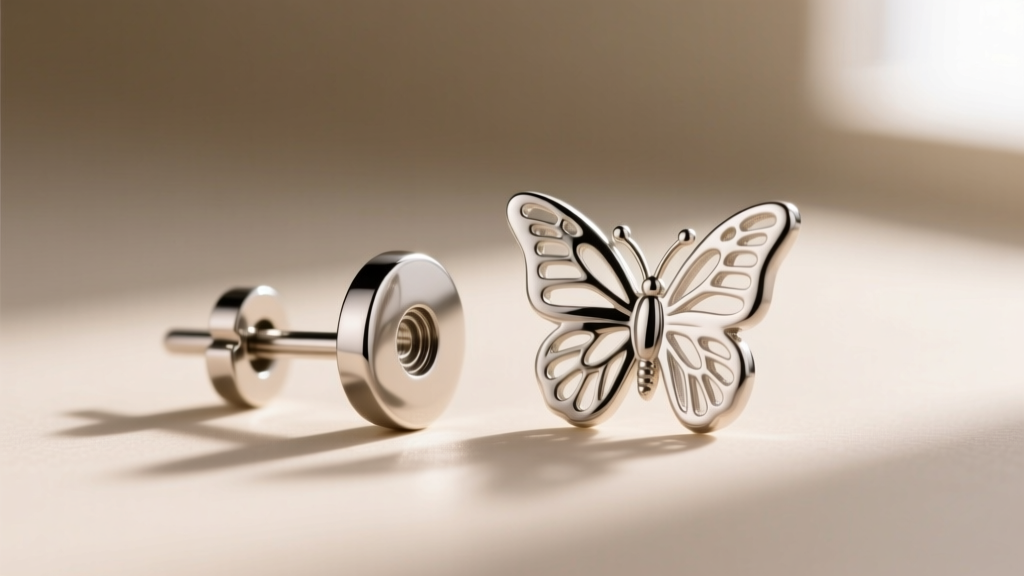
The traditional 'butterfly clutch' earring is officially obsolete in professional piercing circles. The 2026 standard for beginners is the flat-back labret. This style features a flat disc that sits flush against the back of the earlobe, completely eliminating the dark, moist crevices where bacteria and dead skin cells accumulate. Trend-wise, we are seeing a move toward slightly chunkier, low-profile ends—think 4mm to 6mm bezel-set gems or solid gold spheres. Brands like BVLA and Anatometal are leading the charge with threadless (push-pin) designs that allow beginners to easily swap out the decorative front without ever removing the healing post.
2. The Minimalist Bezel-Set Stud
While prong-set diamonds have historically dominated the starter earring market, 2026 is all about the bezel setting. Prongs are notorious for snagging on hair, sweaters, and pillowcases—a disaster for a fresh, tender lobe. A bezel setting encases the gemstone in a smooth, continuous metal rim. This not only provides a sleek, modern 'quiet luxury' aesthetic but also creates a completely snag-free profile. A 3mm or 4mm bezel-set white sapphire or moissanite in ASTM F-136 titanium is currently the most requested beginner piece in high-end studios globally.
3. Ear Cuffs: The Zero-Commitment Cartilage Trend
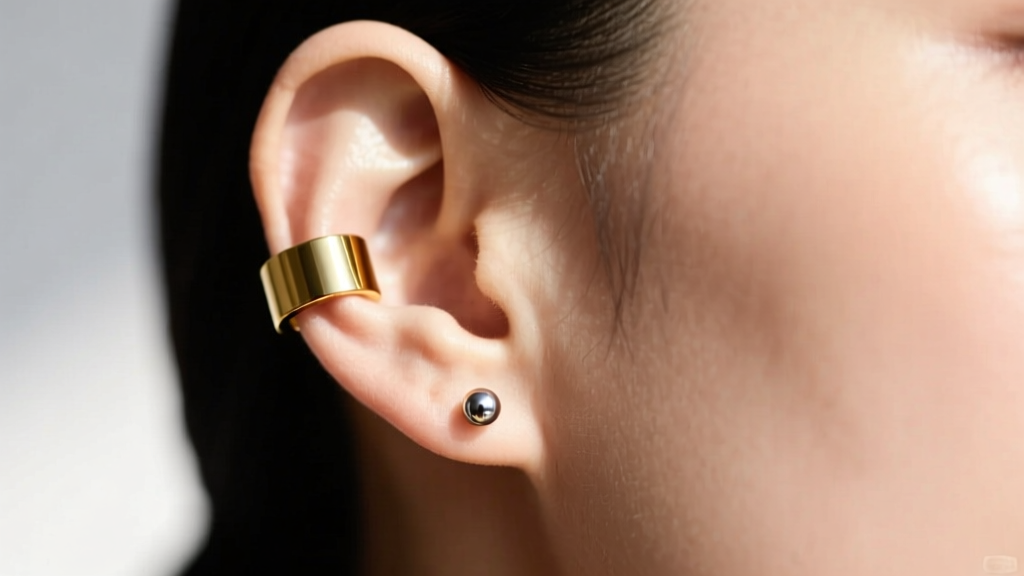
For beginners who want to experiment with the 'curated ear' aesthetic without committing to the 9-to-12-month healing process of a helix or flat piercing, the tension-fit ear cuff is the ultimate 2026 trend. Modern ear cuffs are designed with adjustable inner diameters (typically 8mm to 10mm) and feature intricate, organic shapes like molten gold waves or micro-pave diamond halos. They allow beginners to map out their future piercing placements visually before ever sitting in the piercer's chair.
The Gauge Debate: 20G vs. 18G vs. 16G for New Piercings
Gauge refers to the thickness of the jewelry post, and it is a heavily debated topic among beginners. Standard mall kiosks and piercing guns typically use 20-gauge (0.81mm) or even 22-gauge needles. However, professional piercers strongly advocate for 16-gauge (1.29mm) or 18-gauge (1.02mm) for initial lobe piercings.
Why the thicker post? It comes down to a physical phenomenon known in the industry as the 'cheese-cutter effect.' If you hang a heavy, high-quality gold or gemstone earring on a razor-thin 20-gauge wire, the downward pressure and gravity will cause the thin metal to slowly slice through the healing tissue, leading to migration, tearing, and the dreaded 'split lobe.' A 16-gauge post provides a wider surface area, distributing the weight of the jewelry evenly and offering vastly superior stability. Furthermore, the high-end jewelry market has largely standardized around 16G and 18G; piercing at 16G opens up a significantly wider array of premium 2026 trend pieces for your future upgrades.
Troubleshooting: Common Beginner Mistakes and How to Fix Them
Even with the best jewelry and professional technique, beginners often encounter hurdles during the 6-to-8-week initial healing phase. Here is how to troubleshoot the most common issues using expert-backed methodology:
- Embedding: If the flat-back disc begins to sink into the back of your earlobe, your jewelry post is too short for your swelling. Fix: Visit your piercer immediately to upsize the post length (e.g., from 6mm to 8mm). Once the swelling subsides in a few weeks, you will need to downsize to a snugger fit.
- Irritation Bumps: Small, fleshy bumps near the piercing hole are usually hypertrophic scarring caused by trauma, not infection. Fix: Stop sleeping on the piercing (use a U-shaped travel pillow to cradle your ear), cease all harsh cleaning chemicals, and switch to sterile saline wound wash (0.9% sodium chloride) twice a day.
- Externally Threaded Jewelry: If your jewelry has a screw on the end of the post that must pass through your piercing, remove it. Externally threaded jewelry tears the delicate fistula tissue upon insertion. Fix: Upgrade to internally threaded or threadless (push-pin) jewelry immediately.
'A fresh piercing is a wound that requires a stable, biocompatible environment to heal. Introducing low-grade metals or mechanically flawed jewelry designs doesn't just delay healing; it actively trains the immune system to reject the site.' — Professional Piercing Standards Guidelines, 2025 Edition
Final Thoughts on Starting Your Ear Curation
The era of the 'basic starter stud' is over. In 2026, beginners have access to a market that prioritizes anatomical correctness, premium materials, and sophisticated design from the very first day. By investing in ASTM F-136 titanium, opting for 16-gauge flat-back labrets, and embracing the sleek lines of bezel-set gemstones, you are not just healing a piercing—you are laying a flawless foundation for a lifetime of ear styling. Treat your initial jewelry as a medical-grade investment in your personal aesthetic, and your curated ear will thrive for decades to come.


