Triple Hoop Earring Buying Guide: Sizing, Gauge & Fit
Discover how to choose the perfect triple hoop earring. Our guide covers gauge sizes, material grades, lobe vs. cartilage fit, and styling tips.

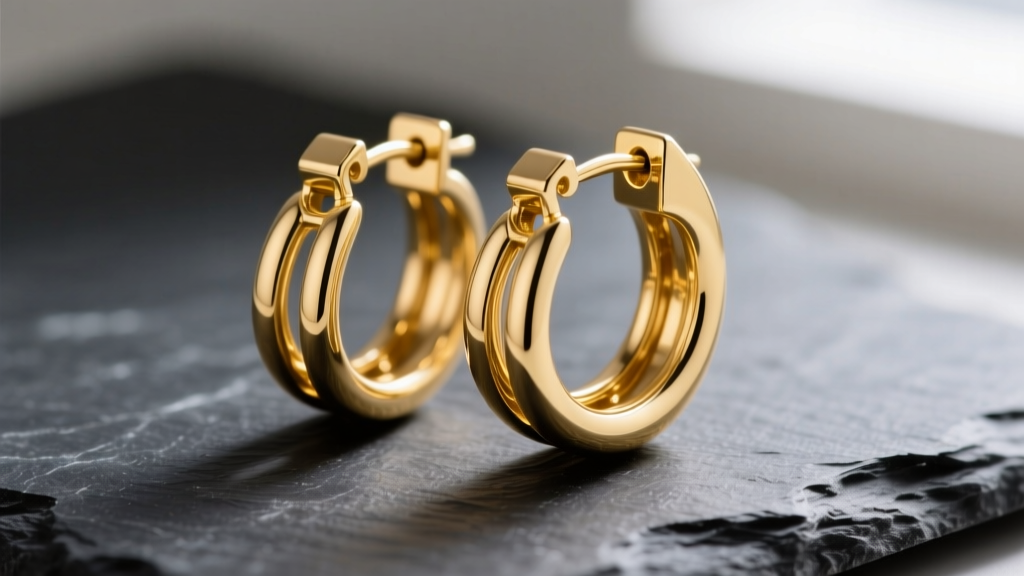
The Anatomy of a Triple Hoop Earring
When curating a sophisticated ear stack, a triple hoop earring offers maximum visual impact while requiring only a single piercing. In 2026, these statement pieces have evolved beyond simple layered dangles. Today, the market is dominated by two distinct structural designs: the concentric nested hoop and the triple-drop chain. Concentric nested hoops feature three rings of varying diameters (typically 8mm, 10mm, and 12mm) that share a single hinge or post, creating a seamless, tunnel-like illusion. Triple-drop designs, conversely, utilize a single top stud or huggie with a delicate chain linking two additional free-hanging hoops.
While visually striking, the structural complexity of a triple hoop earring introduces unique mechanical stresses. The proximity of the rings means they constantly rub against one another, making material hardness and clasp integrity critical factors in your purchasing decision. Choosing the wrong gauge or metal grade can lead to rapid wear, skin irritation, or hardware failure.
Gauge and Sizing: The Make-or-Break Metrics
The most common mistake buyers make is selecting a triple hoop based solely on its outer aesthetic, ignoring the wire thickness (gauge) and inner diameter (ID). Because triple hoops inherently carry more weight than single rings, the gauge must be thick enough to prevent the 'cheese-cutter effect'—a phenomenon where thin wire slowly migrates through the piercing fistula under the weight of the jewelry.
For standard earlobe piercings, a 20-gauge (0.81mm) or 18-gauge (1.0mm) wire is standard. However, if you are placing a triple hoop in a cartilage piercing (like the helix or tragus), you must size up to 16-gauge (1.29mm) or even 14-gauge (1.6mm) to ensure tissue stability.
| Gauge Size | Wire Thickness | Recommended Inner Diameter (ID) | Best Placement | Weight Tolerance |
|---|---|---|---|---|
| 20G | 0.81mm | 8mm - 10mm | Standard Lobe (Secondary/Tertiary) | Low (Under 2.5g) |
| 18G | 1.02mm | 10mm - 12mm | Primary Lobe / Thick Helix | Medium (Up to 4g) |
| 16G | 1.29mm | 10mm - 14mm | Helix, Tragus, Flat | High (4g - 6g) |
| 14G | 1.63mm | 12mm+ | Daith, Rook, Industrial Anchor | Very High (6g+) |
Material Grades: Hypoallergenic Must-Haves
The friction between the three concentric rings of a triple hoop earring generates micro-abrasions on the metal surface. If you purchase gold-plated or gold-filled jewelry, this constant friction will rapidly wear away the outer layer, exposing the base metal (often brass or nickel) to your skin and the elements.
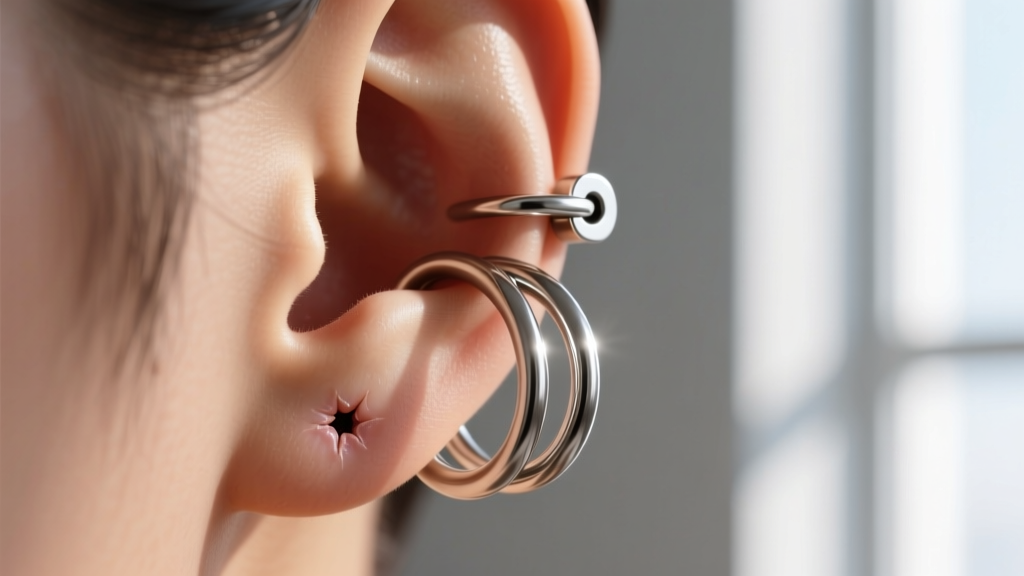
To avoid contact dermatitis, the American Academy of Dermatology strongly recommends avoiding nickel-containing alloys. For a triple hoop, your only safe bets are:
- ASTM F136 Implant-Grade Titanium: The gold standard for cartilage piercings. It is completely nickel-free, highly polished, and resistant to the galvanic corrosion caused by sweat and friction.
- Solid 14k or 18k Gold: Ensure it is solid, not plated. 14k gold offers a better balance of durability and color, as the alloyed metals (like copper and silver) provide the structural rigidity needed to keep the nested hoops from bending out of shape.
- Niobium: A highly reactive metal that is anodized to create vibrant colors without using paints or platings that could chip off during ring-on-ring friction.
Lobe vs. Cartilage: Placement and Hardware Stress
Gravity affects a triple hoop earring differently depending on its placement. In a standard earlobe piercing, the tissue is soft and pliable. A heavy triple nested hoop (weighing 3 to 5 grams) can cause the piercing hole to elongate or migrate downward over time if worn 24/7. For lobe placements, opt for lighter, hollow-core tubing designs or smaller 8mm/10mm/12mm nested huggies that sit flush against the ear.
Cartilage, on the other hand, is rigid but prone to irritation bumps if the jewelry angle is incorrect. The Association of Professional Piercers (APP) notes that cartilage piercings require jewelry that accommodates the natural swelling and angle of the fistula. If your triple hoop has a fixed, rigid post rather than a hinged hoop, it may put torque on a helix piercing, leading to chronic inflammation. Always choose hinged hoops or flexible chain-link triple drops for cartilage to allow the jewelry to move naturally with your ear's anatomy.
Clasp Mechanisms and Failure Modes
The clasp is the weakest point of any multi-ring earring. Understanding the failure modes of different clasp types will save you from losing an expensive piece of jewelry.
Hinged Segment (Clicker)
This is the premier choice for triple nested hoops. A tiny, precision-machined pin snaps into a receiving tube with an audible 'click.' Failure Mode: The pin can bend if you force the hoop open laterally rather than hinging it vertically. Over time, skin oils and soap scum can build up in the receiving tube, preventing a secure snap. Clean the hinge monthly with isopropyl alcohol.
Continuous (Endless) Hoop
Features a thin wire that bends and inserts into a hollow tube. Failure Mode: While great for single rings, continuous hoops are a nightmare for triple nested designs. Aligning three separate wires into three separate receiving tubes simultaneously without bending the wires is nearly impossible. Avoid endless clasps for concentric triple hoops.
Latch-Back (Saddleback)
Common in larger vintage-style hoops. Failure Mode: The tension wire frequently catches on hair and sweaters. Because triple hoops present three times the surface area for snagging, latch-backs are highly discouraged for active wearers.
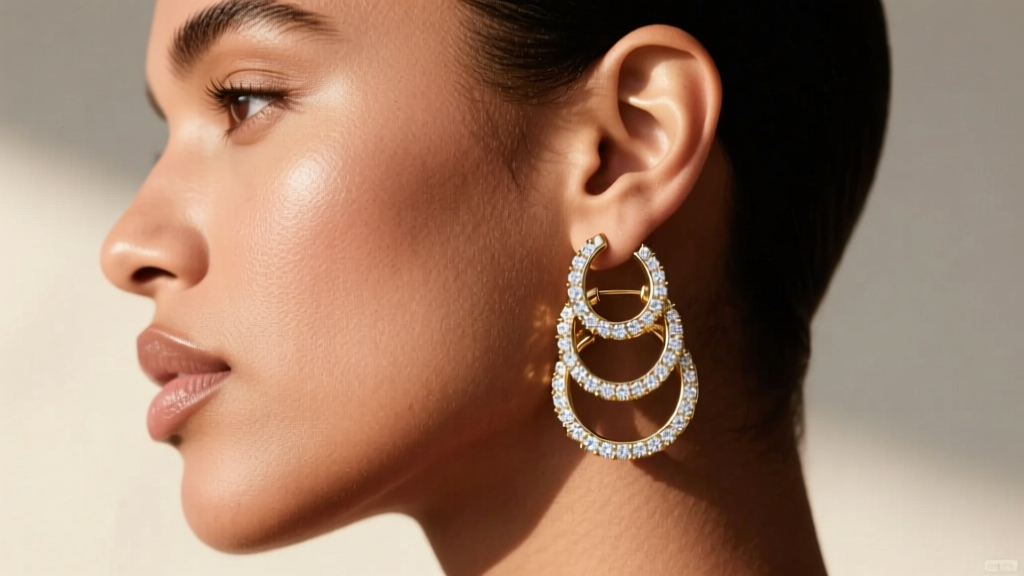
2026 Pricing Tiers and Brand Benchmarks
When budgeting for a high-quality triple hoop earring, pricing is heavily dictated by material weight and manufacturing precision. Machining three perfectly aligned hinges requires advanced jewelry fabrication techniques.
- Budget Tier ($25 - $60): Typically PVD-coated surgical steel or brass. Acceptable for occasional lobe wear, but expect the PVD coating to wear off at the friction points within 6 to 12 months.
- Mid-Tier ($80 - $250): Solid 14k gold huggies or ASTM F136 titanium with anodized accents. Brands in this tier use precision CNC-machined hinges that will last a lifetime with proper care.
- Luxury Tier ($400 - $1,200+): 18k solid gold with pave diamond accents or custom threadless ends. At this price point, you are paying for the gem-setting labor and the premium weight of high-karat gold.
Final Fit Checklist Before You Buy
Before adding a triple hoop earring to your cart, run through this rapid diagnostic checklist to ensure a perfect, pain-free fit:
- Verify your piercing gauge: Check with your piercer or use a caliper to measure your current jewelry. Never force a 16G triple hoop into an 18G hole.
- Measure your inner diameter needs: Use a ruler to measure the distance from your piercing hole to the edge of your ear. Add 2mm to that number to find your minimum comfortable ID.
- Check the metal stamp: Look for '14k', '18k', 'Ti-6Al-4V' (Grade 5 Titanium), or 'F136'. If it just says 'gold tone' or 'surgical steel', proceed with caution.
- Assess the gap spacing: If buying nested hoops, ensure there is at least a 1.5mm gap between the rings. Anything tighter will trap dead skin and moisture, leading to localized irritation.
By prioritizing structural integrity, biocompatible materials, and precise sizing, your triple hoop earring will remain a secure, stunning focal point of your ear curation for years to come.


