Beaded Black Earrings: The Ultimate 2026 Buying Guide
Discover how to choose the perfect beaded black earrings in 2026. Compare onyx, jet, and glass beads, check wire gauges, and find your ideal pair.

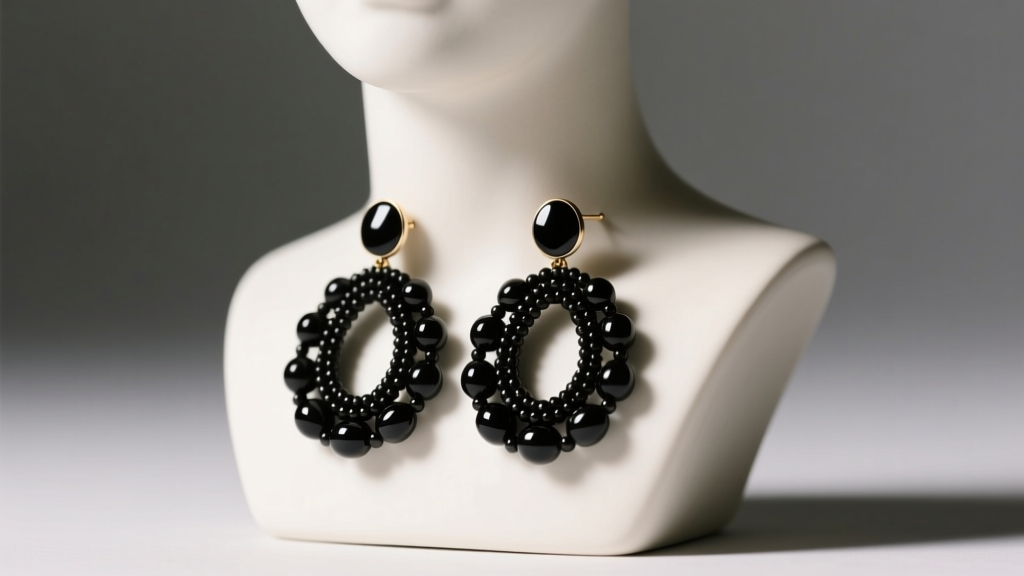
The Renaissance of Dark Aesthetics: Why Beaded Black Earrings?
In 2026, the jewelry market has seen a massive resurgence in dark academia, gothic minimalism, and avant-garde evening wear. At the center of this movement are beaded black earrings. Unlike metallic hoops or diamond studs, black beaded silhouettes offer a unique interplay of texture, light absorption, and architectural drape. However, not all dark beads are created equal. The market is flooded with dyed agates masquerading as precious stones, fragile organic gems, and poorly weighted hardware that ruins earlobes over time. This comprehensive buying guide will teach you how to evaluate material integrity, hardware mechanics, and structural weight before you invest in your next pair.
Decoding the Beads: Onyx, Jet, Glass, and Seed Beads
The term "black bead" is a massive umbrella. To make an informed purchase, you must understand the geological and synthetic origins of the materials used in high-end and artisan jewelry.
1. Black Onyx (and the Dyed Agate Reality)
True, naturally occurring black onyx is incredibly rare. According to the Gemological Institute of America (GIA), the vast majority of commercial "black onyx" is actually gray or white banded agate that has been treated with heat and a sugar-sulfuric acid solution to turn it permanently black. While this treatment is stable and accepted in the gem trade, it means you are paying for treated agate, not a rare black gemstone. Dyed agate is heavy, cool to the touch, and highly durable, making it ideal for structured drop earrings.
2. Jet: The Organic Lightweight
Jet is a fossilized wood (a type of lignite coal) that was wildly popular in Victorian mourning jewelry. It is incredibly lightweight, making it perfect for oversized, dramatic beaded black earrings that won't stretch your lobes. However, jet is soft and porous. It can easily be scratched by harder materials and will degrade if exposed to harsh chemicals or prolonged heat.
3. Lampwork and Murano Glass
For artisan buyers, black lampwork glass beads offer unmatched depth. Artisans often encase black glass in clear layers or add silver leaf inclusions that catch the light. Glass is heavier than jet but more scratch-resistant than acrylic. It is the gold standard for colorful, yet dark, statement pieces.
4. Miyuki and Toho Seed Beads
For fringe and dangle styles, Japanese seed beads (specifically Miyuki Delica or Toho Treasures) are the industry standard. Unlike cheap, irregular Chinese seed beads, Miyuki Delicas are cylindrical and uniform in size. A size 11/0 (approx. 1.6mm) black seed bead fringe offers a fluid, silk-like drape, while an 8/0 (approx. 3mm) creates a heavier, more textured tassel.
Material Comparison Chart
| Material | Mohs Hardness | Weight Profile | Price Range (Per Pair) | Best Earring Style |
|---|---|---|---|---|
| Treated Black Onyx | 7.0 | Heavy | $45 - $150 | Structured Drops, Studs |
| Whitby Jet | 2.5 - 4.0 | Very Light | $80 - $300+ | Oversized Hoops, Carved Dangles |
| Lampwork Glass | 5.5 - 6.5 | Medium-Heavy | $30 - $120 | Artisan Drops, Huggies |
| Miyuki Seed Beads | N/A (Glass) | Light | $25 - $90 | Fringe, Tassels, Chandeliers |
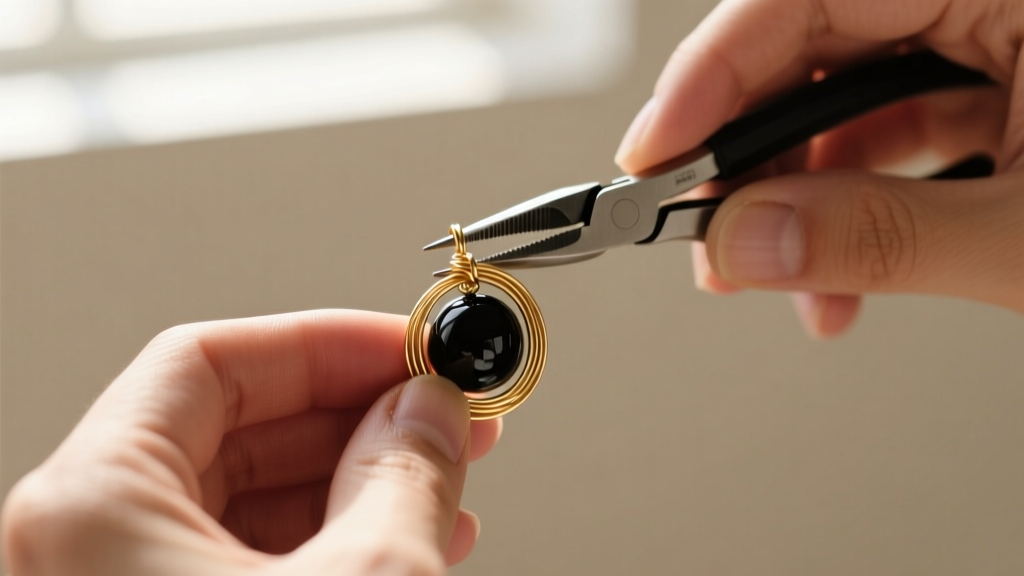
Hardware & Wire Wrapping: The Anatomy of Durability
A beautiful black bead is useless if the hardware fails. When evaluating beaded black earrings, inspect the wire wrapping and headpins. Heavy stone beads require robust structural support to prevent the bead from snapping the wire and falling out.
Headpin Gauges Matter
The wire that runs through the bead (the headpin) must be thick enough to support the bead's weight without bending.
- 24-Gauge (0.51mm): Too soft for heavy onyx or glass. Only suitable for lightweight seed bead tassels or tiny 4mm jet beads.
- 22-Gauge (0.64mm): The sweet spot for most medium-weight lampwork glass and standard onyx drops. It fits through most bead holes while providing structural rigidity.
- 20-Gauge (0.81mm): Required for large, heavy statement beads. Note that many cheap, mass-produced beads have drill holes too small for 20-gauge wire, so artisans must specially source large-hole beads.
The Wrapped Loop vs. Simple Loop
Look closely at the top of the bead where the wire forms a loop to attach to the ear wire. A "simple loop" (just bending the wire into a circle) will eventually pull open under the weight of a swinging bead, causing you to lose the earring. High-quality artisan earrings will feature a wrapped loop, where the wire is tightly coiled around the stem two or three times before forming the loop. This mechanically locks the bead in place.
Weight Distribution & Lobe Health
Black onyx and solid glass are dense materials. A pair of 2-inch solid onyx drop earrings can easily weigh 15 to 20 grams per ear. Over time, this constant downward pull will stretch the earlobe piercing, leading to a permanent droop or even a blowout.
What to look for: If you love the look of heavy black beads but want to protect your lobes, seek out earrings that feature a leverback clasp rather than a standard French hook. Leverbacks enclose the wire, distributing the weight more evenly across the back of the lobe. Additionally, look for designs that incorporate a lightweight metal chain or a hollow acrylic spacer bead between the ear wire and the heavy stone to shift the center of gravity closer to the ear.
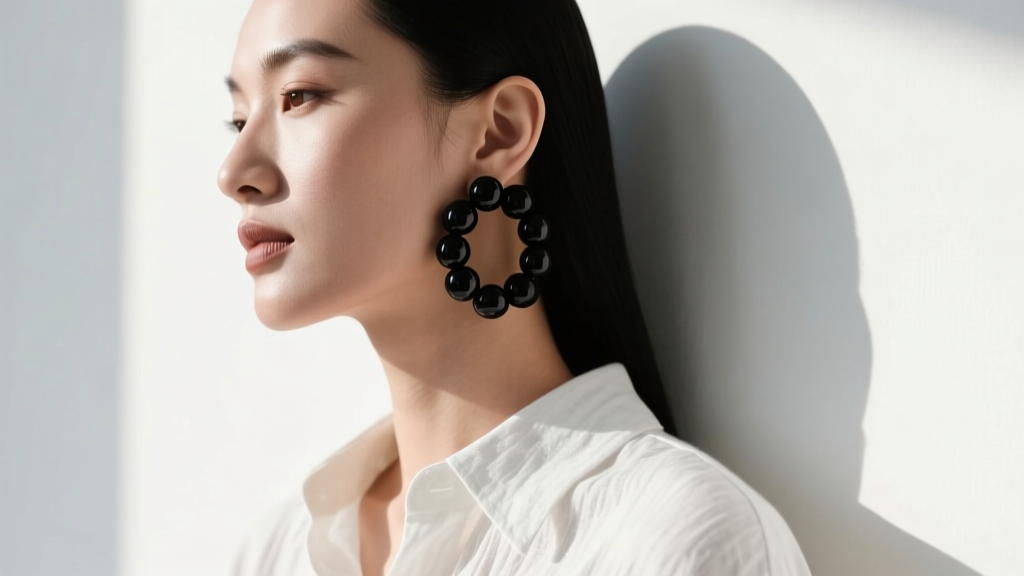
Styling Framework: Face Shapes & Bead Proportions
Black beads absorb light, which means they create stark, high-contrast silhouettes against the skin. Choosing the right shape is critical for facial balancing.
Expert Styling Rule: Because black beads lack the light-reflecting facets of crystals, their physical outline does the heavy lifting. Always contrast the bead's geometry with your face shape.
- Round Faces: Avoid chunky, round black bead hoops, which will emphasize facial width. Instead, opt for long, linear black seed bead fringe or elongated onyx teardrops to create a vertical elongating effect.
- Angular/Square Faces: Soften sharp jawlines with round, spherical black lampwork glass beads or curved jet huggies. The organic curves of the beads will contrast beautifully with sharp bone structure.
- Heart-Shaped Faces: Look for chandelier-style beaded earrings that are wider at the bottom than the top. A triangular arrangement of black onyx and silver beads will balance a narrower chin.
Pricing Tiers: What Should You Pay in 2026?
Understanding the fair market value of beaded black earrings prevents you from overpaying for synthetic materials or underpaying for suspiciously cheap "gemstones."
- Tier 1: Fast Fashion & Acrylic ($12 - $30): Mass-produced, often using dyed plastic or resin beads with base-metal hardware (brass or copper). Expect tarnishing and scratched beads within a few months.
- Tier 2: Artisan & Handmade ($40 - $120): The sweet spot for quality. You will find genuine lampwork glass, high-quality Miyuki seed bead weaving, and 14k gold-filled or sterling silver wire wrapping. These pieces offer excellent durability and unique designs.
- Tier 3: Fine Jewelry & Antique ($150 - $500+): Features genuine Whitby Jet, rare untreated black spinel, or high-grade onyx set in solid 14k/18k gold. Antique Victorian jet earrings also fall into this tier and hold historical collector value.
Care & Maintenance for Dark Beads
Maintaining the deep, rich black color of your earrings requires specific care protocols based on the material.
For Treated Onyx and Glass: These are highly durable. You can clean them with warm water, a drop of mild dish soap, and a soft microfiber cloth. Avoid ultrasonic cleaners if the beads have internal fractures, as the vibrations can cause them to shatter.
For Jet and Organic Beads: Never use chemical jewelry dips, alcohol, or perfume near jet. As noted by the GIA's gem encyclopedia, jet is porous and will absorb chemicals, leading to a dull, chalky finish. Simply wipe jet beads with a dry, soft cloth after wearing to remove skin oils.
For Seed Bead Fringe: Store fringe earrings hanging up or laid perfectly flat in a velvet-lined box. If you toss them into a jewelry dish, the nylon or silk thread used to string the beads will kink, permanently ruining the fluid drape of the black tassels.
By scrutinizing the bead origin, verifying the wire gauge, and matching the silhouette to your anatomy, you can confidently invest in beaded black earrings that are as structurally sound as they are visually striking.


