Gold Triangle Earrings: Troubleshooting Snags, Droop & Care
Fix common issues with gold triangle earrings. Learn how to stop geometric droop, prevent sharp vertex snags, and choose the right gold karat.

The Geometry Problem: Why Gold Triangle Earrings Fail
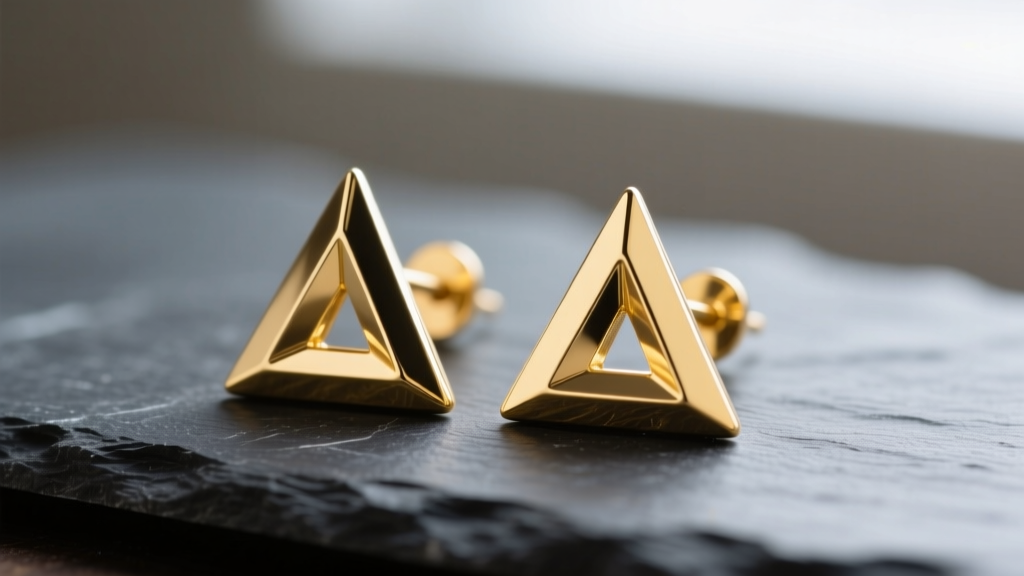
Geometric jewelry has dominated the accessory market for the last decade, but gold triangle earrings present unique structural and wearability challenges that standard round or oval studs simply do not face. Whether you are dealing with a pair of delicate 14k gold lobe studs or heavy 18k gold cartilage threadless ends, the sharp angles and uneven weight distribution of triangular designs require specific troubleshooting. Unlike symmetrical hoops or evenly weighted pearls, triangles have a distinct center of gravity and hazardous vertices. In this comprehensive guide, we break down the exact physics, metallurgy, and styling fixes needed to keep your geometric earrings sitting perfectly and safely.
Issue 1: The Inverted Triangle Droop
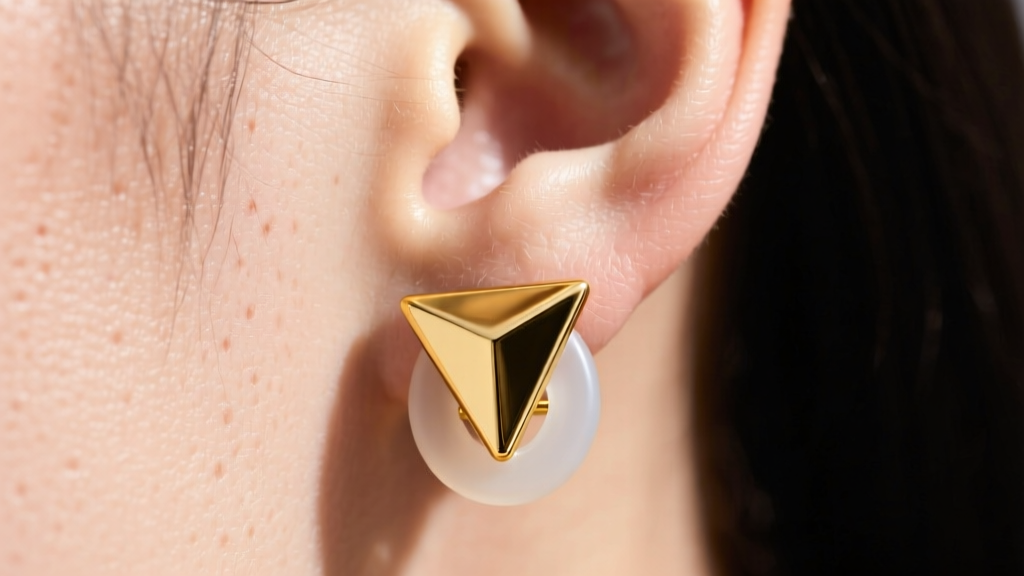
The most frequent complaint regarding gold triangle earrings is the "forward droop." This occurs when the earring is oriented as an inverted triangle (point facing up, heavy base facing down). Because the bulk of the metal's mass sits below the piercing hole, gravity pulls the heavy base forward, causing the top point to tilt backward and poke the skin behind the earlobe. This is a simple physics issue related to the fulcrum point of the earring post.
Troubleshooting Fixes:
- Silicone O-Rings: Swap standard metal butterfly backs for thick silicone O-rings (like those from Bling Thing). The high-friction grip prevents the post from rotating downward.
- Ear-Lifting Patches: For heavy 18k solid gold designs, use adhesive earlobe support patches (such as Chrysm Earlift). These clear medical-grade tapes adhere to the back of the earlobe, providing a rigid scaffold that physically blocks the earring from drooping.
- Hollow-Cast Alternatives: If the droop is unmanageable, consider switching to electroformed or hollow-cast gold triangle earrings, which reduce the overall weight by up to 60% while maintaining the exact same visual volume.
Issue 2: Vertex Snagging and Fabric Damage
Sharp geometric angles are the enemy of delicate fabrics and loose hair. A standard gold triangle earring features vertices cut at 45 to 60-degree angles. These points act as micro-hooks that easily catch on cashmere sweaters, silk blouses, and fine hair, leading to ruined garments and painful earlobe tugs.
To solve this, you must look for micro-chamfered edges. High-end jewelers will slightly bevel or round the sharp outer edges of the triangle without altering the overall geometric silhouette. If you already own a pair of razor-sharp gold triangle earrings, a professional jeweler can use a polishing wheel with a soft muslin buff and a mild rouge compound to gently soften the vertices. Never attempt to file gold jewelry at home, as you risk removing the rhodium plating (if white gold) or creating deep, irreversible gouges in the metal.
Material and Gauge Troubleshooting Matrix
Not all gold is created equal, and the structural integrity of your earring depends heavily on the alloy mix and the thickness of the post. Use this matrix to diagnose and fix material failures.
| Symptom | Root Cause | Ideal Spec | Quick Fix |
|---|---|---|---|
| Post bends easily | Gold karat too high (soft) | 14k Gold (HV 140-160) | Have a jeweler solder a steel or platinum core inside the post. |
| Earring falls out | Post gauge too thin (20G+) | 18G (1.02mm) or 16G (1.29mm) | Use a silicone friction back or upgrade to a threaded post. |
| White gold turns yellow | Rhodium plating wearing off | Solid 14k Yellow or Rose Gold | Re-plate with rhodium every 12-18 months. |
| Skin irritation/green tint | Copper/Nickel alloy reaction | 14k+ Palladium White or 18k+ Yellow | Switch to nickel-free alloys or implant-grade titanium posts. |
Advanced Fixes for Lobe Strain and Post Bending
When discussing gold triangle earrings, we must address the metallurgy of the post itself. According to the Gemological Institute of America (GIA), pure 24k gold is far too soft for jewelry that undergoes lateral stress, possessing a Vickers Hardness (HV) of merely 25. Even 18k gold (75% pure gold, alloyed with copper and silver) only reaches an HV of about 125. While 18k gold is excellent for the visible face of the earring, it is highly prone to bending when used for thin posts.
According to the Association of Professional Piercers (APP), jewelry weight and gauge thickness must be proportionate to the piercing site to prevent migration and tissue tearing. For heavy geometric shapes, a minimum of 18-gauge thickness is recommended to distribute pressure evenly across the fistula.
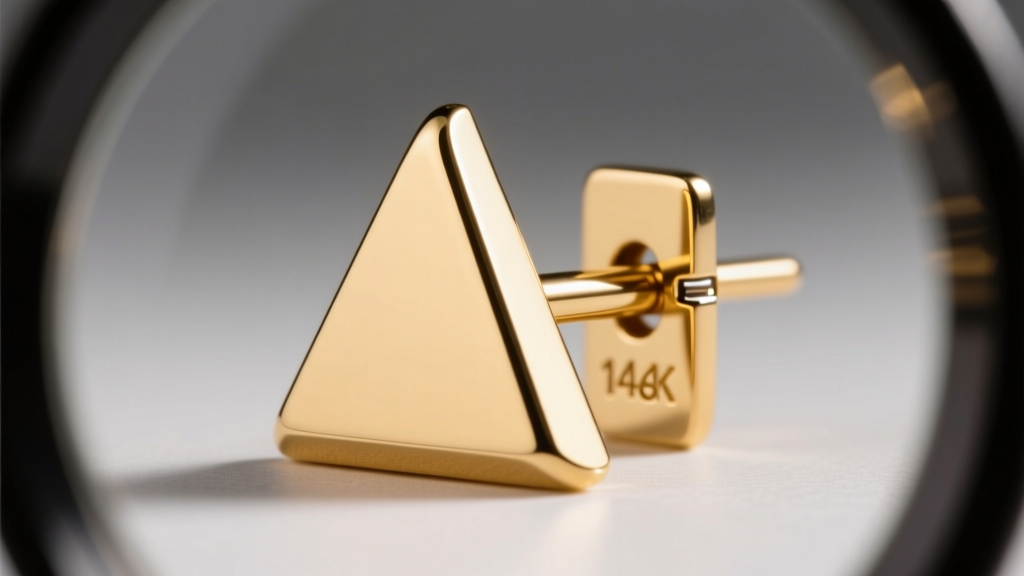
If your gold triangle earrings feature a standard 20-gauge (0.81mm) 18k post, it will almost certainly bend when putting on or taking off winter clothing. The ultimate troubleshooting fix is to request an 18-gauge 14k gold post replacement from your jeweler. 14k gold contains more alloy metals (like zinc and copper), pushing its hardness up to 160 HV, making it vastly superior for structural posts. For internal threading, ensure the post is at least 16-gauge to accommodate the threaded screw mechanism without compromising the metal's integrity.
Cartilage vs. Lobe: Placement Strategies for Triangles
The location of your piercing drastically changes how a triangle earring behaves. In the earlobe, gravity is the primary enemy. In the cartilage (helix, flat, or conch), the angle of the piercing channel dictates the earring's orientation.
For cartilage piercings, gold triangle earrings should ideally be mounted on threadless (press-fit) ends rather than traditional friction posts. Threadless ends use a slightly bent pin that creates tension inside the hollow post, locking the heavy triangle securely in place. This prevents the earring from spinning in the cartilage channel, which is a common issue that can lead to irritation bumps (hypertrophic scarring). If you are wearing a triangle in a flat piercing, opt for an equilateral triangle design rather than an elongated isosceles shape, as the wider base provides better visual balance against the broader canvas of the upper ear.
Maintenance: Polishing Angular Gold Without Ruining Edges
Maintaining the mirror finish of gold triangle earrings requires a delicate touch. The biggest mistake owners make is using rotary polishing tools (like a Dremel) or stiff-bristled polishing brushes. These tools will aggressively round off the sharp geometric vertices, turning a crisp triangle into a soft, undefined blob.
Proper Cleaning Protocol:
- Ultrasonic Cleaning: Safe for solid gold triangles without gemstones. Use a mild ammonia-free jewelry solution for exactly 3 minutes to dislodge sebum and skin cells from the sharp inner corners.
- Manual Polishing: Use a treated, non-abrasive jeweler's cloth (such as a Sunshine cloth). Fold the cloth to create a sharp edge, and gently run it along the vertices in one direction. This preserves the crisp 45-degree angles while removing oxidation and fingerprints.
- Storage: Never store gold triangle earrings loose in a jewelry box. The sharp points will scratch softer pieces, and the points themselves can become blunted against harder gemstones like diamonds or sapphires. Store them individually in soft flannel pouches.
Final Verdict
Gold triangle earrings are a bold, architectural statement, but they demand more mechanical consideration than traditional jewelry. By understanding the center of gravity, opting for 14k gold posts in 18-gauge thicknesses, and utilizing silicone friction backs, you can completely eliminate the common frustrations of drooping and snagging. Treat your geometric jewelry with the structural respect it requires, and it will maintain its crisp, modern aesthetic for a lifetime.


