Troubleshooting & Repairing Mother of Pearl Hoop Earrings
Learn how to fix dullness, peeling inlays, and clasp issues on mother of pearl hoop earrings with expert troubleshooting and care tips.

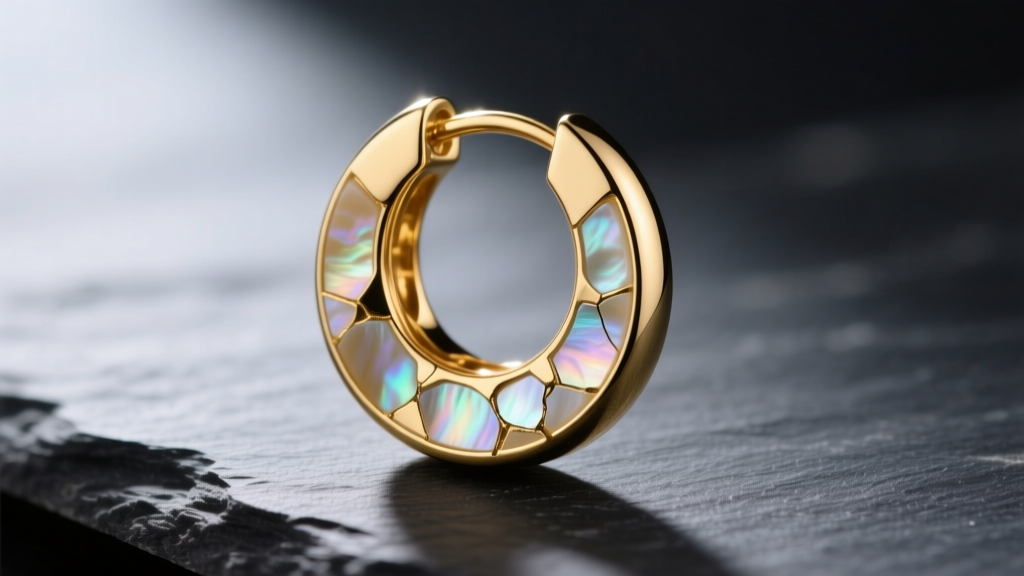
The Vulnerability of Nacre: Why Mother of Pearl Hoops Fail
Mother of pearl, scientifically known as nacre, is a mesmerizing organic-inorganic composite material produced by mollusks. It consists of microscopic hexagonal platelets of aragonite (a form of calcium carbonate) glued together by flexible biopolymers like conchiolin. While this structure gives nacre its signature iridescent luster, it also dictates a Mohs hardness of just 2.5 to 4.5. When crafted into mother of pearl hoop earrings, this relative softness and structural vulnerability are magnified by the very nature of the hoop silhouette.
Unlike studs that sit flush against the earlobe, hoops act as pendulums. Every time you turn your head, walk, or brush your hair, the hoop swings, creating micro-impacts against your neck, clothing, and the metal itself. Over time, this kinetic stress leads to three primary failure modes in mother of pearl hoop earrings: surface dulling and etching, adhesive failure resulting in peeling inlays, and structural warping of the hoop wire or clasp. In this comprehensive troubleshooting guide, we will diagnose these specific issues and provide actionable, professional-grade repair and maintenance frameworks to restore your earrings to their original brilliance.
Troubleshooting Dullness and Discoloration
The most common complaint among wearers of mother of pearl hoop earrings is a gradual loss of iridescence, leaving the shell looking chalky, yellowed, or dull. This is rarely a defect in the stone itself; rather, it is a chemical reaction. The conchiolin protein matrix that binds the aragonite platelets is highly porous and susceptible to acidic degradation. Human sweat, which has a pH ranging from 4.5 to 7.0, along with the alkaline compounds found in hairsprays, perfumes, and lotions, will slowly dissolve the microscopic top layers of the nacre.
The Cleaning Matrix: What to Use and Avoid
To troubleshoot dullness, you must first halt any ongoing chemical etching and then gently polish the surface without removing the delicate nacre layers. Never use ultrasonic cleaners, as the high-frequency cavitation bubbles will shatter the aragonite platelets. Similarly, avoid any commercial silver dips or ammonia-based cleaners. According to the Gemological Institute of America (GIA), pearls and nacre require strictly neutral, non-abrasive cleaning agents.
| Cleaning Agent | Effect on Nacre | Verdict |
|---|---|---|
| Ultrasonic Cleaners | Causes micro-fractures and delamination of the shell layers. | NEVER USE |
| Ammonia / Silver Dip | Strips the conchiolin protein, causing permanent chalkiness. | NEVER USE |
| Steam Cleaners | Thermal shock can crack the shell and melt inlay adhesives. | NEVER USE |
| Mild Castile Soap | Neutral pH safely lifts oils without degrading the shell. | SAFE TO USE |
| Distilled Water | Prevents mineral deposits from tap water clouding the surface. | SAFE TO USE |
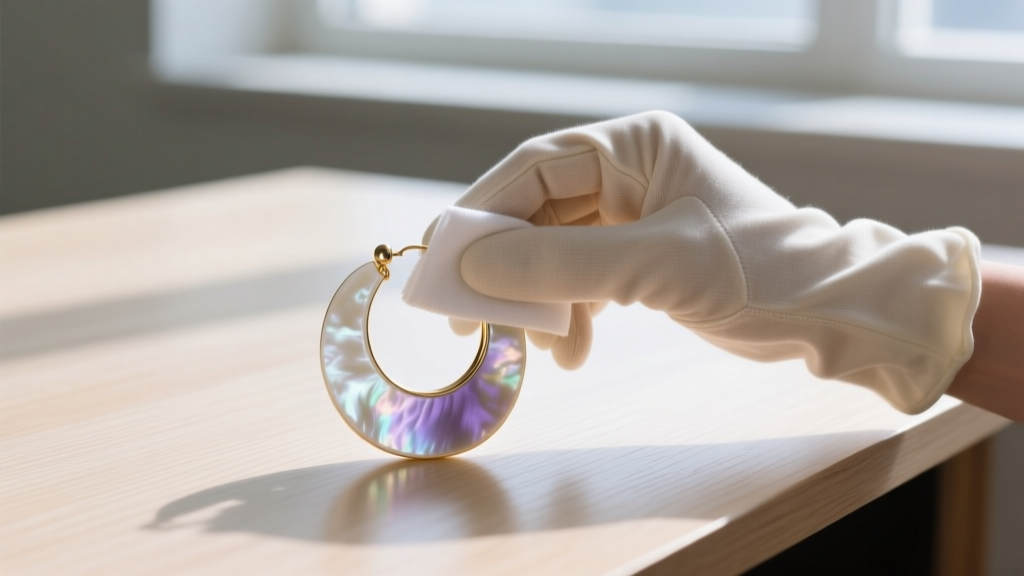
Actionable Fix: Mix two drops of pH-neutral liquid Castile soap into a bowl of distilled water. Dampen a lint-free microfiber cloth (never submerge the earrings, especially if they are inlaid, as water can seep under the shell and weaken the glue). Gently wipe the mother of pearl in a single direction. Dry immediately with a separate soft cloth. If the dullness persists, the nacre may be permanently etched, requiring a professional lapidary to lightly buff the surface with a specialized tin oxide polishing compound.
Fixing Peeling or Loose Shell Inlays
The vast majority of mother of pearl hoop earrings on the market are not carved from solid blocks of shell; instead, they feature thin veneers of nacre inlaid into a metal channel or glued onto a flat metal backing. The pendulum motion of hoops, combined with temperature fluctuations, causes the metal and the shell to expand and contract at different rates. This thermal and kinetic stress eventually breaks down the adhesive bond, causing the shell to lift, rattle, or fall out entirely.
Adhesive Selection and Application
A common amateur mistake is reaching for cyanoacrylate (Super Glue) to reattach a loose inlay. Cyanoacrylate is notorious for "blooming"—releasing a white, cloudy vapor as it cures that will permanently frost the surface of the mother of pearl. Furthermore, it cures brittle, meaning it will shatter under the flexing stress of a hoop earring. Expert jewelers and conservators, as noted in technical guides on Ganoksin, rely on specific flexible adhesives for organic materials.
- Two-Part Jeweler's Epoxy: Best for deep channels or heavy, thick shell segments. It provides a rigid but incredibly strong bond. Choose a 5-minute set time to allow for precise positioning.
- G-S Hypo Cement: Best for ultra-thin shell veneers. It features a fine needle applicator, dries clear, and retains a slight flexibility that absorbs the shock of the hoop swinging.
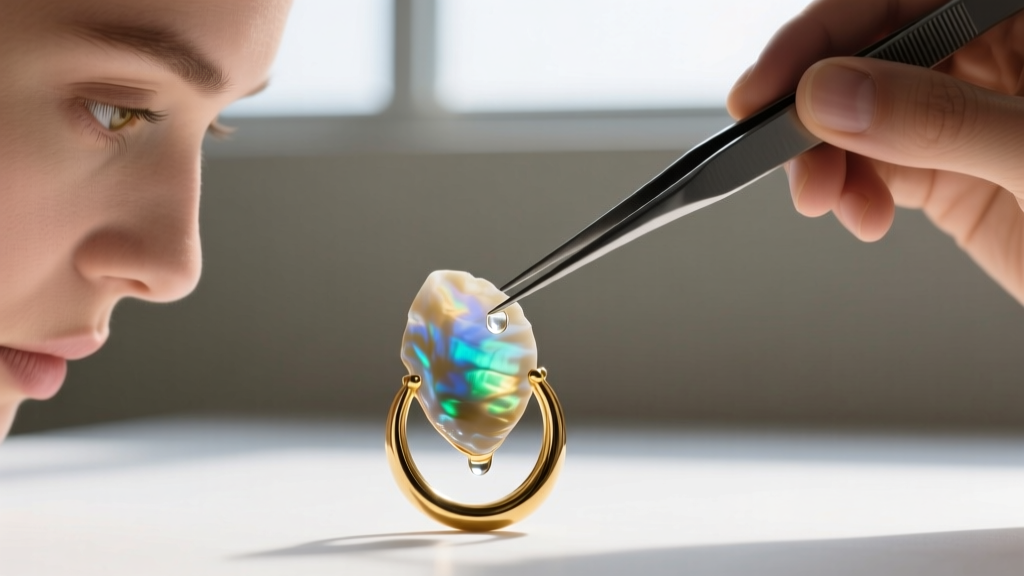
Actionable Fix: First, you must remove the old adhesive. Dip a wooden toothpick in pure acetone and carefully scrape the metal channel. Crucial Warning: Do not let acetone touch the mother of pearl, as it can strip the shell's natural oils and cause micro-cracking. Once the metal is clean and roughed up slightly with a fiberglass scratch pen, apply a microscopic bead of G-S Hypo Cement to the metal. Use a silicone-tipped tool or wooden skewer to press the shell into place. Wipe away any squeeze-out immediately with a dry cotton swab. Clamp lightly using a silicone mold or binder clip padded with felt, and let it cure undisturbed for 24 hours.
Structural Hoop Issues: Wire Gauge and Clasp Tension
Mother of pearl is surprisingly dense. A pair of solid, medium-sized MOP hoop earrings can easily weigh between 8 to 15 grams per earring. When this weight is suspended from a thin wire hoop, it creates a severe downward vector that pulls on the earlobe and warps the metal circle into an oval shape. This not only ruins the aesthetic of the hoop but also compromises the structural integrity of the clasp mechanism.
Wire Gauge vs. MOP Weight Capacity
If your mother of pearl hoop earrings are constantly bending out of shape or tearing your earlobes, the manufacturer likely used an inadequate wire gauge to save on precious metal costs. You must evaluate the wire thickness to troubleshoot this structural failure.
| Wire Gauge | Diameter (mm) | Max Recommended MOP Weight | Troubleshooting Notes |
|---|---|---|---|
| 22-Gauge | 0.64mm | Under 3 grams | Too thin for most MOP hoops; will warp easily and cause earlobe sagging. |
| 20-Gauge | 0.81mm | 3 to 6 grams | Standard for lightweight, hollow-shell inlay hoops. Prone to bending if dropped. |
| 18-Gauge | 1.02mm | 6 to 12 grams | Ideal for solid carved MOP hoops. Provides necessary rigidity and ear support. |
| 16-Gauge | 1.29mm | 12+ grams | Required for oversized, heavy statement hoops. May require stretched piercings. |
Actionable Fix: If your 20-gauge hoops have warped into an oval, you can gently reshape them by rolling the metal (avoiding the shell) on a steel ring mandrel using a rawhide or nylon-jaw mallet. However, if the metal repeatedly warps during wear, the only permanent solution is to take them to a bench jeweler to have the hoop wire completely replaced with an 18-gauge or 16-gauge wire, or to add a supportive silicone earlobe backing (like an invisible ear support patch) to distribute the weight across a wider area of the ear.
Diagnosing Clasp and Hinge Failures on Huggie-Style Hoops
Many modern mother of pearl hoop earrings utilize a "huggie" design with a hinged snapback clasp. The heavy weight of the shell segments can cause the tiny tension pin inside the clasp to bend or compress, resulting in a clasp that refuses to click shut or pops open unexpectedly during wear.
Actionable Fix: Inspect the male pin and the female catch under a 10x jeweler's loupe. If the pin is bent, do not use standard steel pliers, which will mar the gold or silver finish. Instead, use nylon-jaw pliers to gently bend the pin back to a perfect 90-degree angle. If the clasp still feels loose, the metal catch may have stretched. Use a steel burnisher or the flat edge of a bezel roller to gently tap and compress the outer walls of the female catch, narrowing the opening until the pin snaps in with an audible, secure click.
Preventative Storage and Daily Wear Framework
Troubleshooting is only half the battle; preventing the degradation of mother of pearl hoop earrings requires a disciplined storage and wear protocol. Because nacre is easily scratched by harder materials (like diamond, sapphire, or even quartz dust), storing them loose in a jewelry box will result in a network of fine, dulling abrasions across the shell's surface.
Always store your MOP hoops individually in soft, anti-tarnish flannel pouches. Include a 3M anti-tarnish strip in the storage box to prevent the silver or gold alloy settings from oxidizing, which can transfer dark sulfide stains to the porous edges of the shell. Finally, adopt the "last on, first off" rule: put your mother of pearl earrings on only after your perfume, hairspray, and makeup have fully dried, and remove them immediately upon returning home, wiping them with a dry microfiber cloth before putting them away. By respecting the organic chemistry of nacre and the mechanical physics of the hoop silhouette, you can ensure your earrings remain luminous and structurally sound for decades.


