16g vs 18g Earring Sizing: Troubleshoot Fit & Healing Issues
Confused by 16g vs 18g earring sizes? Learn how to troubleshoot fit issues, prevent cartilage irritation, and choose the right gauge.

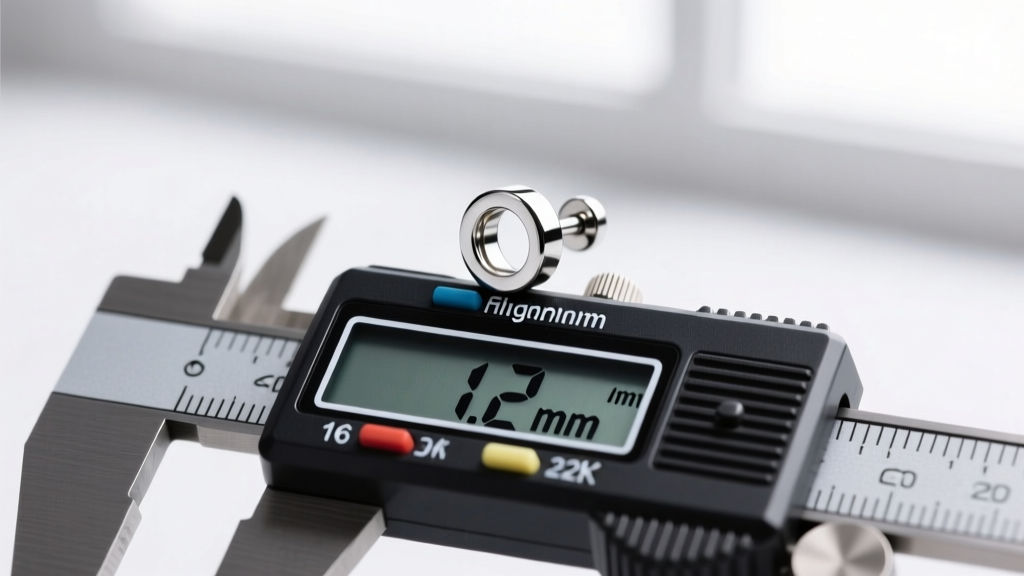
When navigating the world of body jewelry, the difference between a 16g vs 18g earring might seem like a negligible fraction of a millimeter. However, in the context of piercing biomechanics, tissue healing, and long-term wearability, that 0.2mm variance is often the dividing line between a thriving piercing and a chronic irritation nightmare. Whether you are dealing with a stubborn cartilage bump, a migrating lobe, or simply jewelry that refuses to sit flush, understanding the mechanical realities of gauge sizing is your first step toward a solution.
The Core Difference: 16g (1.2mm) vs 18g (1.0mm) Explained
To troubleshoot effectively, we must first establish the exact metrics. In the Standard Wire Gauge (SWG) system used for body jewelry:
- 18 Gauge (18g): Measures exactly 1.0mm in thickness.
- 16 Gauge (16g): Measures exactly 1.2mm in thickness.
While 0.2mm sounds trivial to the naked eye, from a structural engineering perspective, a 16g wire possesses roughly 44% more cross-sectional area than an 18g wire. This massive difference in mass directly impacts the jewelry's tensile strength, its ability to distribute weight across the fistula (the piercing channel), and its resistance to bending. When you are evaluating a 16g vs 18g earring for a specific anatomical placement, you are not just choosing a thickness; you are choosing a load-bearing capacity.
Troubleshooting Common Gauge Mismatches
Most fitting and healing complications arise when the jewelry gauge does not align with the tissue's needs or the piercing's original creation. Here is how to diagnose and solve the two most frequent gauge-related failures.
Scenario A: The 'Dead Space' Irritation Bump (18g in a 16g Hole)
The Problem: You were pierced with a 16g needle, but you inserted an 18g earring. The jewelry slides in easily, but weeks later, a hypertrophic scar (irritation bump) forms next to the exit hole.
The Biomechanics: The 0.2mm gap between the 1.0mm jewelry and the 1.2mm fistula creates a 'dead space.' This micro-movement allows the jewelry to act like a piston, constantly introducing bacteria and physical trauma into the healing channel. Furthermore, the gap traps moisture and dead skin cells, creating an anaerobic environment ripe for infection.
The Solution: Remove the 18g jewelry immediately. Cleanse the area with sterile saline and insert a high-quality 16g implant-grade titanium labret or straight barbell to eliminate the dead space and stabilize the tissue.
Scenario B: The 'Cheese Cutter' Effect (Heavy Dangles on 18g)
The Problem: You have standard 18g lobe piercings and want to wear heavy statement drops. Over time, the piercing hole elongates, migrating downward, and the tissue becomes thin and red.
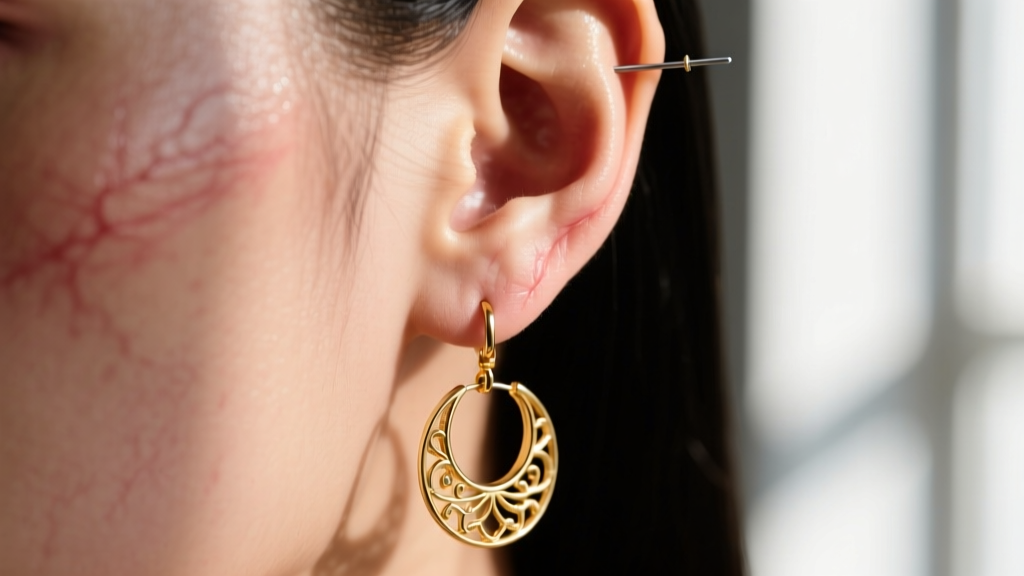
The Biomechanics: Physics dictates that Pressure = Force ÷ Area. An 18g earring provides a very small surface area (1.0mm) to distribute the weight of a heavy dangle. The resulting high localized pressure literally slices through the tissue over time, a phenomenon piercers call the 'cheese cutter effect.'
The Solution: Reserve 18g wires exclusively for lightweight studs and sleepers. If you wish to wear heavy dangles, hoops, or ear cuffs that put tension on the lobe, you must transition your piercings to 16g or even 14g (1.6mm) to distribute the load safely.
Cartilage vs. Lobe: Which Gauge Solves Your Problem?
Anatomical location dictates gauge requirements. The tissue density and blood supply vary wildly between the earlobe and the upper ear cartilage.
- Cartilage (Helix, Conch, Tragus, Forward Helix): The Association of Professional Piercers (APP) strongly recommends 16g (or 14g) as the minimum standard for cartilage. Cartilage is avascular and highly prone to irritation bumps from movement. The rigidity of a 16g titanium barbell acts as a splint, keeping the fistula perfectly straight during the 6-to-12-month healing process. Using an 18g barbell in cartilage often results in the jewelry bowing inside the tissue, leading to curved, easily irritated healing channels.
- Earlobes: Lobes are forgiving. Standard mall-shop piercings are often done at 20g or 18g. For basic, lightweight studs, 18g is perfectly functional. However, if you are planning to wear heavy hoops, chains, or gauged jewelry in the future, starting or stretching to 16g provides a much more durable foundation.
Performance Metrics: 16g vs 18g Comparison Chart
| Feature | 16 Gauge (1.2mm) | 18 Gauge (1.0mm) |
|---|---|---|
| Primary Use Case | Cartilage, heavy lobe drops, initial healing | Standard lobe studs, delicate nose screws |
| Weight Capacity | High (Resists migration and cheese-cutting) | Low (Only suitable for lightweight ends) |
| Healing Stability | Excellent (Minimal flex, reduces micro-tears) | Moderate (Flexes easily, risks irritation bumps) |
| Jewelry Availability | Massive (Standard for high-end body jewelry) | High (Common in commercial fashion jewelry) |
Material Grades and Healing Complications
Gauge size does not exist in a vacuum; it interacts directly with the material of the earring. When troubleshooting allergic reactions or contact dermatitis, the 16g vs 18g earring debate plays a surprising role.
Many commercial 18g earrings are made from 'surgical steel' (316L), which contains up to 10-14% nickel. Because an 18g wire exerts higher pressure per square millimeter against the fistula wall than a 16g wire, it drives metal ions into the tissue more aggressively. If you have a mild nickel sensitivity, an 18g steel earring is far more likely to trigger a flare-up than a thicker piece simply due to the increased localized pressure.
The Expert Fix: Regardless of whether you need 16g or 18g, abandon surgical steel for healing or irritated piercings. Upgrade to ASTM F136 Implant-Grade Titanium or Niobium. These materials are entirely nickel-free and biocompatible. For gold, ensure it is 14k or 18k solid, nickel-free, and cadmium-free, as outlined by BVLA's material education standards.
Step-by-Step Gauge Transition Guide (18g to 16g)
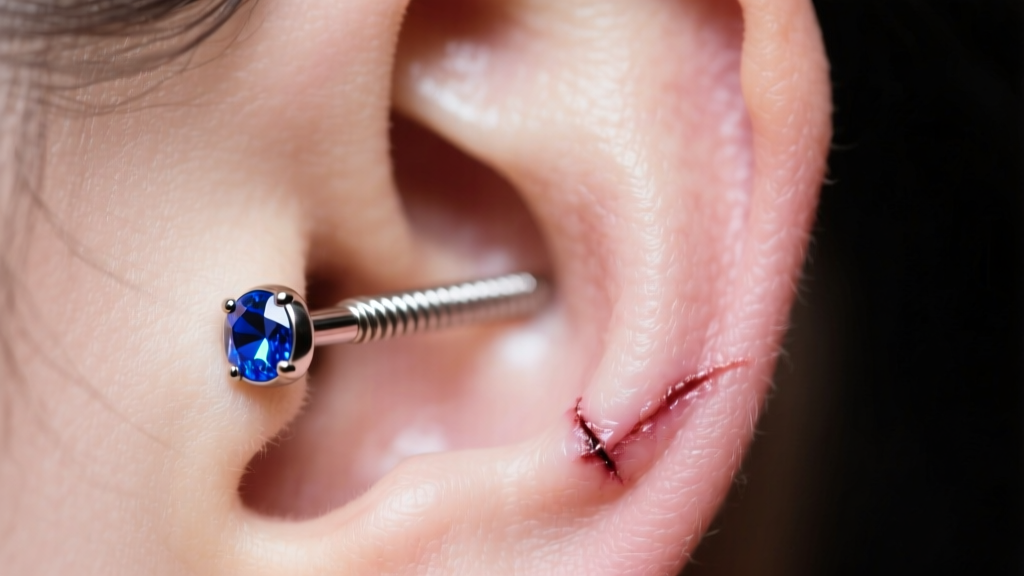
If your lobes were pierced at 18g and you want to upgrade to the superior stability and high-end jewelry options available in 16g, you must stretch the tissue safely. Do not simply force a 1.2mm earring through a 1.0mm hole, as this will cause blunt force trauma and tearing.
- Wait for Complete Healing: Ensure your 18g piercing has been fully healed for at least 6 months.
- Prepare the Tissue: Massage the earlobe with pure, cold-pressed jojoba oil or vitamin E oil for 5 minutes daily for a week to increase tissue elasticity.
- Use a Taper Pin: Purchase a sterilized, single-use 18g-to-16g insertion taper. Lubricate the taper with a water-based lubricant.
- Insert Slowly: Gently push the taper through the fistula. If you feel sharp pain or see 'white' stretching tissue (blanching), stop. The tissue needs more time to relax.
- Follow with Jewelry: Once the 1.2mm end of the taper is through, immediately follow it with a sterilized 16g titanium flat-back labret.
Expert Sourcing and Pricing Realities
When you commit to 16g for its superior healing and structural benefits, you will notice a shift in where you shop. High-end body jewelry brands like NeoMetal, Anatometal, and BVLA primarily manufacture their threadless and internally threaded ends for 16g (and 14g) posts.
Pricing Guide:
- Basic 16g Titanium Labret Post: $12 - $25
- 16g Threadless Titanium End (e.g., NeoMetal Bezel): $20 - $45
- 16g 14k Solid Gold End (e.g., BVLA): $85 - $300+
While 18g fashion earrings from mall kiosks might cost $10 for a multi-pack, investing in 16g implant-grade jewelry is an investment in the long-term health and aesthetics of your anatomy. By understanding the mechanical and biological differences between these two sizes, you can eliminate chronic irritation, prevent migration, and build a jewelry collection that fits perfectly and lasts a lifetime.
For further reading on safe healing practices and jewelry standards, always consult the APP Healing Guidelines before attempting any gauge modifications on fresh piercings.


