Solving Irritation: Good Earrings for Cartilage Piercings
Discover how to choose good earrings for cartilage piercings to solve irritation bumps, embedding, and allergies with expert metallurgy and gauge guides.

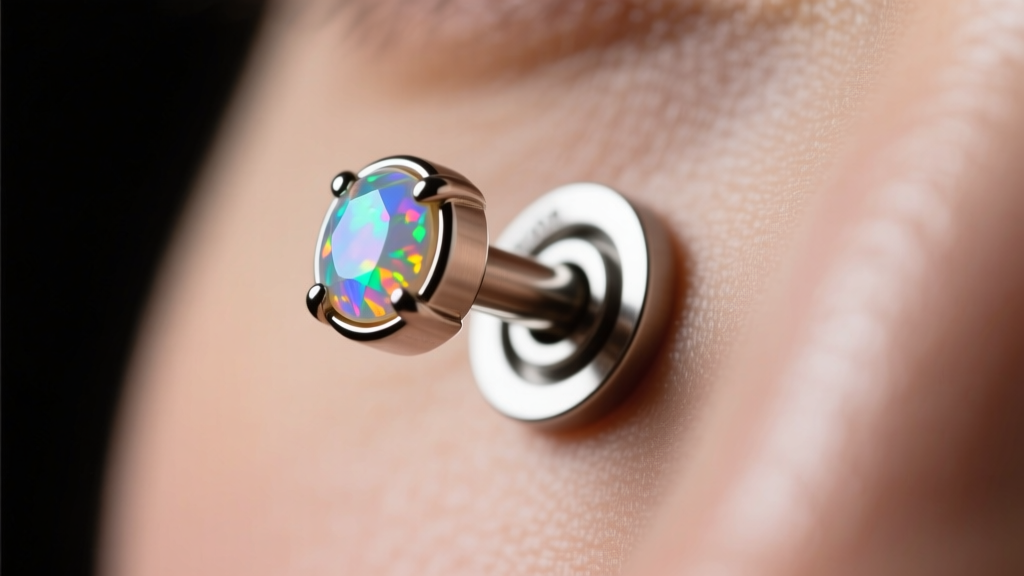
Cartilage piercings—whether a classic helix, a bold conch, or a delicate tragus—are notorious for their stubborn healing processes and sudden flare-ups. Unlike the highly vascular earlobe, cartilage is avascular, meaning it relies on surrounding tissue for blood supply and immune response. This biological reality makes the fistula (the piercing channel) highly sensitive to pressure, friction, and foreign materials. When your piercing stalls, develops hypertrophic scarring (irritation bumps), or exhibits signs of rejection, the jewelry itself is often the primary culprit.
Finding truly good earrings for cartilage piercings requires moving beyond aesthetic preferences and treating jewelry selection as a matter of biomechanics and metallurgy. In this troubleshooting guide, we break down the exact material grades, structural metrics, and mechanical designs required to solve chronic cartilage complications and achieve a fully healed, stable fistula.
The Anatomy of Cartilage Irritation: Why Standard Jewelry Fails
Most cartilage complications stem from a mismatch between the jewelry's physical properties and the body's healing requirements. Standard retail earrings often feature butterfly backs, thin posts, and porous alloys. These design choices trap moisture, harbor bacteria, and create localized pressure points. When you sleep on a hoop or a poorly fitted stud, the pressure restricts lymphatic drainage, leading to the dreaded 'irritation bump'—a localized buildup of fluid and scar tissue that the body forms to protect the fistula from persistent trauma.
To resolve these issues, we must evaluate jewelry across three critical vectors: metallurgical biocompatibility, dimensional accuracy (gauge and length), and mechanical assembly (threading).
Material Science: What Actually Qualifies as Biocompatible
The term 'hypoallergenic' is largely a marketing myth. When troubleshooting allergic contact dermatitis or delayed healing, you must look at exact alloy compositions. According to the Association of Professional Piercers (APP), only specific, verifiable grades of metal are safe for long-term cartilage wear.
| Material | Nickel Content | Biocompatibility | Avg. Price (Single Stud) |
|---|---|---|---|
| ASTM F-136 Titanium | 0% | Excellent (Medical Implant Grade) | $30 - $80 |
| 14k/18k Solid Gold | 0% (if palladium-alloyed) | Excellent (Must be nickel-free) | $80 - $250+ |
| Niobium | 0% | Excellent (Highly inert) | $25 - $60 |
| 316L Surgical Steel | 8% - 10% | Poor (Triggers nickel allergies) | $10 - $30 |
| Sterling Silver (925) | Variable (often contains copper/nickel) | Dangerous (Causes argyria/tarnishing) | $15 - $40 |
If you are experiencing persistent itching, flaking, or weeping clear fluid, you are likely suffering from a nickel allergy. The Mayo Clinic notes that nickel allergy is one of the most common causes of allergic contact dermatitis. Upgrading to verified ASTM F-136 implant-grade titanium or palladium-based white gold is the only permanent solution.
Gauge and Post Length: The Metrics That Prevent Migration
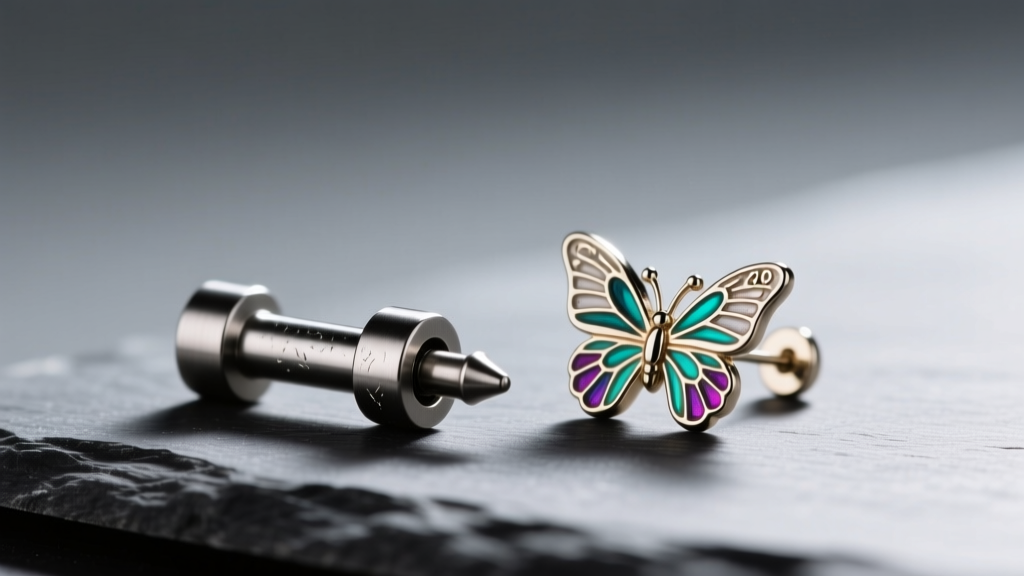
The thickness of your jewelry (gauge) and the length of the post dictate the structural integrity of the piercing. Using jewelry that is too thin or too short will inevitably lead to mechanical failure of the fistula.
The 'Cheese Cutter' Effect
Standard fashion earrings are typically 20-gauge (0.81mm) or 18-gauge (1.0mm). In cartilage, this thin wire acts like a cheese cutter. The natural tension of the skin, combined with the weight of a hoop or snagging on hair, will cause a thin wire to slowly migrate and slice through the cartilage tissue. Good earrings for cartilage piercings must be a minimum of 16-gauge (1.2mm) or 14-gauge (1.6mm) to distribute pressure evenly and prevent migration.
Post Length and Embedding
Cartilage swells significantly during the first 4 to 8 weeks of healing. A post that is too short will embed into the skin, cutting off circulation and requiring surgical removal. Initial jewelry should feature a post length of 1/4 inch (6.35mm) or 5/16 inch (7.9mm). Once the swelling subsides (usually around week 6), you must 'downsize' to a 3/16 inch (4.76mm) or 5/32 inch (3.97mm) post. Failing to downsize leaves excess metal that catches on clothing, creating the leverage that causes irritation bumps.
Troubleshooting Common Cartilage Complications
Let's apply these material and dimensional rules to solve specific, real-world cartilage problems.
Expert Insight: Never attempt to treat an irritation bump with tea tree oil, aspirin pastes, or harsh chemicals. These methods cause chemical burns on the delicate fistula tissue, exacerbating the scarring. The only cure is removing the source of physical irritation.
Scenario 1: The Persistent Irritation Bump
- Symptom: A hard, fleshy, or fluid-filled bump localized to one side of the piercing hole.
- Root Cause: Sleeping on the piercing, wearing a hoop before full healing, or an improper piercing angle.
- The Fix: Switch to a flat-back titanium labret. The flat disc distributes pressure evenly against the back of the ear, eliminating the localized pressure points caused by butterfly backs or hoop curvature. Use a sterile saline spray twice daily and avoid touching the area.
Scenario 2: The Swelling and Embedding Cycle
- Symptom: The decorative end of the stud is sinking into the skin, and the area is hot and throbbing.
- Root Cause: The post length is too short for your current level of inflammation.
- The Fix: Visit a professional piercer immediately to swap the jewelry for a longer titanium post (e.g., moving from 6mm to 8mm). Do not wait, as embedded jewelry can be swallowed by the healing tissue within 24 hours.
Scenario 3: Argyria (Skin Discoloration)
- Symptom: The skin around the piercing has turned a permanent gray, blue, or black color.
- Root Cause: Wearing sterling silver or low-grade plated metals in a fresh or unhealed cartilage piercing. The oxidation of silver and copper alloys leaches into the tissue.
- The Fix: Remove the silver immediately and replace it with implant-grade titanium. Note that argyria discoloration is often permanent and may require laser treatment by a dermatologist to fade, as noted by Cleveland Clinic guidelines on heavy metal skin reactions.
Threadless vs. Internally Threaded: A Mechanical Breakdown
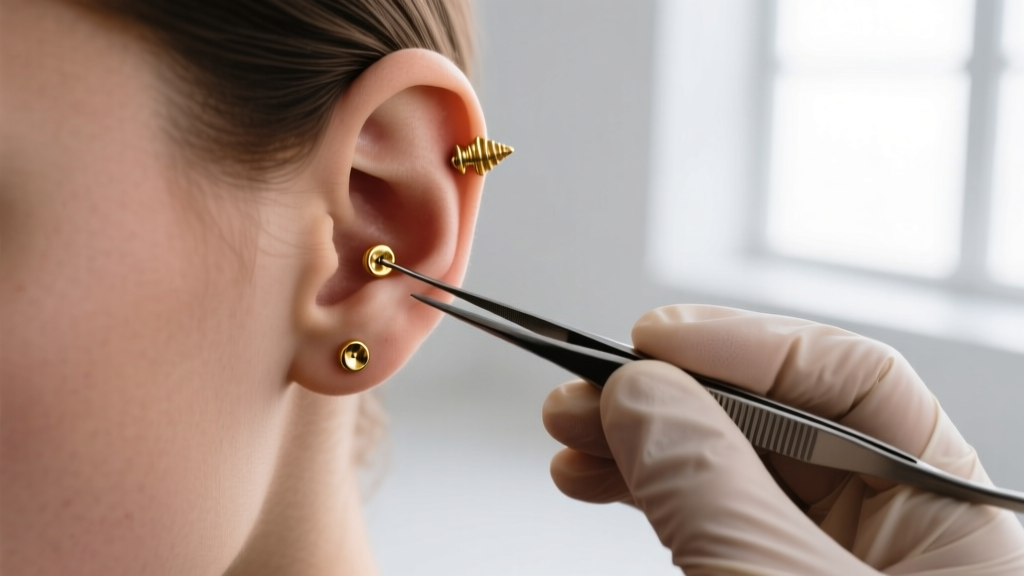
The way the decorative end attaches to the post is just as critical as the metal itself. You will encounter three types of assembly in the jewelry market:
- Externally Threaded: The screw threads are on the post itself. As you push this through your piercing, the sharp metal threads act like a file, tearing the delicate fistula lining and introducing bacteria. Never wear externally threaded jewelry in cartilage.
- Internally Threaded: The screw threads are on the inside of the decorative end, while the post is completely smooth. This allows the jewelry to glide through the fistula without causing micro-tears. This is the gold standard for high-end body jewelry brands like Anatometal and Industrial Strength.
- Threadless (Push-Fit): The decorative end features a slightly bent pin that creates tension when pushed into the hollow post. Threadless jewelry (popularized by brands like BVLA and Neometal) is often preferred by piercers because it eliminates the risk of the end unscrewing and falling out in your sleep, while providing a perfectly smooth insertion.
Final Checklist for Your Next Piercer Visit
Before purchasing new jewelry or visiting a studio to troubleshoot a stalled cartilage piercing, ensure your selection meets this strict criteria:
- Material: Certified ASTM F-136 Titanium or solid 14k/18k nickel-free gold.
- Style: Flat-back labret (avoid hoops, seamless rings, or butterfly backs entirely until the piercing is at least 12 months old).
- Gauge: 16g (1.2mm) or 14g (1.6mm) to prevent the cheese-cutter effect.
- Assembly: Threadless or internally threaded only.
- Fit: Snug enough that the flat back rests flush against the skin without indenting it, allowing zero room for movement or friction.
By treating your cartilage piercings with the same precision and material scrutiny as a surgical implant, you eliminate the variables that cause chronic irritation. Invest in high-quality, properly fitted jewelry, and your body will reward you with a stable, beautifully healed piercing that lasts a lifetime.


