Trending Types of Earrings in 2026: A Style Analysis
Discover the top trending types of earrings in 2026. Our style analysis covers materials, gauge sizes, and face-shape pairings for modern ear curation.

The Evolution of Ear Curation: 2026 Trend Overview
The landscape of fine jewelry has shifted dramatically as we move through 2026. The era of haphazard, maximalist ear stacks is being replaced by intentional, architecturally driven curation. When analyzing the most sought-after types of earrings this year, the focus is squarely on modularity, mixed-metal integration, and biomechanical comfort. Consumers are no longer just buying isolated pieces; they are investing in interconnected ecosystems of jewelry that adapt to their daily needs.
According to recent market analyses, the demand for customizable, high-grade body jewelry has outpaced traditional fashion earrings by over 35% in the luxury sector. This shift is driven by a more educated consumer base that prioritizes ASTM-certified materials and precision engineering over mass-produced novelty items. Understanding the nuanced differences between these trending styles is essential for both collectors and stylists aiming to create harmonious, long-lasting ear projects.
Deconstructing the Top Styles Dominating the Market
1. The Modular Huggie & Charm System
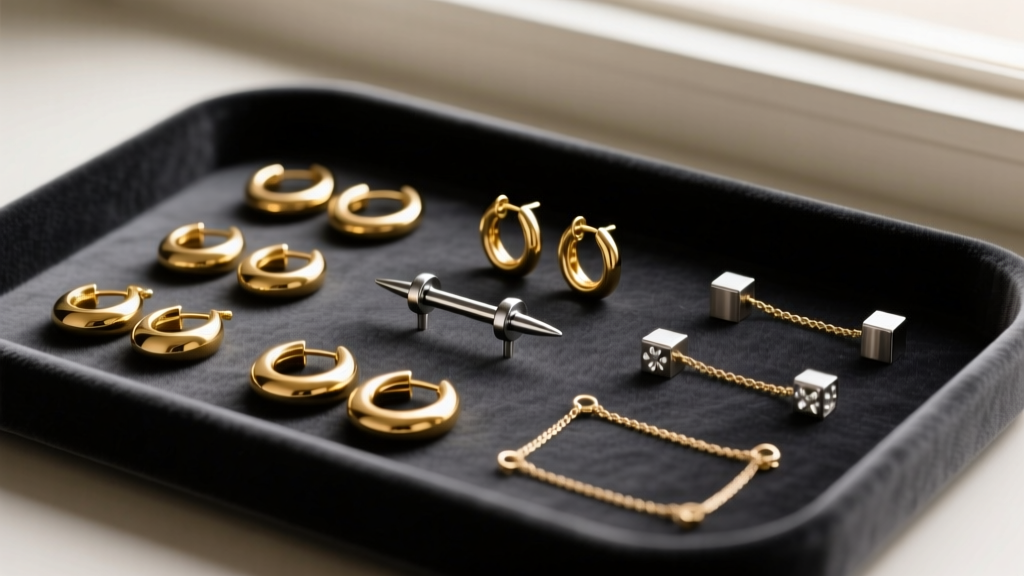
Huggies have evolved from simple, static hoops into highly engineered modular bases. In 2026, the leading designs feature a 12-gauge (2.0mm) or 14-gauge (1.6mm) thickness, providing the structural integrity needed to support heavy, interchangeable charms without warping. The most critical innovation is the micro-clicker hinge mechanism, which offers an audible, secure closure that prevents the loss of attached pendants.
For lobe piercings, an inner diameter of 9mm to 11mm remains the standard for a flush 'hug' fit. However, for upper ear placements like the helix or tragus, precision is paramount. A 6mm to 7mm inner diameter is required to prevent the jewelry from catching on hair or clothing. Brands are now offering charm attachments that utilize a threadless (press-fit) pin system, allowing users to swap out gemstone clusters or pearl drops in seconds without the risk of cross-threading.
2. Asymmetric Ear Threads & Chain Connectors
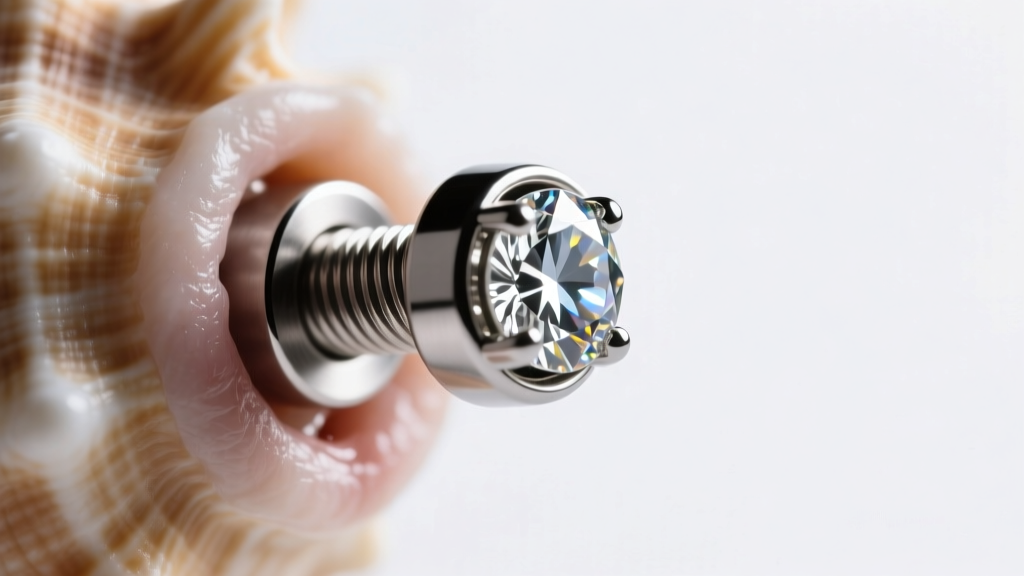
Ear threads—delicate chains that pull through the fistula—have seen a massive resurgence, but with crucial structural upgrades. Historically, 22-gauge (0.6mm) threads caused 'cheese-cutter' migration in stretched or delicate lobes. The 2026 standard utilizes flattened 20-gauge (0.8mm) ribbon chains made from nickel-free 18k gold. This wider surface area distributes weight evenly, mitigating the risk of tissue tearing while maintaining the illusion of a floating chain.
Styling these requires an understanding of tension. A chain connecting a lobe stud to a mid-helix stud must have exactly 2mm to 3mm of slack when the ear is at rest. If the chain is too taut, natural facial movements (like smiling or chewing) will pull on the cartilage piercing, leading to irritation bumps and potential rejection.
Material Science: What is Actually Selling?
The modern consumer demands transparency in metallurgy. The days of vague 'surgical steel' labels are over. Below is a breakdown of the primary materials dominating the high-end earring market this year, complete with their specific use cases and inherent limitations.
| Material | Grade / Standard | Best Application | Price Range (USD) | Primary Failure Mode |
|---|---|---|---|---|
| Niobium | Unalloyed (Reactive) | Hypersensitive skin, fresh piercings | $45 - $110 | Scratches easily; heavy in large gauges |
| Titanium | ASTM F-136 (Ti6Al4V) | Healing cartilage, structural bases | $60 - $180 | Limited natural color palette without anodizing |
| 18k Gold | Recycled, Nickel-Free | Healed lobes, luxury display pieces | $280 - $950+ | Softness leads to bending in gauges thinner than 16g |
| Platinum | Pt950 / Ruthenium Alloy | Heirloom studs, diamond settings | $600 - $2,500+ | Extreme density causes dragging in upper cartilage |
For those navigating the complexities of metal allergies, the Association of Professional Piercers (APP) strongly recommends ASTM F-136 titanium or pure niobium for any compromised tissue. Conversely, for fully healed, mature fistulas, recycled 18k gold remains the pinnacle of aesthetic warmth and longevity, provided the alloying metals are strictly palladium or silver, never nickel.
Face Shape & Piercing Placement Matrix
Selecting the right types of earrings goes beyond personal preference; it requires an understanding of facial geometry and how jewelry directs the eye. In 2026, stylists use a matrix approach to balance proportions through strategic cartilage and lobe placements.
- Round Faces: The goal is vertical elongation. Avoid wide, chunky huggies or large circular hoops that emphasize width. Instead, opt for elongated drop earrings or a vertical flat-back labret in the upper conch. A 14-gauge titanium barbell with a marquise-cut gemstone draws the eye downward, creating a slimming illusion.
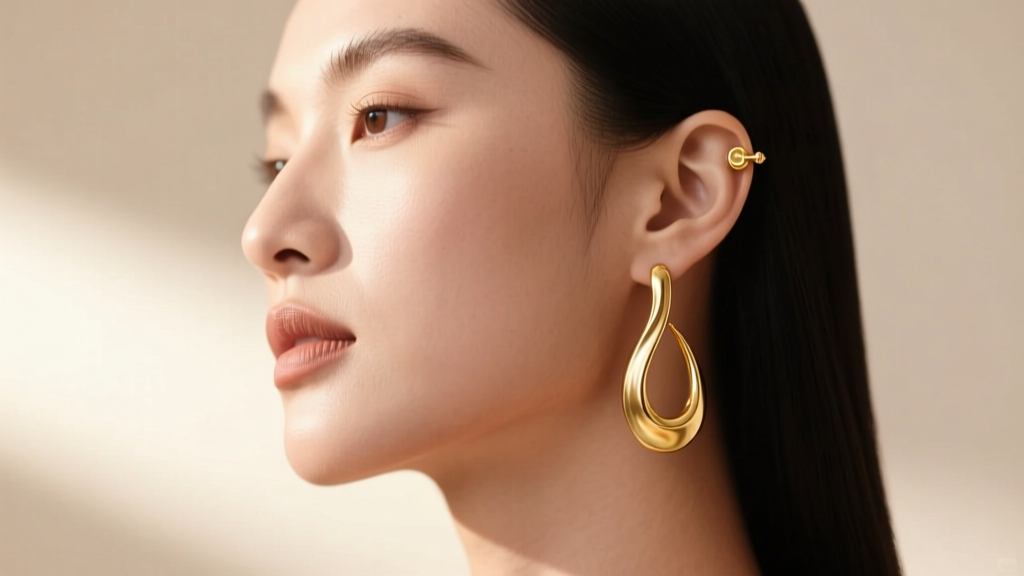
- Square Faces: Softening the jawline is key. Angular, geometric ear cuffs can clash with strong bone structure. Choose soft, curved 18k gold drop earrings or organic, fluid shapes like molten-gold huggies. A delicate forward helix stud helps draw attention upward and softens the overall profile.
- Heart-Shaped Faces: With a wider forehead and narrow chin, balance is achieved by adding visual weight to the lower half of the ear. Teardrop dangles and bottom-heavy lobe clusters work beautifully. Avoid heavy tragus piercings, which can make the lower face appear narrower.
- Oval Faces: The universal canvas. Almost any style works, but the current trend leans toward 'constellation' clusters—groupings of three to five micro-studs (18g or 16g) scattered across the helix and lobe to create a customized, celestial map.
Troubleshooting Common Cartilage & Lobe Issues
Even the most beautifully curated ear can fail if the biomechanics are ignored. As jewelry enthusiasts experiment with more complex stacks, specific failure modes have become prevalent. Understanding how to troubleshoot these issues is a hallmark of true expertise.
The Embedding Epidemic
Embedding occurs when the skin swells over the decorative end or the flat back of a labret stud, effectively swallowing the jewelry. This is most common in fresh conch or helix piercings where the initial post length (often 1/4 inch or 6mm) is too short to accommodate the inflammatory phase. According to guidelines supported by the Gemological Institute of America (GIA) and body modification experts, upgrading to a longer post (5/16 inch or 8mm) during the first three weeks of healing is non-negotiable. Once the swelling subsides, downsizing to a snug 3/16 inch (4.5mm) post prevents the jewelry from catching and causing irritation bumps.
Galvanic Reactions and Metal Mixing
A lesser-known issue in multi-pierced ears is the galvanic shock that can occur when two dissimilar metals (e.g., a titanium helix stud and an 18k gold lobe hoop) are connected by a conductive medium, such as saline solution or sweat, in close proximity. While rare in fully healed ears, in compromised or healing tissue, this micro-current can cause delayed healing and contact dermatitis. The rule of thumb for 2026 styling: maintain a single metal type across all healing piercings on the same ear.
Final Thoughts on Curating Your Stack
The types of earrings defining 2026 are a testament to the merger of fine jewelry aesthetics and body-modification engineering. By prioritizing ASTM-certified materials, respecting the anatomical limitations of your cartilage, and choosing modular designs that offer long-term versatility, you can build an ear curation that is not only visually stunning but biologically harmonious. Whether you are investing in a threadless diamond cluster or a precision-hinged niobium huggie, the key to modern styling lies in the details: the gauge, the thread type, and the intentional placement.


