Understanding Navy Earring Regs in 2026: A Sailor's Guide
Master the latest navy earring regs with our 2026 beginner guide. Learn exact sizes, authorized materials, and uniform rules for US sailors.


Introduction to Navy Uniform Jewelry Standards
Whether you are a brand-new recruit heading to Great Lakes for boot camp, a seasoned sailor preparing for a command inspection, or a family member looking to buy a compliant gift, understanding the official navy earring regs is absolutely critical. The United States Navy maintains some of the most stringent uniform and grooming standards in the military, and jewelry is no exception. These regulations are not arbitrary; they are deeply rooted in operational safety, particularly concerning flight deck operations, damage control gear, and the proper sealing of protective gas masks.
In this comprehensive 2026 beginner-friendly explainer, we will break down the exact specifications outlined in the NAVPERS 15665I uniform manual. We will cover authorized dimensions, metallurgical requirements, uniform-specific authorizations, and the most common infractions that end up on a sailor's counseling jacket. By the end of this guide, you will know exactly what is permitted on your earlobes and what needs to stay locked in your civilian jewelry box.
The Core Navy Earring Regs: Size, Material, and Style
When reviewing the official Navy Personnel Command Uniform Regulations, the rules for female sailors' earrings are highly specific. There is zero room for interpretation when it comes to the physical dimensions and materials of your jewelry.
Authorized Dimensions and Gauges
The Navy strictly authorizes ball-shaped earrings that measure between 4mm and 6mm (approximately 1/8 inch to 1/4 inch) in diameter. This specific size range is mandated to ensure the earring is visible enough to meet uniform standards but small enough to prevent snagging on ropes, cables, or tactical equipment.
- 4mm (1/8"): The smallest authorized size. Often preferred for a subtle, conservative look in daily working uniforms.
- 5mm (3/16"): The middle ground. Highly popular and widely available at military clothing stores.
- 6mm (1/4"): The absolute maximum authorized size. Anything larger, even by a millimeter, is considered a uniform infraction.
Regarding the gauge (the thickness of the post), standard 20-gauge (0.81mm) or 18-gauge (1.02mm) posts are standard and fully compliant. However, the regulations explicitly forbid the wearing of "flesh tunnels," plugs, or any jewelry designed to stretch the earlobe. If your earlobes are visibly stretched from previous modifications, you may be required to consult with your command regarding grooming standards, as holes that do not close naturally can sometimes be deemed unauthorized body modifications.
Metallurgical Requirements and Finishes
The Navy does not just dictate the shape; it dictates the metallurgy. Authorized materials are strictly limited to plain yellow gold, white gold, platinum, sterling silver, or white pearl.
From a practical and dermatological standpoint, solid 14k or 18k gold and surgical-grade stainless steel (often sold as white gold or silver alternatives) are highly recommended for sailors on deployment. Gold-plated or silver-plated brass earrings are technically compliant in color, but the plating inevitably wears off in the harsh, salt-air environment of a naval vessel. Once the base metal is exposed, it can cause severe contact dermatitis or localized infections, which is a significant liability when medical resources are limited on a submarine or destroyer. Always opt for solid metals.

The Backing Mechanism: Friction vs. Screw-Back
While the uniform manual specifies "post or screw-on" earrings, experienced sailors know that the backing mechanism is just as important as the front. Standard friction backs (butterfly clutches) are notorious for falling out during physical labor, rack inspections, or while changing into coveralls. Investing in screw-back earrings or purchasing high-tension silicone friction backs is a pro-tip that will save you from losing your jewelry and facing the wrath of your Chief Petty Officer during a morning uniform inspection.
Gender-Specific Guidelines and Uniform Matrix
One of the most frequently asked questions by new recruits and civilian spouses is whether male sailors can wear earrings. The answer, according to current military grooming standards, is a definitive no while in uniform.
Male Sailors
Under current navy earring regs, male personnel are strictly prohibited from wearing earrings, ear cuffs, or any visible ear jewelry while in uniform, on a military installation, or conducting official business off-base. This applies to all uniforms, from the Navy Working Uniform (NWU) Type III to the Service Dress Blues. Male sailors are, however, permitted to wear earrings in civilian attire while off-base and off-duty, provided the jewelry does not violate any local laws or bring discredit upon the Navy.
Female Sailors and the Uniform Matrix
Female sailors are authorized to wear one earring per ear, centered on the lower earlobe. However, authorization changes depending on the specific uniform being worn. Below is a quick-reference matrix for 2026 uniform standards:
| Uniform Type | Earring Authorization | Specific Notes & Restrictions |
|---|---|---|
| Service Dress Blue / White | Authorized | 4-6mm gold, silver, or white pearl. Must be conservative. |
| Summer / Winter Service Uniform | Authorized | 4-6mm gold or silver. Pearls generally discouraged but tolerated. |
| Navy Working Uniform (NWU) | Authorized | 4-6mm gold, silver, or pearl. Screw-backs highly recommended. |
| Physical Training Uniform (PTU) | NOT Authorized | All jewelry is prohibited during PT for safety and snag prevention. |
| Coveralls / Flight Deck Gear | Command Discretion | Often prohibited on flight decks or in engineering spaces due to FOD/safety risks. |
Common Uniform Infractions to Avoid
During routine barracks inspections or quarterdeck watch standers, Division Officers and Chiefs look for specific jewelry violations. Avoid these common mistakes:
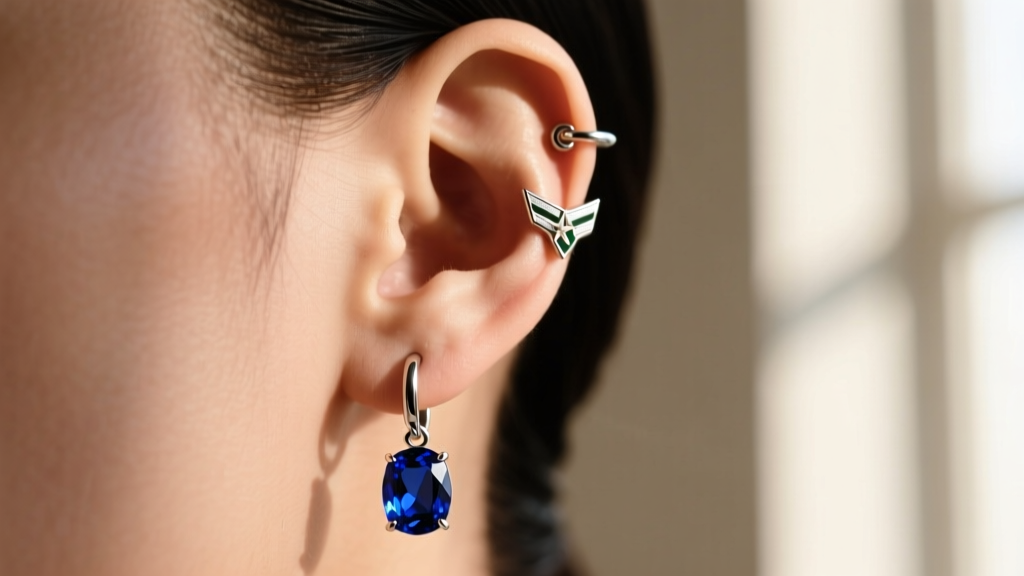
- Cartilage and Tragus Piercings: Even if the hole is healed, wearing jewelry in the upper cartilage, tragus, or helix is a direct violation. Earrings must be centered on the lower earlobe only.
- Dual Piercings: Wearing two earrings in a single earlobe (e.g., a standard lobe piercing plus a secondary lower lobe piercing) is unauthorized. Only one earring per ear is permitted.
- Colored Pearls or Gemstones: While white pearls are authorized, black pearls, pink pearls, or ball earrings featuring inset diamonds, cubic zirconia, or colored gemstones are strictly forbidden. The ball must be a solid, uniform color.
- Hoops and Dangles: Any earring that hangs below the earlobe or forms a continuous ring (hoop) is a safety hazard and an immediate uniform infraction.
Pro-Tip for Recruits: If you have multiple ear piercings from your civilian life, you do not need to let them close up. Simply leave them empty while in uniform. However, ensure that the empty holes do not appear excessively stretched or torn, as extreme body modifications can sometimes be flagged by medical and command staff during enlistment processing.
Where to Buy Compliant Navy Earrings
Finding earrings that perfectly meet the 4mm to 6mm requirement can sometimes be tricky in standard civilian jewelry stores, where sizing often jumps from 3mm to 8mm. For guaranteed compliance, your best resource is the Navy Exchange (NEX), either in-store on base or online.
The NEX carries military-spec jewelry brands that manufacture exact 4mm, 5mm, and 6mm ball studs in 14k yellow gold, sterling silver, and synthetic white pearl. These are usually sold in multi-packs, which is highly recommended. Buying a pack of three or four pairs ensures you have backups when a friction back inevitably falls out on the deck plates of a cruiser. Prices at the NEX typically range from $15 for basic silver-plated sets to $85 for solid 14k gold pairs, offering options for both boot camp budgets and senior officer preferences.
Final Thoughts on Maintaining a Sharp Appearance
Adhering to the navy earring regs is about more than just avoiding a counseling statement; it is about presenting a unified, professional, and safety-conscious image. The military relies on standardized grooming to ensure that every sailor, regardless of their background, presents a sharp and cohesive front. By investing in high-quality, solid-metal ball studs with secure screw-backs, and by strictly observing the uniform matrix, you will ensure that your jewelry enhances your uniform rather than detracting from it. Keep your lobes compliant, keep your gear safe, and wear the uniform with pride.


