How to Tell If Real Diamond Earrings: 7 Expert Tests
Learn how to tell if real diamond earrings are authentic with 7 expert tests. Discover fog, water, and loupe methods to spot fakes instantly.


The Challenge of Verifying Mounted Diamond Earrings
In the current jewelry landscape, distinguishing authentic diamond earrings from simulants like cubic zirconia (CZ) or moissanite requires more than a casual glance. With lab-grown diamonds (LGDs) now dominating the market, the definition of a 'real' diamond encompasses both earth-mined and lab-created stones. Both share identical physical, chemical, and optical properties. However, simulants do not. If you have inherited a pair of studs, purchased vintage drops, or simply want to verify your everyday huggies, knowing how to tell if real diamond earrings are authentic is a critical skill.
It is important to understand a fundamental gemological limitation: unlike loose diamonds, earrings are mounted. The metal setting and post obscure the pavilion (the bottom half of the stone), rendering popular internet tricks like the 'read-through' or 'dot' test completely useless for studs, drops, and dangles. Instead, this guide bypasses internet myths and provides seven gemologist-approved testing methods you can perform at home, alongside the exact limitations of each test.
1. The Fog Test: Evaluating Thermal Conductivity
Diamonds are exceptional thermal conductors. They disperse heat rapidly, which is why they feel cold to the touch and clear up instantly when exposed to moisture. To perform the fog test, ensure the earring is clean and free of oils. Hold the earring close to your mouth and breathe on it steadily for about two seconds, just as you would to fog up a mirror.
If the stone is a real diamond, the fog will dissipate almost instantly—usually within one to two seconds. If the stone remains foggy for three seconds or longer, you are likely looking at cubic zirconia or glass, which are thermal insulators and retain heat. Expert Caveat: Moissanite is also a highly effective thermal conductor and will pass the fog test just like a real diamond. Therefore, this test is only useful for ruling out CZ and glass, not moissanite.
2. The Loupe Inspection: Reading Inclusions and Inscriptions
A 10x triplet jeweler's loupe is the most vital tool for any jewelry assessment. When examining your earrings, you are looking for two specific indicators of authenticity: natural inclusions and laser inscriptions.
Identifying Natural Inclusions
Earth-mined diamonds are formed under extreme heat and pressure, resulting in internal birthmarks known as inclusions. Under 10x magnification, look for tiny feathers, needles, clouds, or pinpoint crystals. If your diamond earrings are graded VS or SI, these inclusions will be visible under a loupe. Conversely, cubic zirconia is synthetically created in a sterile environment and is entirely flawless. If your stone is perfectly clear under magnification, it is a major red flag for a simulant (though it could also be a high-clarity lab-grown diamond).
Spotting Moissanite's Double Refraction
Moissanite is doubly refractive, meaning light splits into two rays as it passes through the stone. If you look through the bezel or crown facets of a moissanite earring with a loupe, you will see 'facet doubling'—the back facet lines will appear as double lines. Diamonds are singly refractive and will only show single, crisp facet lines.
Locating Laser Inscriptions
Most certified lab-grown and mined diamonds (typically 0.15 carats and above) feature a microscopic laser inscription on the girdle. According to the Gemological Institute of America (GIA) and the International Gemological Institute (IGI), these inscriptions match the diamond's grading report. Use your loupe to scan the outer edge of the earring's stone for a tiny serial number or the words 'Lab Grown'.
3. Checking the Setting and Metal Hallmarks
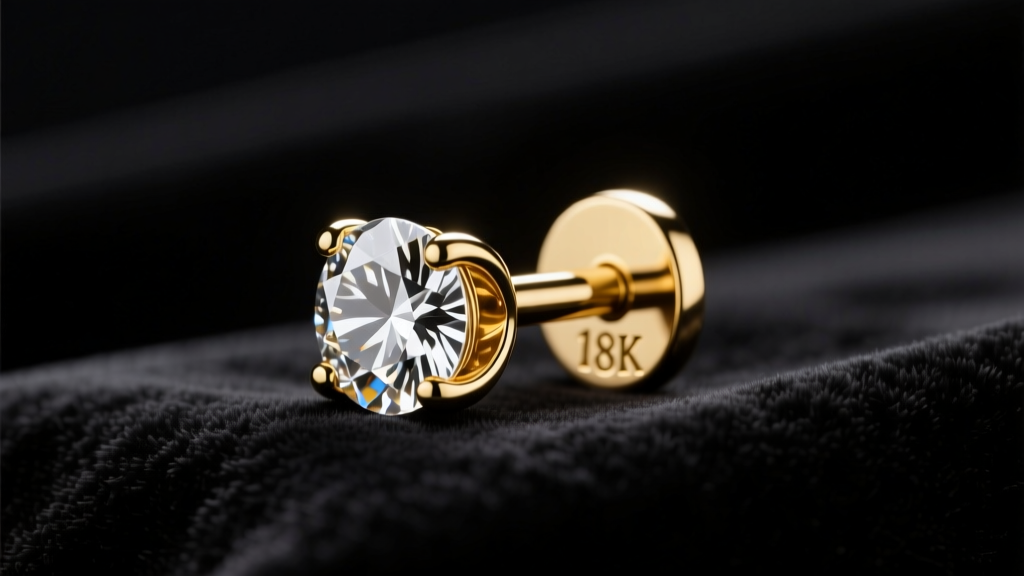
Because real diamonds are highly valuable, jewelers rarely set them in cheap base metals. Inspecting the earring post, the clutch (backing), and the basket setting can provide immediate clues about the stone's authenticity. Use your loupe to look for stamped hallmarks on the metal.
| Hallmark | Metal Type | Diamond Authenticity Likelihood |
|---|---|---|
| 14K, 18K, 22K | Solid Gold | High (Standard for real diamonds) |
| PT, PLAT, 950 | Platinum | Very High (Premium setting for high-value stones) |
| 925 | Sterling Silver | Low (Usually set with CZ or white sapphire) |
| Unstamped / Brass | Base Metal / Plated | Extremely Low (Almost certainly a simulant) |
Note on Sterling Silver: While it is rare, some fashion jewelers do set small, low-grade melee diamonds in 925 sterling silver. However, if you are examining a 1-carat solitaire stud earring stamped '925', it is almost certainly cubic zirconia.
4. The Water Density Test (And Its Limitations)
The water test involves dropping the loose stone into a glass of water to see if it sinks. Real diamonds have a high specific gravity (3.52) and will sink immediately. However, because earrings are mounted in metal, the metal's weight will force the earring to sink regardless of the stone. Furthermore, cubic zirconia has an even higher specific gravity (5.6 to 6.0) and will also sink. This test is only useful if you are trying to rule out hollow glass or plastic simulants, which may float or sink very slowly. For mounted diamond earrings, skip this test entirely.
5. The UV Light (Fluorescence) Test
Approximately 25% to 35% of natural earth-mined diamonds exhibit fluorescence when exposed to ultraviolet (UV) light, most commonly glowing a soft blue. To test your earrings, take them into a dark room and shine a standard blacklight (UV-A) on them. If the stones emit a distinct blue glow, you have strong evidence that they are natural diamonds.
Cubic zirconia and moissanite generally do not fluoresce blue under UV light (moissanite may show a faint yellowish or greenish reaction). Expert Caveat: A lack of fluorescence does not mean the diamond is fake. 65% to 75% of real diamonds have no fluorescence. Additionally, many lab-grown diamonds are engineered to be completely non-fluorescent. This test is a helpful positive indicator, but not a definitive negative one.
6. Thermal vs. Electrical Conductivity Testers
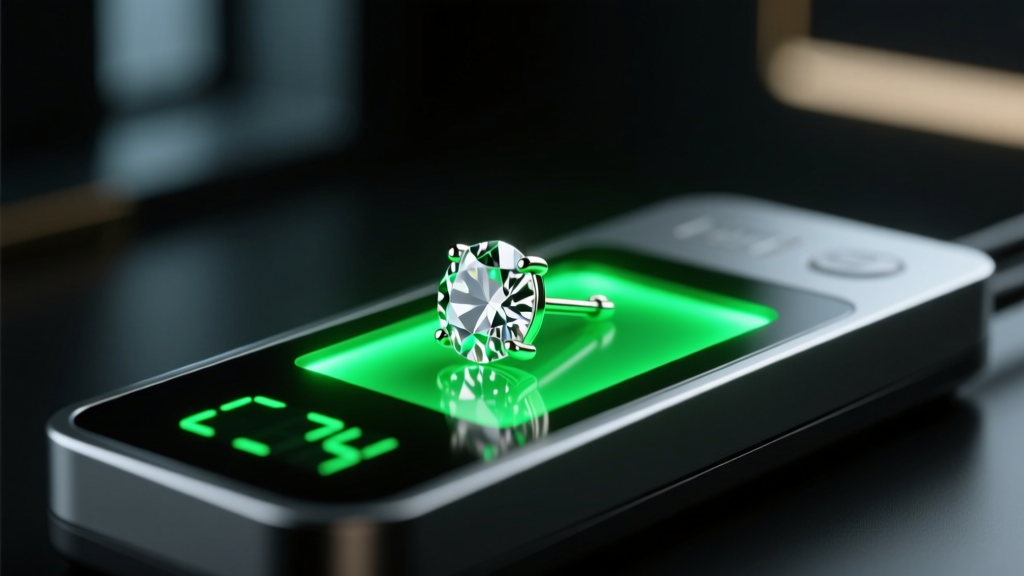
If you are serious about verifying your diamond earrings at home, investing in a diamond tester is the most reliable route. However, you must understand the difference between thermal and electrical testers to avoid a costly mistake.
Standard, inexpensive diamond testers measure thermal conductivity. Because both diamonds and moissanite disperse heat rapidly, a basic thermal tester will beep and light up 'green' for both stones. To accurately differentiate between a real diamond and moissanite, you must use a dual-tester that also measures electrical conductivity. Moissanite is electrically conductive, while diamonds (with the rare exception of natural blue boron-doped diamonds) are not. A dual-tester will correctly identify moissanite by triggering a specific 'moissanite' warning light, saving you from a false positive.
7. Inspecting Prong Wear and Facet Abrasion
Diamonds are the hardest natural material on earth, scoring a perfect 10 on the Mohs scale of mineral hardness. Because of this, the facet junctions (the sharp edges where the cuts meet) on a real diamond will remain incredibly crisp and sharp, even after decades of daily wear in a prong setting.
Cubic zirconia, on the other hand, scores an 8 to 8.5 on the Mohs scale. Over time, CZ stones will accumulate microscopic scratches, and the sharp facet junctions will become rounded, abraded, or cloudy, especially where the metal prongs grip the stone. If your vintage earrings feature stones with dull, scratched, or rounded edges, they are almost certainly simulants.
Gemologist's Advice: While these at-home tests are excellent for screening out obvious simulants like CZ and glass, they cannot definitively separate earth-mined diamonds from lab-grown diamonds. Only advanced spectroscopic equipment, available at certified gemological laboratories like the American Gem Society (AGS) affiliates, can detect the subtle growth patterns that differentiate mined from lab-created stones.
When to Consult a Certified Professional
If your earrings pass the fog test, show crisp facet lines under a loupe, are set in 18K gold or platinum, and pass a dual electrical/thermal tester, you can be highly confident they are real diamonds. However, if you are preparing to insure the earrings, sell them, or pass them down as an heirloom, at-home testing is not sufficient. Take the earrings to a certified independent appraiser or a GIA Graduate Gemologist. They will provide a definitive grading report, confirming not only the stone's authenticity but also its exact carat weight, color, clarity, and cut quality, ensuring your investment is properly protected.


