How Do You Know If Diamond Earrings Are Real? A Gemologist's Guide
Learn how do you know if diamond earrings are real with our gemologist-approved guide. Master at-home tests, electronic testers, and mounting clues.

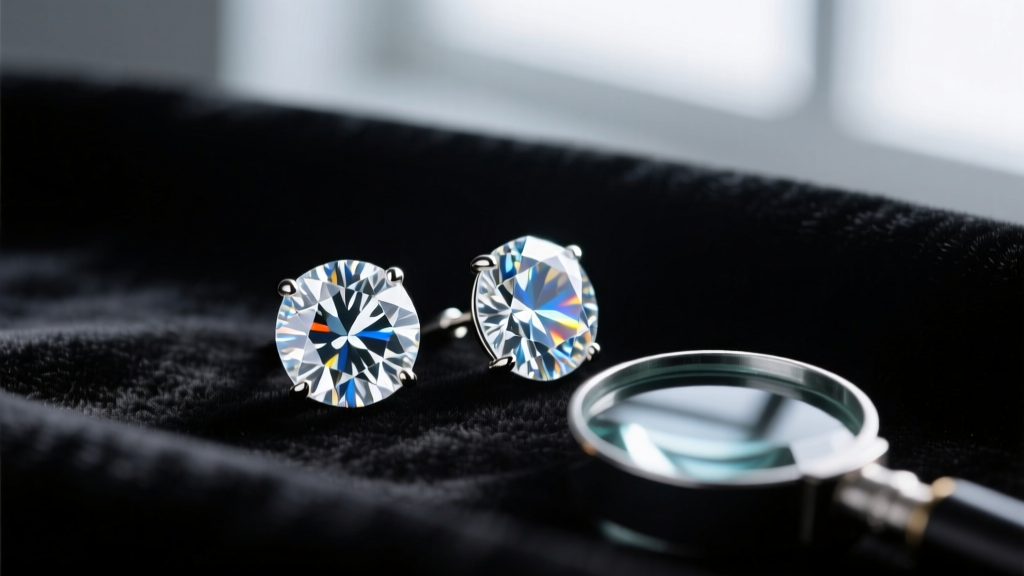
The Science of Sparkle: Why Visual Inspection Isn't Enough
When you inherit a pair of vintage studs or purchase a new set of solitaires, the question inevitably arises: how do you know if diamond earrings are real? In today's advanced jewelry market, relying on the naked eye is a gamble. The rise of high-quality simulants like cubic zirconia (CZ) and moissanite, combined with the explosive growth of lab-grown diamonds, means that visual sparkle alone is no longer a reliable indicator of authenticity.
As gemologists, we approach diamond verification through a framework of thermal conductivity, refractive index, and microscopic inclusion mapping. This step-by-step guide will walk you through the exact methodologies professionals use to separate natural earth-mined diamonds from lab-created counterparts and clever imitations, ensuring your investment is genuine.
Step-by-Step At-Home Diamond Earring Tests
Before investing in professional equipment, you can perform several non-destructive tests at home. These methods rely on the unique physical and optical properties of carbon crystal lattices.
1. The Fog Test (Thermal Conductivity)
Diamonds are exceptional thermal conductors. They disperse heat rapidly, which is why they feel cold to the touch and resist fogging. To perform this test, clean your earring thoroughly with a microfiber cloth to remove oils and lotions. Hold the earring by the post or backing, bring it close to your mouth, and breathe on it heavily, just as you would fog a mirror.
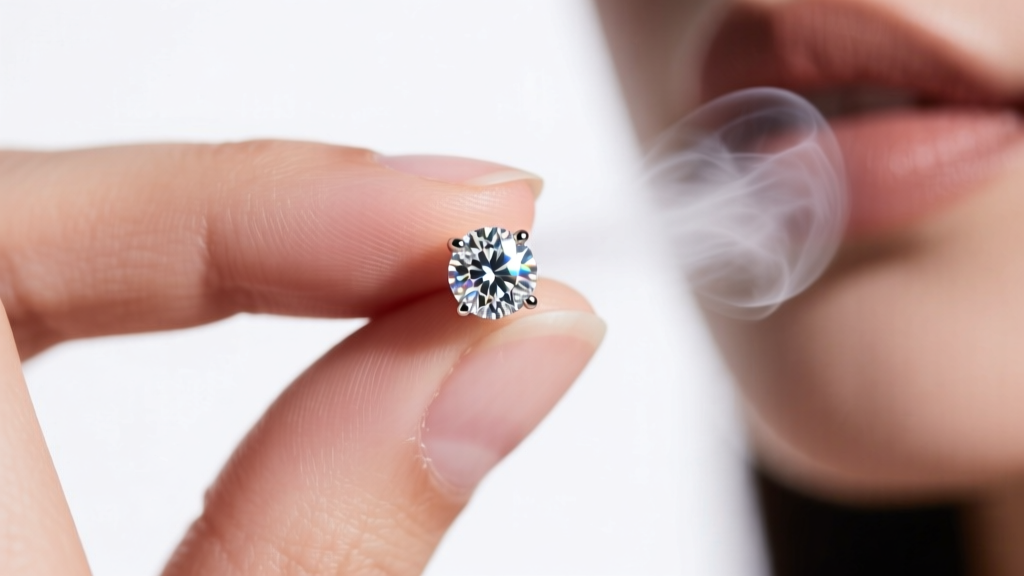
The Verdict: If the stone is a real diamond, the fog will dissipate almost instantly (within 1 to 2 seconds). If the fog lingers for 3 to 4 seconds, you are likely looking at a simulant like CZ or glass, which are thermal insulators and retain surface condensation much longer.
2. The Read-Through Test (Refractive Index)
This test is highly effective for loose stones or earrings with open-back settings (where the pavilion of the diamond is exposed). Diamonds possess a high refractive index (RI of 2.42), meaning they bend light so sharply that it reflects internally rather than passing straight through.
Place the earring face-down on a piece of paper with small, printed text (like a newspaper or a book page). Look directly down through the flat table of the stone.
The Verdict: If you can read the letters or see distorted black smudges through the stone, it is not a diamond. A genuine diamond will scatter the light so intensely that the text becomes entirely illegible. Note: This test does not work well on moissanite, which also has a high refractive index and will similarly obscure text.
3. Loupe Inspection for Inclusions and Inscriptions
Using a standard 10x triplet jeweler's loupe, examine the stone under a bright, directed light source. You are looking for two distinct features:
- Natural Inclusions: Earth-mined diamonds almost always contain microscopic birthmarks like feathers, crystals, or clouds. If the stone is completely flawless under 10x magnification, it is highly suspect and likely a lab-grown stone or a CZ simulant.
- Laser Inscriptions: Many modern diamonds (both natural and lab-grown) feature a microscopic laser inscription on the girdle (the narrow outer edge). Look for acronyms like GIA, IGI, or GCAL followed by a report number. This instantly proves it is a graded diamond, though you will need to verify the report online to determine if it is natural or lab-created.
Advanced Verification: Using Electronic Testers
For serious buyers and collectors, at-home breath tests are insufficient. The jewelry industry relies on electronic testers to measure thermal and electrical conductivity. However, understanding the limitations of these tools is critical.
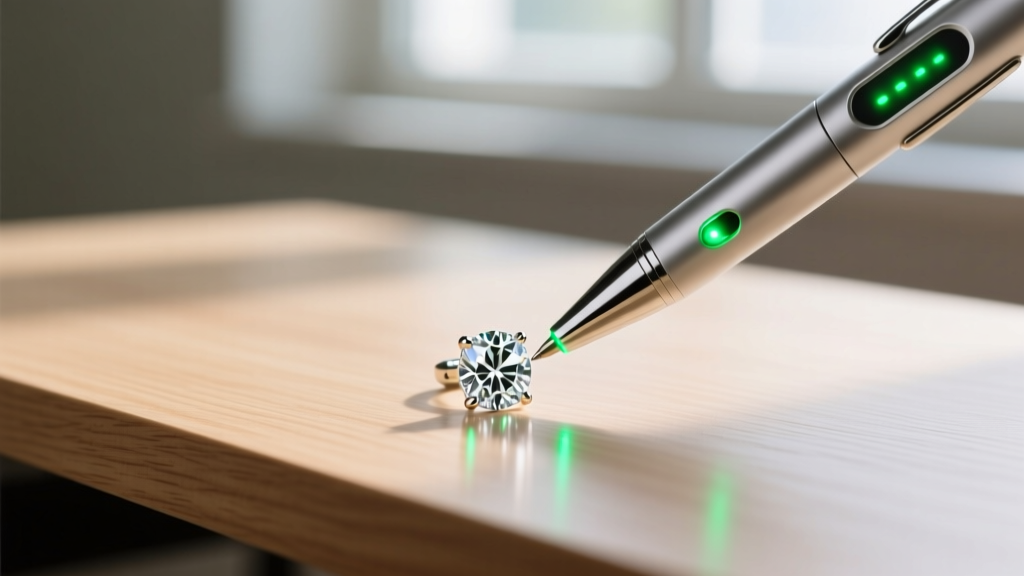
Early thermal testers were easily fooled by moissanite, which shares similar thermal conductivity with diamond. Today, professionals use Dual-Testers (such as the Presidium Multi-Tester III). These devices measure both heat dispersion and electrical conductivity.
While diamonds are thermal conductors, they are electrical insulators. Moissanite, conversely, is a semiconductor. A dual-tester will accurately differentiate between the two by sending a micro-electrical current through the stone. If the device registers high thermal conductivity but zero electrical conductivity, the stone is a diamond. If it registers both, the device will flag it as moissanite.
The UV Fluorescence Check
Shining a long-wave ultraviolet (UV) blacklight on your earrings can provide vital clues. According to the Gemological Institute of America (GIA), approximately 25% to 35% of natural diamonds exhibit some degree of fluorescence, most commonly a soft blue glow. Cubic zirconia generally shows no fluorescence, while some moissanite may show a faint yellow or greenish reaction. While not definitive proof on its own, a strong blue glow is a strong indicator of a natural earth-mined diamond.
Decoding the Mounting: Metal Stamps and Setting Clues
The metal holding your diamond can tell you just as much as the stone itself. High-value diamonds are rarely set in low-value metals due to the risk of loss and the need for durable prongs.
- Hallmarks to Trust: Look inside the earring post or on the backing for stamps like 14K, 18K, 585, 750, PT, or PT950 (Platinum). These indicate precious metals capable of securing a valuable stone.
- Red Flag Stamps: If you see 925 (Sterling Silver), CZ, or gold-plated stamps (like 14K GP or HGE), the stone is almost certainly a simulant. Silver is too soft to securely hold an expensive diamond's prongs over time.
- Setting Architecture: Genuine diamonds are typically set in open-back mountings to allow light to enter the pavilion and maximize brilliance. Simulants are frequently set in closed-back or "foil-backed" settings to artificially enhance their sparkle and hide poor cutting proportions.
Simulant vs. Lab-Grown vs. Natural: A Gemological Breakdown
Understanding the physical differences between diamond alternatives is crucial for accurate identification. Below is a comparative breakdown of the materials commonly used in diamond stud earrings.
| Material | Mohs Hardness | Refractive Index (RI) | Dispersion (Fire) | Avg. Price (1.00 ctw Studs) |
|---|---|---|---|---|
| Natural Diamond | 10 | 2.42 | 0.044 | $1,500 - $6,000+ |
| Lab-Grown Diamond | 10 | 2.42 | 0.044 | $400 - $1,200 |
| Moissanite | 9.25 | 2.65 - 2.69 | 0.104 | $200 - $500 |
| Cubic Zirconia (CZ) | 8.0 - 8.5 | 2.15 - 2.18 | 0.058 | $20 - $100 |
Note: Moissanite exhibits "double refraction." When viewed through a loupe at an angle, the facet lines on the pavilion will appear doubled or blurry, a dead giveaway that the stone is not a singly-refractive diamond.
When to Seek Professional Gemological Appraisal
While at-home tests and dual-testers are excellent for weeding out cheap simulants like CZ and glass, they cannot definitively distinguish between a natural diamond and a lab-grown diamond. Both share the exact same chemical composition (pure carbon) and physical properties.
To verify the origin of your earrings, a gemologist must use advanced spectroscopic equipment to analyze the stone's crystal growth patterns. For example, High Pressure High Temperature (HPHT) lab diamonds often contain microscopic metallic flux inclusions that are magnetic, while Chemical Vapor Deposition (CVD) diamonds may show specific strain patterns under specialized imaging.
"The only foolproof way to guarantee the origin, authenticity, and exact quality grades of your diamond earrings is to submit them to a reputable, independent grading laboratory like the GIA, AGS, or GCAL for a full diamond dossier."
If your earrings lack a verifiable certificate, or if you are preparing them for insurance appraisal, consult a certified gemologist. The American Gem Society (AGS) maintains a directory of credentialed professionals equipped with the necessary spectrometers to provide a definitive, legally binding analysis of your jewelry.
Final Thoughts on Diamond Verification
Determining the authenticity of diamond earrings requires a systematic approach. Start with the fog and read-through tests to eliminate glass and CZ. Use a 10x loupe to search for laser inscriptions and natural inclusions. Finally, employ a dual-mode electronic tester to rule out moissanite. By understanding the science behind the sparkle, you can confidently verify your jewelry and protect your investment in the ever-evolving 2026 diamond market.


