Buying Violin Earrings: 2026 Value & Price Guide
Evaluate violin earrings with our 2026 value guide. Compare pricing tiers, metal grades, weight distribution, and structural durability for music lovers.

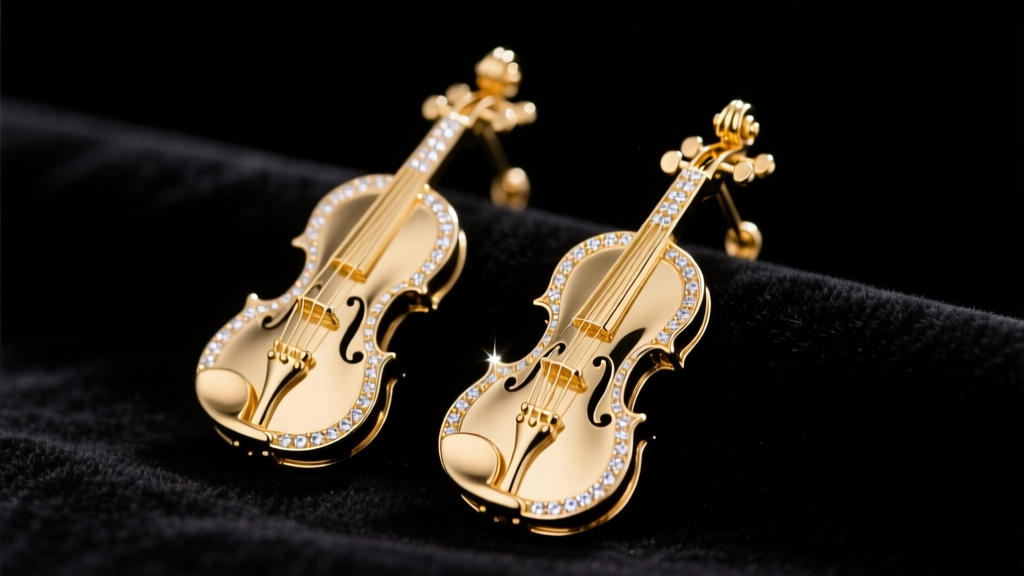
The Unique Engineering Challenge of Musical Novelty Jewelry
Violin earrings occupy a fascinating niche in the jewelry market. They appeal to classical musicians, music educators, and vintage aesthetic enthusiasts alike. However, from a structural and value-assessment perspective, novelty instrument jewelry presents unique engineering challenges that mass-market manufacturers frequently ignore. Unlike simple geometric studs or perfectly balanced hoops, the violin silhouette is inherently asymmetrical and bottom-heavy. When you are investing in a pair of violin earrings, you are not just paying for the metal weight; you are paying for the structural foresight required to make an elongated, top-heavy shape sit correctly on the human ear.
In this 2026 budget and value assessment, we bypass the superficial aesthetic appeal and examine the metallurgical realities, weight distribution mechanics, and pricing tiers of violin earrings. Whether you are looking for a $40 pair of sterling silver studs for daily teaching wear or a $1,500 set of solid gold dangles with tonewood inlays, understanding where the true value lies will save you from buyer's remorse and broken jewelry.
Weight Distribution: The Hidden Marker of Quality
The most common failure in budget violin earrings is poor post placement. A violin's body is significantly wider and heavier than its neck and scroll. If a manufacturer solders the earring post at the very top (the scroll), the earring will act as a pendulum. The heavy bottom body will pull the earring forward, causing the post to bend downward and the sharp lower edges of the violin to dig into the wearer's neck or jawline.
High-value violin earrings solve this through precise center-of-mass soldering. In a well-crafted stud or drop, the post or jump ring is attached near the "bridge" area of the violin body, allowing the neck and scroll to extend upward while the lower bout rests flush against the earlobe. When assessing value in a physical store or via detailed online photos, always check the solder point. If the post is attached to the extreme top edge of a 20mm long violin silhouette without a counter-weight or specialized ear wire harness, it is a low-value design destined to droop.
Material Tiers and 2026 Market Pricing
The market for musical jewelry is heavily segmented. Below is a breakdown of what you should expect to pay, and more importantly, what materials and construction methods justify those price points in the current market.
| Tier | Price Range | Base Metal & Finish | Post Gauge & Clasp | Detailing Method |
|---|---|---|---|---|
| Budget / Fast Fashion | $12 - $35 | Zinc/Brass Alloy, Flash Plating (<0.1 microns) | 22g (0.64mm) weak post, basic butterfly back | Stamped recesses, painted enamel |
| Mid-Market / Artisan | $45 - $140 | Solid 925 Sterling Silver or Heavy Vermeil (2.5+ microns) | 20g (0.81mm) or 18g (1.02mm) post, secure friction or leverback | Oxidized silver f-holes, CZ accents |
| Fine / Luxury | $250 - $1,500+ | 14k/18k Solid Gold, Platinum | 18g (1.02mm) solid post, custom clasps | Tonewood inlays, micro-pave diamonds |
The Plating Deception: Flash vs. Vermeil
When buying gold-toned violin earrings in the $20 to $50 range, you must scrutinize the plating thickness. According to the Federal Trade Commission Jewelry Guides, terms like "gold flashed" or "gold washed" indicate a microscopic layer of gold (often less than 0.1 microns). Because violin earrings have intricate curves, f-holes, and simulated strings, these crevices experience high friction against hair and clothing. Flash plating will wear off these high-friction ridges within weeks, exposing the underlying brass or copper alloy, which frequently causes contact dermatitis and the dreaded "green ear" effect.
For genuine value, seek out "Gold Vermeil" (pronounced ver-may). By industry standard, vermeil requires a base of solid 925 sterling silver plated with at least 2.5 microns of 10k, 14k, or 18k gold. This thickness ensures the intricate details of the violin body retain their luster for years, making the $60-$90 premium entirely justifiable.
Detailing: Enamel, Oxidation, and Tonewood Inlays
The way the "f-holes" and strings are rendered is a massive indicator of craftsmanship and value. In budget tiers, the f-holes are simply stamped into the metal and filled with black paint or cheap epoxy. Over time, this paint chips, leaving the violin looking unfinished.
Mid-tier value is found in oxidation. Artisans use chemically darkened sterling silver recessed into the f-holes and string lines. Because the oxidation is a chemical reaction with the silver itself, it will not chip or peel, offering superior longevity. In the luxury tier, jewelers are increasingly turning to authentic materials. High-end luthier-inspired earrings now feature actual tonewood inlays—micro-shavings of spruce (for the top plate) and flamed maple (for the back and sides) sealed under sapphire crystal or resin within a gold bezel. Furthermore, the GIA Gem Encyclopedia notes that luxury novelty pieces often utilize melee diamonds or black sapphires to trace the strings and fingerboard, elevating the piece from mere novelty to fine art.
Structural Failure Points to Inspect Before Purchasing
Before committing your budget to a pair of violin earrings, perform a mental or physical stress test on these specific failure points:
- The Solder Joint at the Neck: If you are buying a dangle style where the violin body hangs from a separate hook via a jump ring, check where the ring attaches. The "neck" of the violin silhouette is the narrowest point. If the jump ring is soldered to a thin, hollow-cast neck, the sheer weight of the lower bout will eventually snap the metal. High-value designs reinforce this joint with a hidden internal steel pin or attach the ring to the broader upper shoulder of the violin body.
- Post Gauge Thickness: Standard ear piercings are 20-gauge (0.81mm) or 18-gauge (1.02mm). Budget manufacturers often use 22-gauge (0.64mm) wire to save on precious metal costs. A 22-gauge post supporting a 15mm long, solid-cast violin body will bend the moment you apply pressure to secure the butterfly back, or worse, bend inside the ear canal if bumped.
- Hollow vs. Solid Casting: Tap the earring lightly with a fingernail. A high-pitched "tink" indicates hollow electroforming or thin-sheet stamping. While hollow earrings are lighter (preventing earlobe stretching), they are prone to denting if dropped on a hard floor. Solid cast 925 silver offers a satisfying, duller acoustic tap and superior dent resistance.
Lobe vs. Cartilage: Choosing the Right Silhouette
The elongated nature of violin earrings dictates where they can be comfortably worn. For standard earlobe piercings, drop and dangle styles (ranging from 25mm to 45mm in length) offer the best visual impact and allow the instrument's shape to be fully appreciated. However, if you are shopping for a helix, tragus, or conch piercing, traditional violin drops are a poor investment. The length will catch on hair, headphones, and winter scarves, creating a high risk of traumatic tearing.
For cartilage piercings, the highest value lies in "violin huggies" or micro-studs. These designs abstract the violin shape, wrapping the upper bout and scroll around a small 10mm hoop, or condensing the silhouette into an 8mm flat-backed labret stud. These designs maintain the musical motif while respecting the anatomical limitations of cartilage placements.
The Final Verdict on Budget Allocation
If your budget is strictly under $30, avoid metal dangles entirely; the plating will fail, and the posts will bend. Instead, opt for acrylic or laser-cut wood violin studs, which offer structural integrity at a low price point. If your budget allows for $60 to $120, you are in the "sweet spot" of jewelry value. Here, you can secure solid 925 sterling silver with heavy gold vermeil, 20-gauge posts, and chemically oxidized detailing that will last a lifetime of daily wear. For budgets exceeding $300, demand solid 14k gold, secure leverback clasps, and authentic material inclusions like tonewood or precision-set melee gemstones. By prioritizing structural engineering over mere surface shine, your violin earrings will remain a cherished, wearable tribute to your musical passion for decades to come.


