What Are Flat Back Earrings? The Material & Fit Guide
Discover what flat back earrings are, compare implant-grade titanium, gold, and steel, and learn exact gauge sizes for perfect cartilage fit.

The Core Question: What Are Flat Back Earrings?
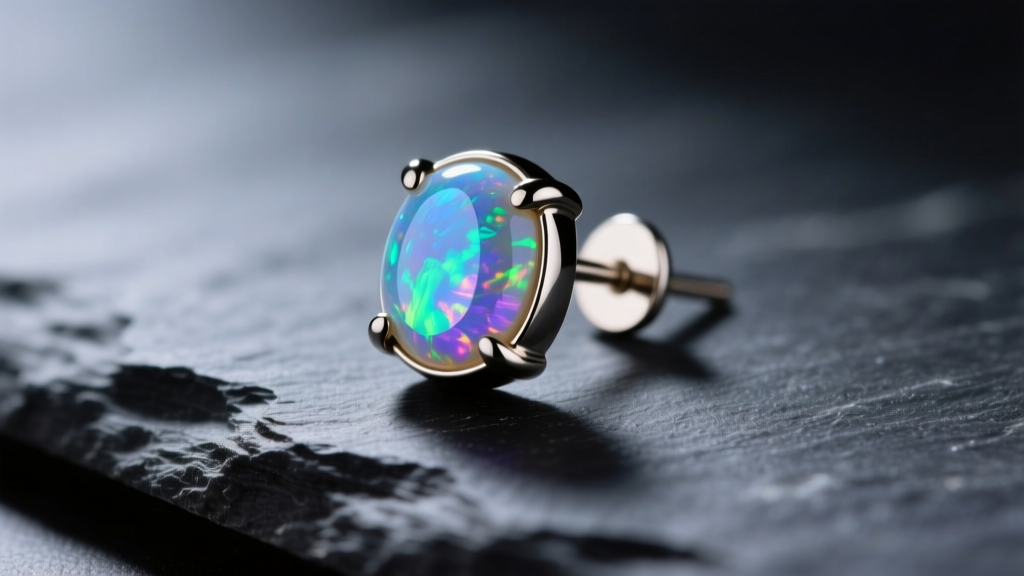
If you have ever struggled with traditional butterfly-back studs poking you while you sleep, or experienced irritation bumps on your cartilage piercings, you have likely encountered the limitations of standard earring posts. So, what are flat back earrings? Often referred to in professional piercing studios as labret studs, flat back earrings feature a completely flat, smooth disc at the base of the post instead of a pointed tip or a bulky friction back. This disc sits flush against the skin, eliminating pressure points, reducing snagging on hair and clothing, and providing a vastly superior healing environment for both lobe and cartilage piercings.
While the structural design of a flat back earring is universally praised by dermatologists and professional piercers for its ergonomic benefits, the material of the earring dictates its biocompatibility, longevity, and overall safety. A poorly chosen metal can lead to contact dermatitis, delayed healing, and tissue rejection, regardless of how perfectly the flat disc fits.
Metallurgy & Material Properties: Choosing Your Metal
Not all metals interact with the human body in the same way. The micro-environment of a piercing channel is warm, moist, and slightly acidic, which can accelerate the corrosion of substandard alloys. Below is a deep dive into the most common materials used for flat back earrings, evaluated on their metallurgical properties and biocompatibility.
Implant-Grade Titanium (ASTM F136)
When professional piercers recommend titanium, they are specifically referring to ASTM F136 implant-grade titanium (Ti-6Al-4V-ELI). This is an alloy containing aluminum and vanadium, processed to extremely strict medical standards for use in surgical implants like joint replacements. It is entirely nickel-free, highly resistant to corrosion, and significantly lighter than steel. According to the Association of Professional Piercers (APP), ASTM F136 is the gold standard for initial piercings and sensitive healed ears. Beware of "commercially pure" titanium (ASTM F67), which is softer and more prone to surface scratching, potentially harboring bacteria in the micro-grooves.
Solid Gold (14k vs. 18k)
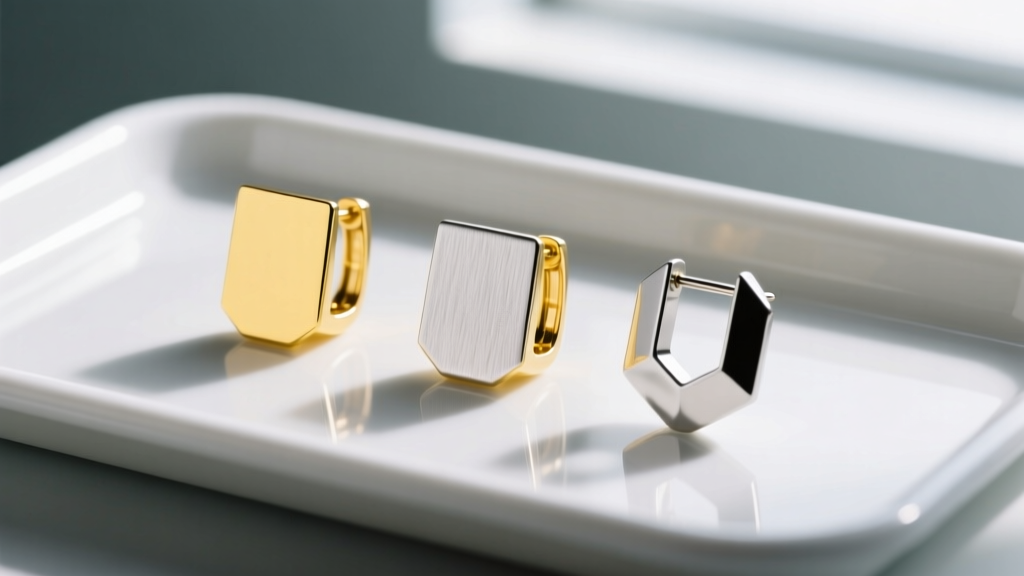
Solid gold is a premium choice for flat back earrings, but its purity dictates its safety. Pure 24k gold is too soft for body jewelry and will easily bend or warp. Therefore, gold is alloyed with other metals. 14k and 18k gold are ideal, provided they are explicitly alloyed to be nickel-free. Many mass-market jewelers use nickel to bleach gold or increase hardness, which triggers severe allergic reactions. High-quality body jewelry brands alloy their gold with palladium or silver instead. While 18k gold offers a richer color, 14k gold is slightly harder and more resistant to scratching, making it an excellent choice for high-friction areas like the tragus or helix.
The 316L Surgical Steel Trap
Surgical steel (typically 316L) is widely sold in mall kiosks and fast-fashion retailers due to its low cost and shiny finish. However, 316L steel contains between 8% and 10% nickel. While the nickel is bound within the alloy, the saline environment of a piercing can cause microscopic amounts of nickel to leach into the tissue over time. For individuals with a nickel allergy—a condition affecting roughly 10% to 20% of the population, as noted by the Cleveland Clinic—surgical steel flat backs will cause persistent itching, redness, and weeping. Steel should be strictly avoided for fresh piercings and by anyone with known metal sensitivities.
Gauge, Length, and Placement Matrix
Understanding what flat back earrings are also requires understanding their precise sizing. Unlike standard earrings that rely on a one-size-fits-all approach, flat backs must be sized to the exact thickness of your tissue to prevent migration or embedment. The post length must account for the natural swelling of the tissue, plus a 1mm to 2mm clearance for the flat disc to sit comfortably without compressing the skin.
| Piercing Placement | Standard Gauge (Thickness) | Initial Healing Length | Downsized Healed Length |
|---|---|---|---|
| Standard Lobe | 18G (1.0mm) or 16G (1.2mm) | 8mm (5/16") | 6mm (1/4") |
| Helix / Cartilage | 16G (1.2mm) | 8mm (5/16") or 10mm (3/8") | 6mm (1/4") |
| Tragus | 16G (1.2mm) | 6mm (1/4") or 8mm (5/16") | 5mm (3/16") |
| Conch | 14G (1.6mm) or 16G (1.2mm) | 8mm (5/16") to 10mm (3/8") | 6mm (1/4") to 8mm (5/16") |
Threading Mechanics: Internal vs. Threadless
The mechanism that holds the decorative top to the flat back post is just as critical as the metal itself. There are two acceptable standards in professional body jewelry, and one that must be avoided at all costs.
- Threadless (Push-Pin): The decorative top features a slightly bent pin that inserts into the hollow post. The tension of the bent metal against the inner wall of the post holds it securely. This is the preferred method for most piercers because it eliminates the risk of cross-threading and allows for seamless insertion.
- Internally Threaded: The screw threads are located on the inside of the hollow post, and the decorative top has a smooth pin that screws into it. This ensures that no sharp threads pass through the piercing channel.
- Externally Threaded (Avoid): The screw threads are on the outside of the post. Every time you insert or remove the earring, these sharp, jagged metal threads scrape through the delicate fistula (tissue tube), causing micro-tears and introducing bacteria. Never purchase externally threaded flat back earrings.
"The transition to threadless and internally threaded jewelry has drastically reduced the rate of irritation bumps and delayed healing in cartilage piercings. The mechanical trauma caused by external threads is a primary culprit in chronic piercing inflammation." — Professional Piercer Guidelines, APP
Troubleshooting Fit and Tissue Embedment
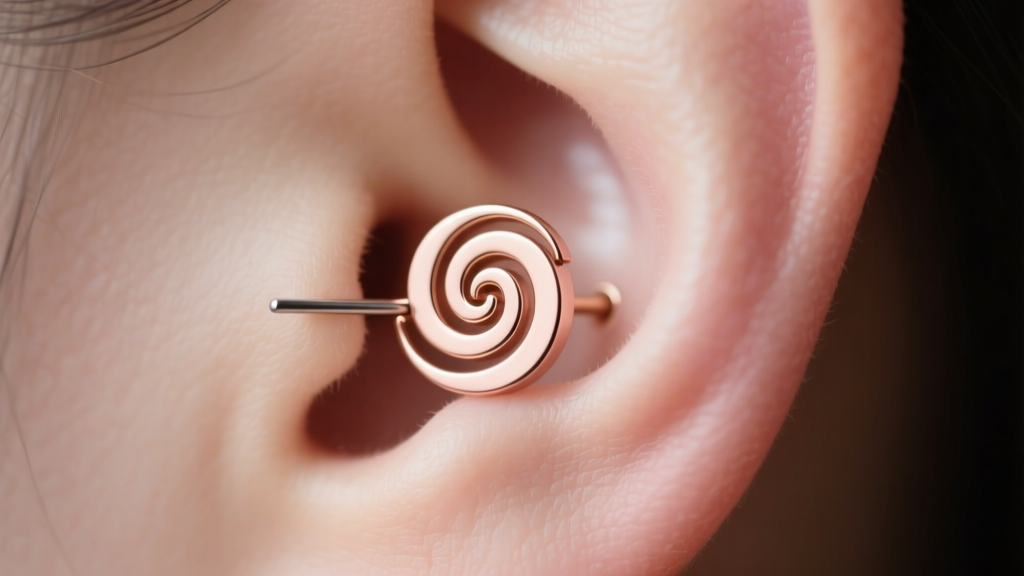
Even with the highest quality ASTM F136 titanium, a poorly sized flat back earring will cause physical trauma. The most common failure mode with flat backs is tissue embedment. This occurs when the post is too short for the thickness of the tissue, or when initial swelling is underestimated. As the tissue swells, the flat disc is forced into the skin, eventually being swallowed by the healing tissue. This is a medical emergency requiring immediate intervention by a professional piercer or doctor to prevent necrosis and severe scarring.
How to Measure for a Replacement
If your current flat back feels tight, or if the disc is leaving a deep, persistent indentation in your skin, you must upsize the post length immediately. To measure your required length:
- Wash your hands thoroughly with antibacterial soap.
- Carefully remove the current earring (if it is fully healed and not embedded).
- Use a digital caliper to measure the post from the base of the disc to the end of the pin, excluding the threading or pin mechanism.
- Add 1mm to 2mm to this measurement to allow for natural tissue movement and lymphatic drainage.
- Purchase a high-quality replacement in the new length, ensuring the gauge (thickness) remains identical to your current jewelry to avoid stretching or irritating the fistula.
Ultimately, understanding what flat back earrings are goes far beyond their aesthetic appeal. By prioritizing implant-grade materials, precision sizing, and safe threading mechanisms, you transform a simple piece of jewelry into a biocompatible tool that promotes long-term tissue health and unparalleled daily comfort.


