When Did Men Start Wearing Earrings? History & Modern Style
Discover when men started wearing earrings, from ancient Persia to 2026 curated ear trends. Explore gauge sizes, materials, and styling frameworks.


The Ancient Origins: When Did Men First Start Wearing Earrings?
If you are asking when did men start wearing earrings, the answer predates modern civilization by thousands of years. Ear piercing is one of the oldest known forms of body modification, and historically, it was predominantly a male practice. The earliest physical evidence comes from Ötzi the Iceman, a natural mummy dating back to roughly 3300 BCE. Ötzi had stretched earlobe piercings measuring approximately 7-11mm in diameter, proving that men were modifying their ears during the Copper Age.
Beyond physical remains, archaeological artifacts and ancient carvings provide massive cultural context. According to The Metropolitan Museum of Art, jewelry in antiquity was heavily tied to social status, spiritual protection, and tribal affiliation. In ancient Persia, specifically within the Achaemenid Empire (circa 550–330 BCE), earrings were a staple of masculine military and royal attire. The stone carvings at Persepolis depict Persian soldiers and noblemen wearing elaborate hoop earrings and drop styles, signifying their rank and wealth. Similarly, in ancient Egypt, pharaohs and high-ranking male officials adorned their ears with heavy gold plugs and intricate dangles, utilizing the metal’s association with the sun god Ra.
Maritime Myths and the Sailor’s Silver
As we move into the Middle Ages and the Age of Exploration, the masculine earring evolved from a symbol of royal lineage to a talisman of survival. Sailors, pirates, and explorers in the 16th to 19th centuries famously wore single hoop earrings, typically crafted from silver or gold. This was not merely a fashion statement; it was rooted in deep maritime superstition and practical economics.

Maritime lore suggested that piercing the earlobe improved long-distance eyesight, a vital skill for navigators and lookouts. More importantly, a gold or silver earring served as a portable insurance policy. If a sailor drowned and washed ashore, the precious metal earring was meant to pay for a proper Christian burial. Furthermore, crossing the equator or rounding Cape Horn earned a sailor the right to wear specific hoops, turning the earring into a wearable resume of nautical endurance.
The 20th Century: Counterculture and the "Left Ear" Myth
By the mid-20th century, men’s earrings in Western culture had largely vanished, relegated to specific subcultures. The Beatnik movement of the 1950s and the hippie counterculture of the 1960s and 70s revived the practice as a symbol of anti-establishment rebellion. However, it was the 1980s and 1990s that introduced a complex, unspoken coding system to men’s ear piercings.
During this era, the "left ear is right, right ear is wrong" myth dominated Western fashion. A single stud in the left ear was deemed socially acceptable and heterosexual, while the right ear was heavily coded as a covert signal for homosexuality. This arbitrary rule dictated men's jewelry choices for two decades. Simultaneously, the explosion of hip-hop culture in the 80s and 90s completely rewrote the rules of masculine jewelry. Icons like Tupac Shakur and The Notorious B.I.G. popularized the diamond stud, transforming the earring from a counterculture rebellion into a mainstream symbol of success, wealth, and cultural pride.
2026 Trend Analysis: The Modern Man's Curated Ear
Today, the outdated stigmas and "coded" ear rules are entirely obsolete. In 2026, men’s ear styling is defined by the "curated ear"—a bespoke, highly individualized approach to jewelry placement that borrows heavily from gender-fluid fashion and high-end body jewelry studios. Men are no longer limited to a single diamond stud; they are building full ear projects incorporating huggies, flat-back labrets, ear cuffs, and threadless ends.
"The modern masculine ear project relies on negative space and mixed metals. We are seeing a massive shift away from bulky, heavy dangles toward sleek, architectural huggies and micro-gemstone threadless ends that sit flush against the cartilage."
Modern Men's Earring Styles & Technical Specifications
| Style | Ideal Placement | Standard Gauge | Material Recommendation | Avg. Price Range (2026) |
|---|---|---|---|---|
| Clicker Huggie | Lobe, Helix, Daith | 16g (1.2mm) | ASTM F136 Titanium | $45 - $120 |
| Threadless Flat Back | Lobe, Conch, Flat | 18g (1.0mm) / 16g | 14k Solid Gold | $85 - $250+ |
| Seamless Segment Ring | Tragus, Helix | 18g (1.0mm) | Niobium / Titanium | $30 - $75 |
| Ear Cuff (Non-Pierced) | Outer Helix Ridge | N/A | Sterling Silver / Gold Plated | $25 - $90 |
| Single Diamond Stud | Lobe | 18g (1.0mm) | Platinum / 18k Gold | $300 - $2,000+ |
Technical Buying Guide: Gauges, Materials, and Threading
To build a high-quality, masculine ear wardrobe, you must understand the technical specifications of body jewelry. Buying cheap, mass-produced mall kiosk jewelry leads to contact dermatitis, migration, and tissue tearing.
1. Material Grades Matter
The Association of Professional Piercers (APP) strictly recommends specific materials for body jewelry. Avoid the vague marketing term "surgical steel," which often contains nickel and causes severe allergic reactions. Instead, look for:
- ASTM F136 Implant-Grade Titanium: The gold standard for sensitive ears. It is completely nickel-free, lightweight, and can be anodized to different colors.
- Niobium: A highly biocompatible, pure elemental metal that is excellent for seamless rings and clickers.
- 14k or 18k Solid Gold: Ensure it is nickel-free and alloyed for body jewelry. Avoid gold-plated brass or copper, as the plating will eventually wear off and react with your skin's pH.
2. Threading Mechanics
Never wear externally threaded jewelry (where the screw is on the post that passes through the skin). The threads act like a cheese grater on your fistula. For men's cartilage and lobe projects, rely on threadless (push-pin) or internally threaded jewelry. Threadless ends use a slight bend in the pin to create tension inside the hollow post, offering a secure, seamless look that is perfect for flat-back studs in the conch or lobe.
Curation Framework: Building Your Ear Project
If you are moving beyond a standard lobe piercing and want to embrace the 2026 curated ear trend, follow this structural framework to maintain a balanced, masculine aesthetic:
- Anchor with a Huggie: Start with a 16-gauge titanium or solid gold clicker huggie in the primary lobe piercing. Huggies provide a rugged, structured look that frames the jawline without dangling.
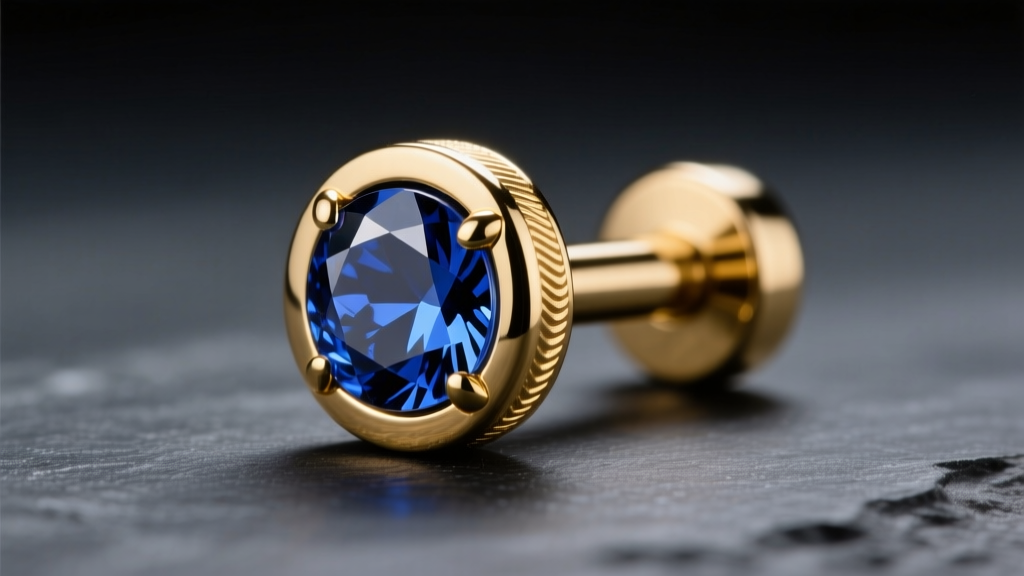
- Add a Flat Focal Point: Place a threadless flat-back labret with a dark gemstone (like black onyx, sapphire, or dark spinel) in the conch or upper lobe. The flat profile ensures it won't snag on headphones or collars.
- Incorporate Negative Space: Do not overfill the ear. Leaving one or two natural ridges unpierced creates visual breathing room and prevents the ear from looking cluttered.
- Maintain Metal Consistency: While mixing metals is trending in women's jewelry, a cohesive masculine ear project usually benefits from sticking to one metal tone (e.g., all yellow gold or all silver-toned titanium) to maintain a deliberate, sharp aesthetic.
Understanding when men started wearing earrings reveals a history of power, survival, and self-expression. By combining this rich heritage with modern, biocompatible materials and intentional styling, today's curated ear is less about following outdated rules and more about mastering the architecture of personal style.


