White Earrings for Women: 2026 Buying Guide & Top Picks
Discover the ultimate 2026 buying guide for white earrings for women. Compare ceramics, enamels, and white gold to find your perfect pair.

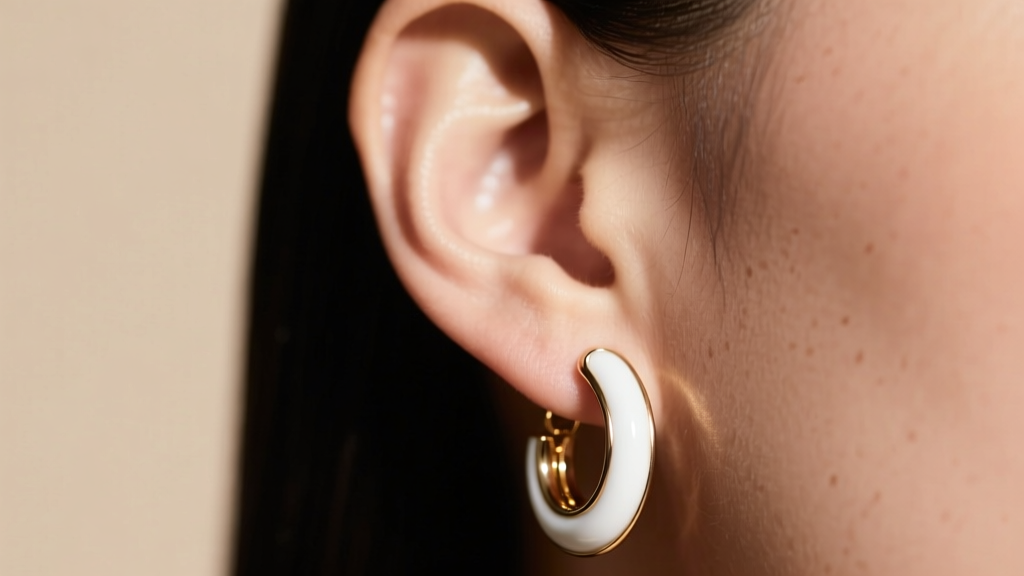
The Evolution of White Earrings in 2026
The jewelry landscape has shifted dramatically as we move through 2026, moving away from hyper-minimalism toward what industry experts call 'sculptural luminosity.' At the center of this trend are white earrings for women, which have evolved from basic pearl studs into complex, mixed-material statement pieces. Whether you are navigating the boardroom, attending a gallery opening, or simply elevating your daily uniform, white reflects light directly onto the face, providing an instant brightening effect that no other color can replicate.
However, the term 'white' in jewelry is a broad umbrella. It encompasses everything from fragile glass enamels and organic pearls to high-tech zirconium ceramics and rhodium-plated white gold. Making the wrong choice can lead to chipped inlays, tarnished backings, or gemstone crazing within months of purchase. This comprehensive buying guide breaks down the metallurgy, gemology, and structural engineering you need to know before investing in your next pair.
Material Matrix: Decoding the 'White' Spectrum
Not all white materials are created equal. The durability, weight, and price point of your earrings will depend entirely on the base material and the finishing technique. Below is a comparative matrix to help you align your budget with your lifestyle requirements.
| Material Category | Mohs Hardness | Avg. Price Range | Best Use Case | Primary Vulnerability |
|---|---|---|---|---|
| High-Tech Ceramic | 8.5 - 9.0 | $90 - $350 | Everyday hoops & huggies | Shattering under extreme blunt force |
| Vitreous Enamel | 4.5 - 5.5 | $40 - $150 | Occasion wear & dangles | Chipping from thermal shock or drops |
| 14k/18k White Gold | 2.5 - 3.0 (Metal) | $250 - $900+ | Heirloom studs & settings | Rhodium plating wear-off |
| 950 Platinum | 4.0 - 4.5 (Metal) | $600 - $2,000+ | Luxury cartilage & lobe studs | Surface patina (scratching) |
| White Mother of Pearl | 2.5 - 3.5 | $50 - $200 | Large statement drops | Acid erosion from perfumes/sweat |
Ceramic vs. Enamel: The Durability Test
If you are looking for a stark, opaque white finish, you will likely encounter either enamel or ceramic. Traditional vitreous enamel is essentially finely ground glass powder fused to a metal base (usually brass or sterling silver) at high temperatures. While beautiful, enamel scores around a 5.0 on the Mohs hardness scale. It is highly susceptible to 'thermal shock'—meaning if you wear enamel earrings in a hot sauna and then step into cold air, the microscopic expansion and contraction can cause the glass to craze or pop off the metal backing.
Conversely, high-tech ceramic (zirconium dioxide) is a modern marvel. Used in aerospace engineering and luxury watchmaking, ceramic is sintered at extreme temperatures to create a material that is virtually scratch-proof and impervious to temperature changes. 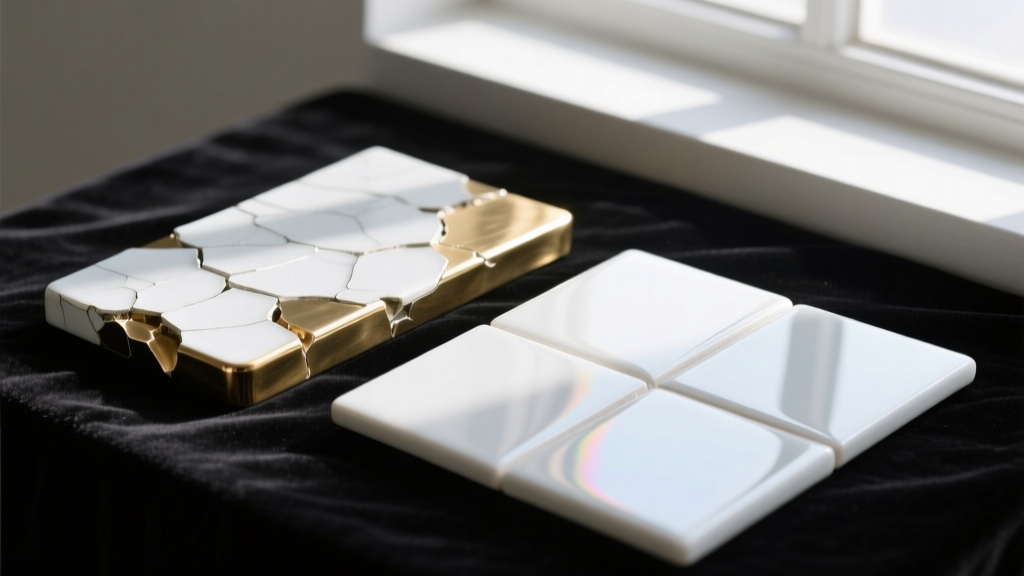 While enamel requires a delicate touch, ceramic huggies and hoops can be worn in the shower, at the gym, and during travel without fear of degradation. The trade-off? Ceramic is brittle; a hard drop onto a tile floor can shatter it, whereas enamel will merely chip.
White Gold vs. Platinum: The Premium Investment
When selecting the metal framework for white diamond or white sapphire earrings, buyers often default to white gold. However, it is crucial to understand that white gold does not actually exist in nature. It is an alloy of yellow gold mixed with white metals like palladium, nickel, or silver. To achieve the mirror-like 'white' finish, it is electroplated with a microscopic layer of rhodium (a platinum-group metal). Over 12 to 18 months of daily wear, this rhodium layer wears away, revealing the faint yellowish-grey alloy beneath. Re-plating costs between $40 and $80 per visit.
Platinum 950, on the other hand, is 95% pure platinum and naturally white. It does not require rhodium plating. According to the Jewelers of America, platinum is also denser and more secure for gemstone prongs. While platinum costs roughly 40% more upfront than 18k white gold, the lifetime maintenance cost is often lower, making it the superior choice for heirloom-quality white earrings.
Gemstone Spotlight: Beyond the Classic Pearl
While Akoya and South Sea pearls remain the undisputed queens of organic white gems, 2026 has seen a massive surge in alternative white gemstones that offer unique optical phenomena without the high maintenance of nacre.
White Topaz and Moonstone Alternatives
White topaz is an exceptional, budget-friendly alternative to diamonds. With a Mohs hardness of 8.0, it is highly resistant to scratching and offers brilliant clarity. However, it lacks the 'fire' (dispersion) of a diamond. For those seeking ethereal glow, rainbow moonstone (a variety of labradorite) offers 'adularescence'—a billowy, floating white-to-blue light that moves across the stone as it catches the light. Moonstone is much softer (6.0 - 6.5 Mohs) and possesses perfect cleavage, meaning it must be set in protective bezels rather than exposed prong settings to prevent splitting.
Opal Inlays and Crazing Risks
White opals, particularly those from Coober Pedy, Australia, provide a mesmerizing play-of-color against a milky white body color. However, opals contain up to 20% water. If exposed to extreme dry heat or sudden temperature shifts, they can develop a network of fine cracks known as 'crazing.' The Gemological Institute of America (GIA) strongly recommends storing opal jewelry in a climate-controlled environment and never cleaning them in ultrasonic machines, which will instantly destroy the stone's internal structure.

Sizing, Gauge, and Piercing Placement
A common failure point when buying earrings online is ignoring the post gauge (thickness) relative to your specific piercing. Cartilage and lobe piercings require entirely different structural specifications to avoid irritation, migration, or the dreaded 'cheese-cutter effect' (where a thin wire slowly slices through the tissue).
- Standard Lobe Piercings (20G / 0.81mm or 18G / 1.02mm): Most commercial white gold studs and lightweight enamel drops are crafted at 20G or 18G. This is ideal for the soft tissue of the lower earlobe.
- Upper Lobe & Flat Piercings (18G / 1.02mm or 16G / 1.29mm): If you are placing white ceramic studs in the upper lobe or flat region, opt for 18G or 16G to provide stability against the thicker, denser tissue.
- Helix & Conch Cartilage (16G / 1.29mm): Cartilage piercings are almost universally pierced at 16G. Inserting a flimsy 20G white gold wire into a 16G cartilage hole will cause the jewelry to move excessively, leading to irritation bumps and delayed healing.
Skin Tone Pairing & The Mixed-Metal Trend
Historically, the rule was simple: cool skin tones wore silver/platinum, and warm skin tones wore yellow gold. However, white earrings introduce a unique variable because the 'white' front acts as a reflector. In 2026, the most avant-garde styling technique involves mixed-metal backings. Imagine a stark white ceramic or mother-of-pearl front, backed by a rich 14k yellow gold post and butterfly clutch. The yellow gold warms up the starkness of the white material, making it incredibly flattering for olive and warm undertones, while the white front maintains that crisp, modern edge.
Expert Troubleshooting: Avoiding Common Pitfalls
The Ultrasonic Trap: Never place white enamel, opals, pearls, or moonstones in an ultrasonic jewelry cleaner. The high-frequency vibrations will shatter enamel, craze opals, and strip the nacre off pearls. Instead, use a soft microfiber cloth and a drop of mild, phosphate-free dish soap in lukewarm water to clean your white earrings.
Another frequent issue is the degradation of silicone earring backs. While clear silicone O-rings are popular for securing heavy white stone drops, they degrade rapidly when exposed to the sulfur in human sweat and the alcohol in hand sanitizers. Replace silicone backs every three months, or upgrade to flat-disc friction backs in 18k white gold for a secure, hygienic, and long-lasting hold.
Final Verdict & Care Instructions
Investing in white earrings for women is an exercise in balancing aesthetics with material science. For indestructible, everyday wear, high-tech ceramic huggies are unmatched. For heirloom brilliance, platinum-set white topaz or diamonds offer generational longevity without the maintenance of rhodium replating. By paying close attention to gauge sizes, avoiding ultrasonic cleaners, and understanding the inherent vulnerabilities of organic gems, your white earrings will remain as luminous in 2036 as they are today.


