Winnie the Pooh Earrings Gold: 2026 Value & Budget Guide
Assess the true value of Winnie the Pooh earrings in gold. Compare 14k solid, vermeil, and plated options for budget, longevity, and skin safety.

The 2026 Market for Nostalgic Disney Gold Jewelry
The intersection of childhood nostalgia and fine jewelry has created a massive surge in character-themed accessories, with Winnie the Pooh remaining one of the most sought-after motifs. As we navigate the 2026 jewelry market, consumers are increasingly scrutinizing the 'kidcore' and nostalgic jewelry trends, moving away from fast-fashion accessories toward pieces that offer genuine longevity and material value. When searching for Winnie the Pooh earrings gold options, buyers are immediately confronted with a wildly fragmented market. Prices can range from $12 for unlicensed, mass-produced alloys to over $600 for custom-cast, solid 14k gold pieces.
Understanding the true value of these earrings requires looking past the beloved Hundred Acre Wood aesthetic and examining the metallurgy, intellectual property (IP) licensing, and structural mechanics of the jewelry. This comprehensive budget and value assessment will break down exactly what you are paying for, helping you determine whether a budget-friendly vermeil pair or an investment-grade solid gold casting is the right choice for your collection.
Material Breakdown: Plated vs. Solid Gold Pooh Earrings
The term 'gold' is heavily manipulated in the fashion jewelry space. To accurately assess value, we must categorize the market into three distinct material tiers. The Federal Trade Commission Jewelry Guides strictly regulate how gold content can be advertised, yet many overseas marketplaces ignore these guidelines, leading to consumer confusion regarding skin safety and tarnish resistance.
| Material Grade | Typical Price Range | Gold Content & Base | Longevity & Skin Safety |
|---|---|---|---|
| Gold-Plated Brass | $12 - $35 | <0.5 microns over brass/alloy | Poor. High nickel risk; tarnishes within months of daily wear. |
| Gold Vermeil | $45 - $95 | 2.5+ microns over 925 Sterling Silver | Good. Hypoallergenic base; requires gentle care to preserve plating. |
| Solid 10k Gold | $150 - $250 | 41.7% pure gold alloy | Excellent. Highly durable, though the yellow hue is slightly muted. |
| Solid 14k Gold | $300 - $700+ | 58.5% pure gold alloy | Heirloom quality. Tarnish-resistant, hypoallergenic, and holds intrinsic scrap value. |
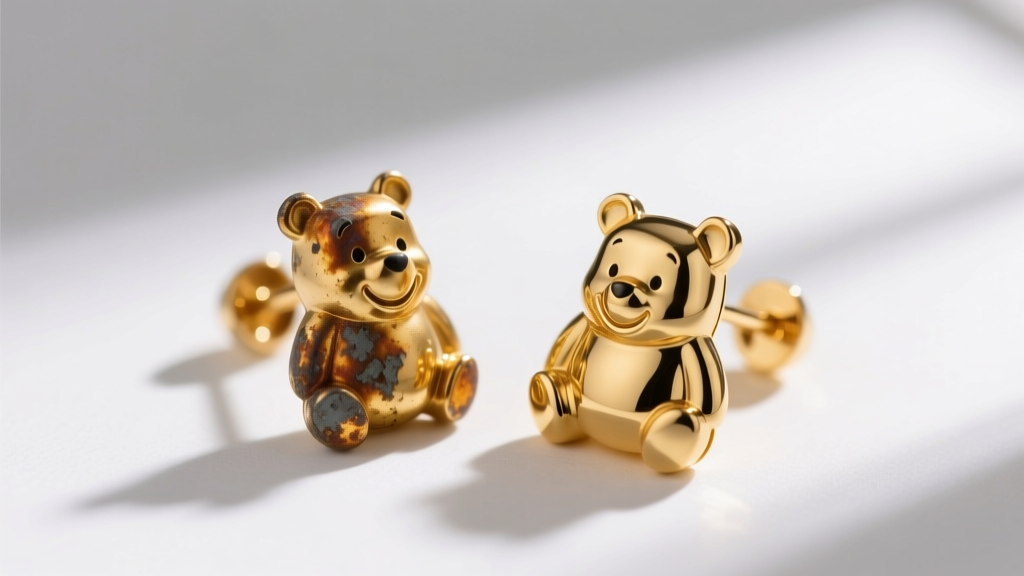
For buyers on a strict budget, gold vermeil offers the best compromise. Because the base metal is sterling silver rather than brass, you eliminate the risk of nickel-induced contact dermatitis—a common failure mode with cheap, unlicensed character earrings found on e-commerce platforms. However, if you intend to wear your Pooh studs daily, the friction of hair and clothing will eventually wear through the 2.5-micron gold layer, necessitating professional re-plating every few years.
Official vs. Unlicensed: Where the Real Value Lies
Disney fiercely protects its intellectual property. This legal reality deeply impacts the pricing and availability of authentic Winnie the Pooh earrings. When you purchase from the Disney Store Official Merchandise catalog or authorized partners like Pandora, a portion of the premium you pay covers the licensing fee.
The Unlicensed 'Fan Art' Market
Platforms like Etsy and AliExpress are flooded with independent jewelers casting Winnie the Pooh designs in solid 10k or 14k gold. From a purely metallurgical standpoint, a $350 custom-cast 14k gold Pooh earring from an independent artisan offers immense material value compared to a $250 gold-plated silver piece from an official licensed brand. However, unlicensed items carry zero resale value as 'official merchandise' and are subject to sudden takedowns, making warranties or future repairs from the original seller highly unreliable.
The Official Premium
Official Disney Parks merchandise occasionally releases limited-run solid 14k gold jewelry, usually through high-end partnerships or exclusive park locations (such as the Jewelers in the Magic Kingdom). These pieces command a massive premium—often 40% to 60% above the intrinsic melt value of the gold—due to the official hallmark and the Disney stamp. For collectors, this premium is justified; for pure jewelry enthusiasts, it represents a poor financial return on investment.
Sizing, Gauges, and Earring Mechanics
A critical, often overlooked aspect of value assessment is the mechanical engineering of the earring post and backing. Character earrings often feature asymmetrical or slightly top-heavy charms (such as Pooh reaching for a honey pot), which places uneven stress on the earlobe.
- 22-Gauge (0.64mm) Posts: Standard for most official Disney Store fashion jewelry. While fine for lightweight studs, a 22g post will easily bend if the gold charm exceeds 1.5 grams, leading to a warped post that is difficult to insert.
- 20-Gauge (0.81mm) Posts: The industry standard for quality fashion and fine jewelry. Offers a good balance of comfort and structural integrity for medium-weight charms.
- 18-Gauge (1.02mm) Posts: Typically reserved for high-end, custom solid gold castings. If you are investing $500+ in solid 14k gold Pooh earrings, demand an 18g or 19g post to ensure the jewelry survives decades of wear without bending.
Furthermore, evaluate the earring back. Standard friction backs (butterfly clutches) are notorious for slipping off heavy charms. If you are purchasing solid gold dangles or 3D cast studs, ensure the jeweler provides La Pousette (locking) backs or secure screw-backs to prevent the catastrophic loss of your investment.
The Enamel Factor: A Hidden Vulnerability
Winnie the Pooh’s iconic red shirt is frequently rendered using enamel. In budget earrings, this is 'cold enamel' (an epoxy resin) which will yellow, scratch, and chip within a year. High-end jewelers use vitreous enamel (fired glass). While vitreous enamel maintains its brilliant red hue indefinitely, it is essentially glass fused to metal. Dropping a vitreous enamel earring onto a porcelain bathroom sink will shatter the red shirt, leaving you with a costly, unrepairable gold charm. For maximum durability and long-term value, opt for fully cast solid gold designs that rely on metal texturing rather than enamel for visual contrast.

Care, Maintenance, and Longevity
According to the Gemological Institute of America (GIA), 14k gold is an exceptionally stable alloy, highly resistant to the oxidation that plagues silver and copper. However, the maintenance routine for your Pooh earrings depends entirely on their finish.
Expert Tip: Never place enameled character earrings in an ultrasonic jewelry cleaner. The high-frequency vibrations will cause microscopic fractures in the enamel, leading to eventual flaking. Solid, un-enameled gold pieces, however, benefit greatly from a 3-minute ultrasonic bath in a mild ammonia-free solution to remove sebum and lotion buildup from the crevices of the casting.
For daily maintenance, a simple microfiber polishing cloth is sufficient to maintain the luster of solid gold. If you own vermeil Pooh earrings, avoid polishing cloths entirely, as the mild abrasives will strip the thin 2.5-micron gold layer, exposing the silver beneath and accelerating tarnish.
Final Verdict: Budgeting for Your Hundred Acre Wood Investment
The true value of Winnie the Pooh earrings in gold is not dictated solely by the character's silhouette, but by the integrity of the materials and the mechanics of the hardware. If your budget is under $100, seek out high-quality 18k gold vermeil over a sterling silver base from reputable independent artisans, ensuring you avoid the nickel-laden traps of mass-produced alloy jewelry.
However, if you are allocating $300 or more, bypass the official licensed fashion jewelry—which often relies on heavy branding markups and fragile enamel—and invest in a custom-cast, solid 14k gold pair with an 18-gauge post and secure locking backs. By prioritizing metallurgical purity and structural engineering over IP licensing fees, you secure a piece of nostalgic jewelry that will genuinely last a lifetime, proving that sometimes, the smartest investment is the one built to endure.


