Yin And Yang Earrings: Technical Guide To Interlocking Designs
Discover the engineering behind yin and yang earrings. We analyze interlocking mechanics, enamel inlay techniques, gauge tolerances, and metal alloys.

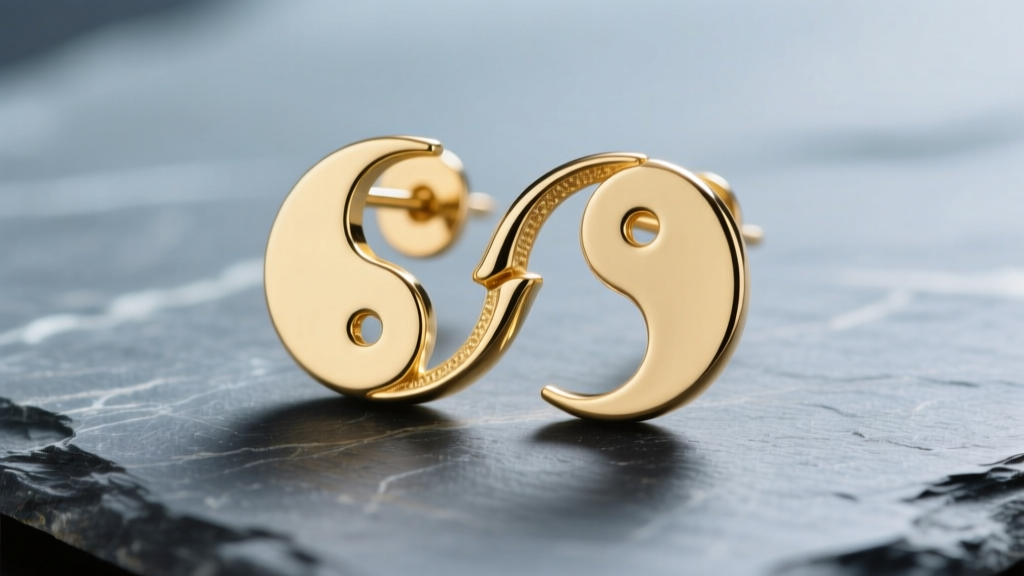
The Engineering of Balance: Anatomy of Interlocking Designs
When evaluating yin and yang earrings from a manufacturing perspective, the primary challenge is structural integrity along the S-curve boundary. Unlike solid geometric studs, the duality motif requires either a static puzzle-fit joint or a dynamic spinner mechanism. Static interlocking yin and yang earrings demand extreme precision; the two halves must meet with a tolerance of ±0.05mm to prevent wobble, snagging on textiles, and eventual metal fatigue at the connection points. Mass-market cast pieces often exhibit gaps up to 0.2mm, which compromises the structural rigidity of the earring face and leads to premature bending of the post.
Dynamic spinner styles introduce a micro-rivet or tension-fitted bezel wire (typically 0.3mm thick) that allows one half of the symbol to rotate independently. This requires a perfectly calibrated pivot point. If the tolerance is too tight, the spinner seizes; if too loose, the rotating half wobbles laterally, creating an uneven visual profile and generating micro-abrasions against the stationary base plate. High-end jewelers utilize CNC (Computer Numerical Control) machining rather than traditional lost-wax casting to achieve the exact dimensional accuracy required for these moving parts.
Material Tolerances and Metal Alloys
The choice of base metal dictates the longevity of both static and dynamic yin and yang earrings. For spinner mechanisms, the friction coefficient of the alloy is the most critical variable. 316L Surgical Steel is widely used in mid-tier jewelry, but it is susceptible to 'galling' (cold welding) in high-friction micro-joints. When the steel spinner rubs against the steel base plate repeatedly, microscopic debris accumulates, eventually seizing the pivot.
Conversely, Grade 23 Titanium (ASTM F136) offers a significantly lower friction coefficient and superior biocompatibility. According to the ASTM International standards for surgical implants, F136 titanium boasts an exceptional strength-to-weight ratio and high resistance to micro-corrosion. For yin and yang earrings intended for cartilage piercings or sensitive lobes, F136 titanium is the undisputed standard. It prevents the pivot from seizing due to oxidized sebum and environmental debris, ensuring the spinner remains fluid for years without requiring chemical lubricants.
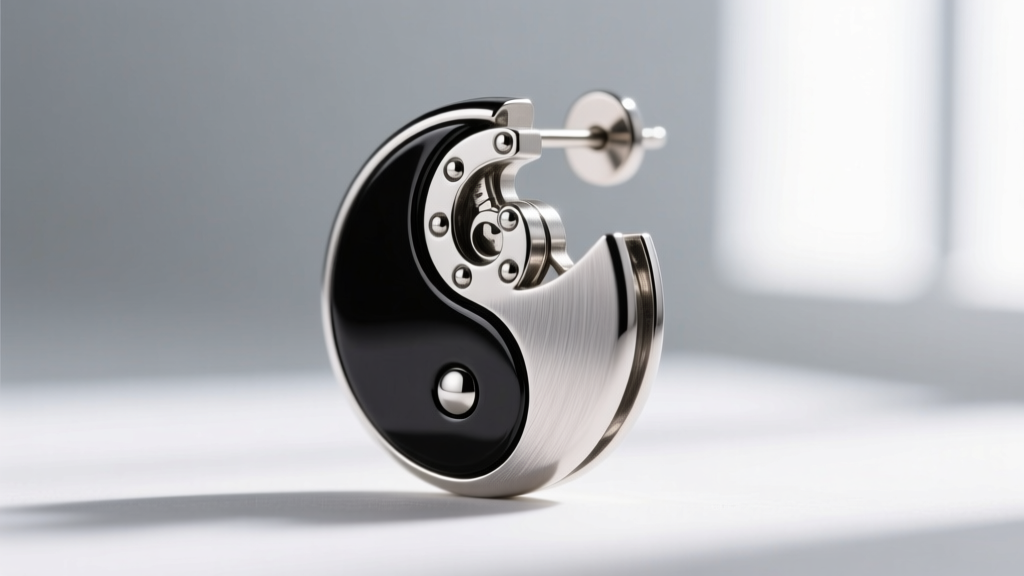
Enamel Inlay vs. Stone Setting: Durability Metrics
The contrasting halves of yin and yang earrings are traditionally rendered in black and white. While white is easily achieved with polished metal, mother-of-pearl, or white sapphire, the black half presents unique manufacturing hurdles. Jewelers typically rely on three methods: vitreous enamel, cold enamel (epoxy resin), or black rhodium plating. Each has distinct failure modes along the curved S-line boundary.
Comparative Failure Rates and Material Science
| Material | Application Method | Durability Profile | Common Failure Mode |
|---|---|---|---|
| Vitreous Enamel | Kiln-fired glass powder (1400°F) | Exceptional UV and scratch resistance | Brittle; chips upon direct impact to the S-curve edge |
| Cold Enamel (Epoxy) | Chemical curing resin | High impact resistance, flexible | Yellows after 2-3 years of UV exposure; shrinks from bezel |
| Black Rhodium | Electroplating | Deep metallic luster, no thickness added | Wears off in 6-12 months on high-friction spinner edges |
| Black Onyx Inlay | Custom-cut cabochon setting | Permanent, high-end finish | Requires complex calibration; risk of stone popping if bezel is weak |
For heirloom-quality yin and yang earrings, vitreous enamel or custom-cut black onyx inlays are preferred. The Gemological Institute of America (GIA) notes that while vitreous enamel is essentially glass and can fracture, its color stability is permanent. Cold enamel, while cheaper and more shock-resistant, will inevitably degrade in color, ruining the high-contrast duality aesthetic that defines the design.
Gauge Sizing and Post Dimensions for Cartilage vs. Lobe
Weight distribution is a frequently overlooked factor in duality-themed jewelry. A standard 10mm yin and yang spinner earring crafted from solid 14k gold or surgical steel weighs approximately 2.8 to 3.4 grams. While this seems negligible, the asymmetrical weight distribution of the spinning half creates localized kinetic stress on the piercing fistula.
- Standard Lobe Piercings (20g / 0.8mm or 18g / 1.0mm): Suitable only for lightweight, static puzzle-fit studs. Heavy spinners on 20g wire will cause the post to bend backward, altering the angle of the earring face and potentially stretching the lobe over time.
- Heavy Lobe & Upper Lobe (16g / 1.2mm): The recommended minimum gauge for dynamic spinner styles. The 1.2mm thickness provides the necessary rigidity to support the kinetic movement without warping.
- Cartilage / Helix Placements (14g / 1.6mm or 16g / 1.2mm): When placing yin and yang earrings in the cartilage, a flat-back labret post is mandatory. The 'cheese-cutter effect'—where a thin, heavy wire slowly migrates through the cartilage tissue—is a severe risk with butterfly-back studs. A 16g or 14g internally threaded titanium flat-back distributes the weight across a wider surface area inside the fistula, preventing migration and rejection.
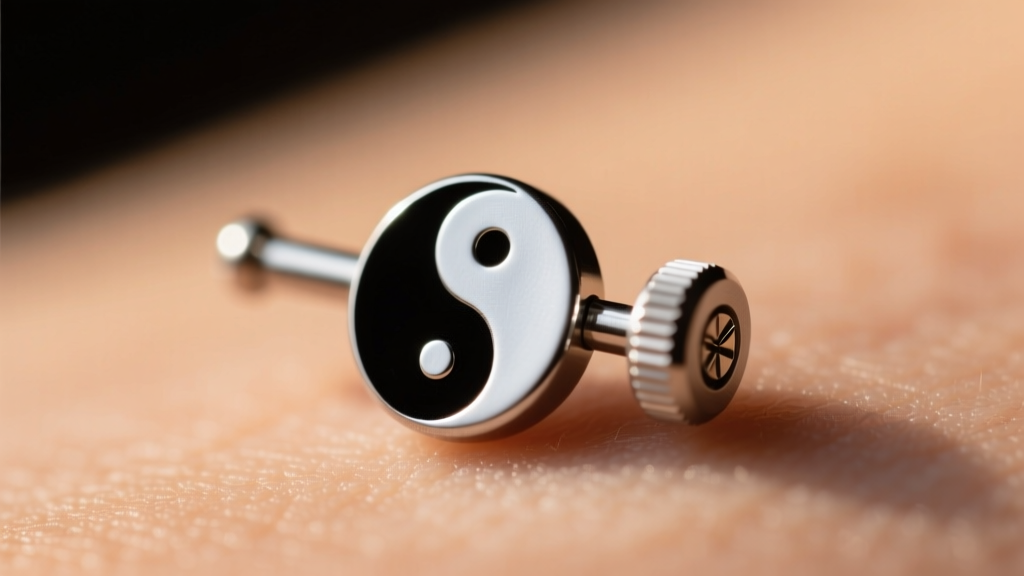
Maintenance: Lubrication and Tension Calibration
Even precision-machined yin and yang spinner earrings require periodic maintenance to maintain their kinetic fluidity. The micro-gap between the spinner and the base plate acts as a trap for dead skin cells, sebum, and cosmetic powders. When a spinner becomes stiff or emits a faint grinding noise, it is experiencing particulate friction, not metal failure.
To resolve this, avoid using harsh chemical dips or ultrasonic cleaners, which can strip vitreous enamel or degrade epoxy resins. Instead, use a soft-bristled detailing brush dipped in a mild, phosphate-free dish soap to gently agitate the S-curve seam. If the pivot remains stiff after cleaning, apply a microscopic drop of synthetic watch oil (such as Moebius 9010) to the central rivet using a fine needle. Do not use organic oils (like olive or jojoba oil), as they will oxidize, turn rancid, and create a sticky residue that will permanently seize the joint.
Sourcing and Price Tiers: What to Expect
Understanding the manufacturing reality of yin and yang earrings helps consumers navigate pricing tiers and avoid overpaying for poorly engineered pieces.
Tier 1: Mass-Market Cast ($15 - $45)
Produced via silicone mold casting. Tolerances are loose (±0.2mm). Posts are often soldered at a slight angle, and black halves are painted or plated with thin rhodium that flakes quickly. Acceptable for occasional wear, but mechanically flawed.
Tier 2: Mid-Range Fabricated ($80 - $250)
Typically crafted in 925 Sterling Silver or 316L Steel. Features cold enamel inlays and basic riveted spinners. The S-curve fit is tighter, but the steel pivots may require occasional cleaning to prevent galling.
Tier 3: Precision CNC & Fine Jewelry ($400 - $1,500+)
Machined from solid 14k/18k Gold or ASTM F136 Titanium. Features vitreous enamel or precision-cut onyx inlays. Tolerances are held to ±0.05mm, ensuring a seamless puzzle fit or a frictionless spinner mechanism that will last generations. Posts are internally threaded or threadless to protect the piercing tract.
Conclusion
The appeal of yin and yang earrings lies in their philosophical symbolism, but their execution is a rigorous test of a jeweler's technical proficiency. By prioritizing CNC-machined tolerances, biocompatible titanium alloys, and stable inlay materials like vitreous enamel or onyx, collectors can acquire pieces that are not only visually striking but mechanically bulletproof. Whether opting for a static puzzle-fit stud or a dynamic cartilage spinner, understanding the engineering beneath the S-curve ensures your jewelry remains as balanced and enduring as the concept it represents.


