10k Gold Rosary Necklace: Durability & Material Comparison Guide
Discover why a 10k gold rosary necklace offers superior durability. Compare 10k, 14k, and 18k gold alloys for daily wear rosary links and pendants.

The Unique Mechanical Demands of a Rosary Necklace
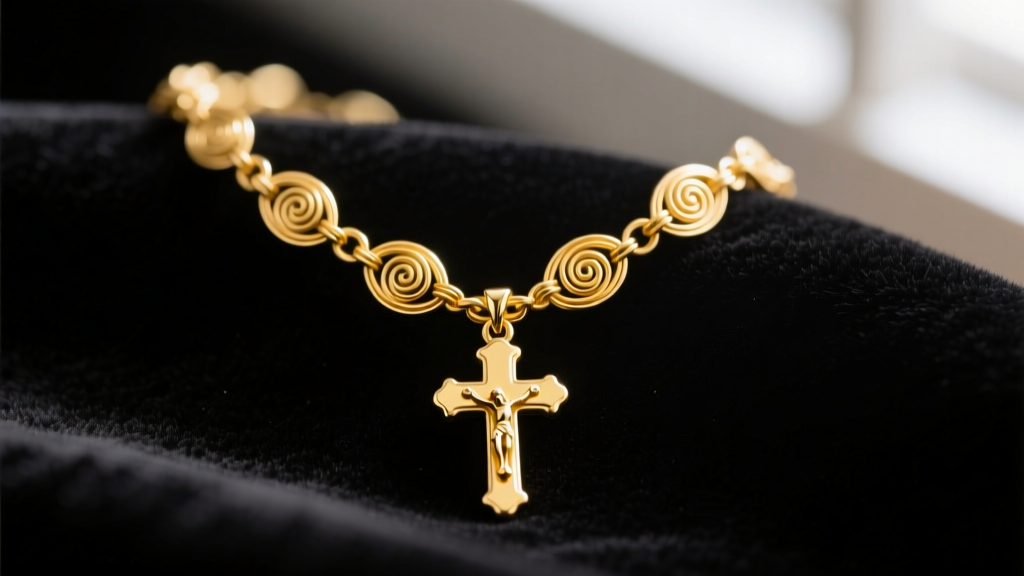
When evaluating fine jewelry, consumers often default to the assumption that higher gold purity equates to higher quality. However, this heuristic fails dramatically when applied to a 10k gold rosary necklace. Unlike a standard cable chain or a simple pendant necklace, a traditional rosary is a complex mechanical assembly. It consists of dozens of individual wire-wrapped links, gemstone or metal beads, a centerpiece (often a medal or sacred heart), and a terminal crucifix.
Because of this intricate architecture, a rosary is subjected to unique mechanical stresses. The wire loops that secure the beads act as microscopic hinges. Every time the necklace is draped, tucked, or pulled, these loops experience shear stress and torsional strain. If the gold alloy is too soft, the wire wraps will gradually loosen, leading to lost beads and structural failure. This is precisely where 10-karat gold transitions from a budget alternative to an engineering necessity for devotional jewelry.
Metallurgical Breakdown: What Exactly is 10k Gold?
To understand the performance of a 10k gold rosary necklace, we must examine its atomic composition. Pure 24k gold is notoriously malleable, possessing a tensile strength far too low for load-bearing jewelry components. To create 10k gold, pure gold is alloyed with a precise matrix of secondary metals. By definition, 10k gold contains exactly 41.7% pure gold (10 parts gold out of 24). The remaining 58.3% consists of alloy metals, typically a carefully calibrated mix of copper, silver, and zinc.
According to metallurgical standards outlined by the Gemological Institute of America (GIA), the specific ratio of these alloy metals dictates not only the color of the gold but its mechanical behavior:
- Copper: Increases hardness and tensile strength while imparting a warmer, reddish hue. High copper content is vital for the structural integrity of thin rosary wire.
- Silver: Adds malleability and ductility, allowing the wire to be drawn into extremely thin gauges without snapping during the manufacturing process.
- Zinc: Acts as a deoxidizer during the melting process and lowers the overall melting point of the alloy, ensuring a uniform crystalline structure upon cooling.
This high alloy content is what gives 10k gold its remarkable rigidity, making it the premier choice for the wire-wrapping techniques required in high-end rosary construction.
Vickers Hardness and Tensile Strength
In materials science, the Vickers Hardness (HV) test measures a metal's resistance to permanent indentation and deformation. For a rosary necklace, a higher HV rating means the small jump rings and wire wraps are significantly less likely to pull open under stress.
| Gold Purity | Gold Content | Average Vickers Hardness (HV) | Tensile Strength | Rosary Link Suitability |
|---|---|---|---|---|
| 10k Gold | 41.7% | 125 - 140 HV | Very High | Excellent (Ideal for wire wraps) |
| 14k Gold | 58.3% | 110 - 125 HV | High | Good (Requires thicker gauge) |
| 18k Gold | 75.0% | 90 - 115 HV | Moderate | Poor (Prone to link deformation) |
| 24k Gold | 99.9% | 25 - 35 HV | Very Low | Unusable (Wire wraps will fail) |
As the data illustrates, a 10k gold alloy can be up to 40% harder than its 18k counterpart. When a 10k gold rosary necklace catches on a sweater or is subjected to the weight of a solid gold crucifix, the 10k links maintain their closed geometry, whereas 18k links would slowly stretch into ovals and eventually snap.
Wire Gauge and the Art of the Rosary Link
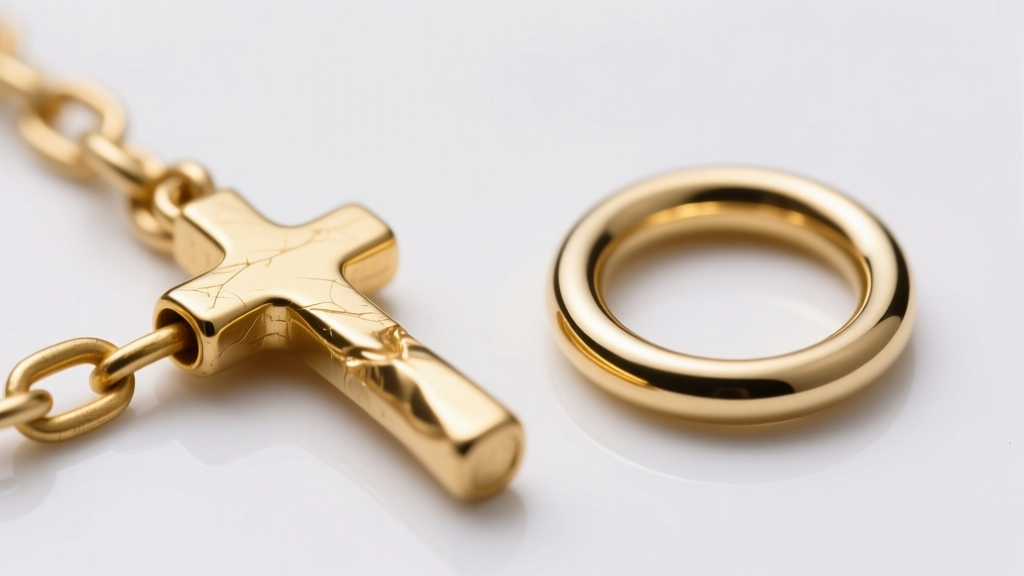
The durability of any chain is inextricably linked to its wire gauge. Rosary chains typically utilize much finer wire than standard necklace chains to maintain a delicate, unobtrusive profile that complements the beads. Standard rosary wire ranges from 24-gauge (0.51mm) to 20-gauge (0.81mm).
"When wrapping a 6mm gemstone bead for a rosary decade, a master jeweler relies on the 'memory' and yield strength of the wire. If the gold is too pure, the final twist will not hold flush against the bead, leaving a microscopic gap that will eventually snag and unravel." — Master Bench Jeweler Protocol
Because 10k gold possesses superior yield strength, artisans can confidently use 22-gauge or even 24-gauge wire to create secure, tight wraps around glass, onyx, or precious gemstone beads. If the same design were attempted in 14k or 18k gold, the jeweler would be forced to step up to a thicker 20-gauge wire to achieve the same breaking strength, resulting in a heavier, bulkier, and more expensive final piece.
The Tarnish Factor: Oxidation and Skin Chemistry
The most common criticism levied against 10k gold is its susceptibility to tarnish. Because 58.3% of the metal consists of reactive alloys like copper and silver, 10k gold can oxidize when exposed to environmental sulfur, high humidity, or the specific pH and amino acid profile of human sweat.
However, in the context of a rosary necklace, this is a highly manageable variable. Unlike a ring that sits flush against the skin in a high-friction, high-moisture environment, a rosary necklace rests over clothing or hangs freely against the chest. To mitigate oxidation, reputable manufacturers employ two primary strategies:
- High-Polish Finishing: A mirror-polished surface minimizes the microscopic surface area available for sulfur molecules to bond, significantly slowing the tarnishing process compared to matte or brushed finishes.
- Anti-Tarnish Coatings: Many modern 10k gold rosaries are treated with a nano-ceramic or e-coating that provides an invisible, hypoallergenic barrier against moisture and oxygen without altering the metal's optical properties.
For those with highly acidic skin chemistry, a 10k white gold rosary necklace is often rhodium-plated, providing a completely inert, bright white surface that eliminates tarnish and skin reactions entirely.
Pricing and Value Proposition
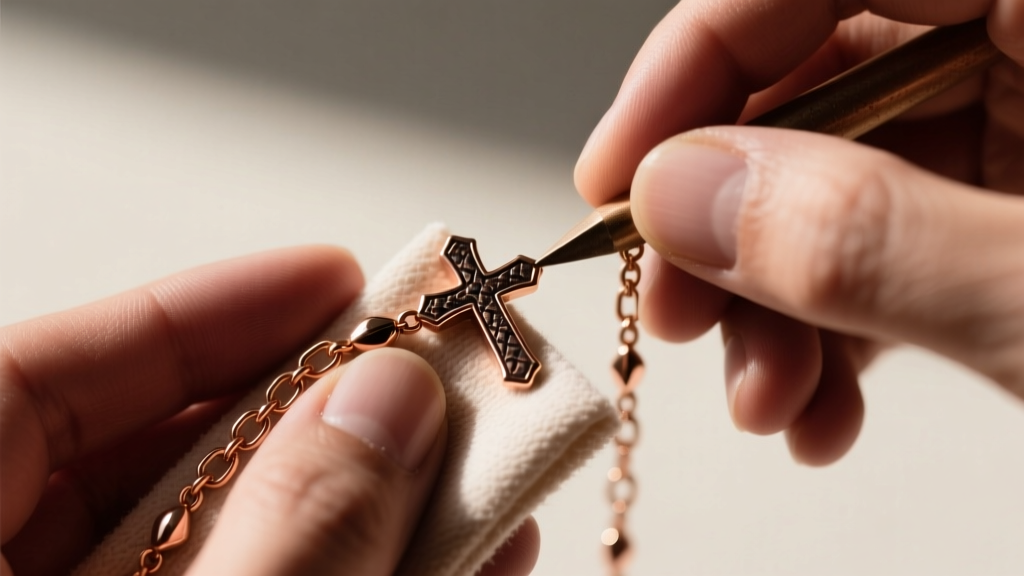
When analyzing the market for a 10k gold rosary necklace, buyers must separate the intrinsic melt value of the gold from the immense labor value of the piece. A traditional hand-linked rosary requires a jeweler to cut, loop, wrap, and close over 60 individual wire links, not including the assembly of the centerpiece and crucifix.
While the raw gold in a 10k piece is roughly 30% to 40% less expensive than 14k gold based on World Gold Council spot pricing, the retail price gap is often much narrower. This is because the bench labor, which constitutes the majority of the cost in complex rosary fabrication, remains identical regardless of the karat. Therefore, choosing 10k gold does not necessarily result in a "cheap" necklace; rather, it allows the buyer to allocate their budget toward higher quality gemstone beads (such as genuine Swarovski crystal or natural lapis lazuli) or a more ornate, solid cast crucifix, rather than overpaying for pure gold content that will be hidden inside the wire.
Final Verdict: Who Should Choose 10k Gold?
A 10k gold rosary necklace is not a compromise; it is a highly specialized material choice optimized for structural longevity. It is the definitive choice for:
- Daily Wearers: Those who intend to wear their rosary every day, inside and outside the shirt, where snagging and pulling are inevitable.
- Heirloom Seekers: Buyers looking for a piece that will survive decades of use without requiring constant re-soldering of pulled links by a bench jeweler.
- Active Individuals: Those who want the prestige and beauty of real gold but require a tensile strength that can withstand an active, hands-on lifestyle.
By prioritizing the mechanical advantages of a 10k alloy, you ensure that the intricate architecture of the rosary remains intact, allowing the piece to serve its devotional and aesthetic purpose for a lifetime.


