Expert Guide: Choosing the Perfect 14k Gold Paperclip Necklace
An expert technical guide to 14k gold paperclip necklaces, covering link soldering, gauge thickness, clasp mechanics, and precise layering formulas.

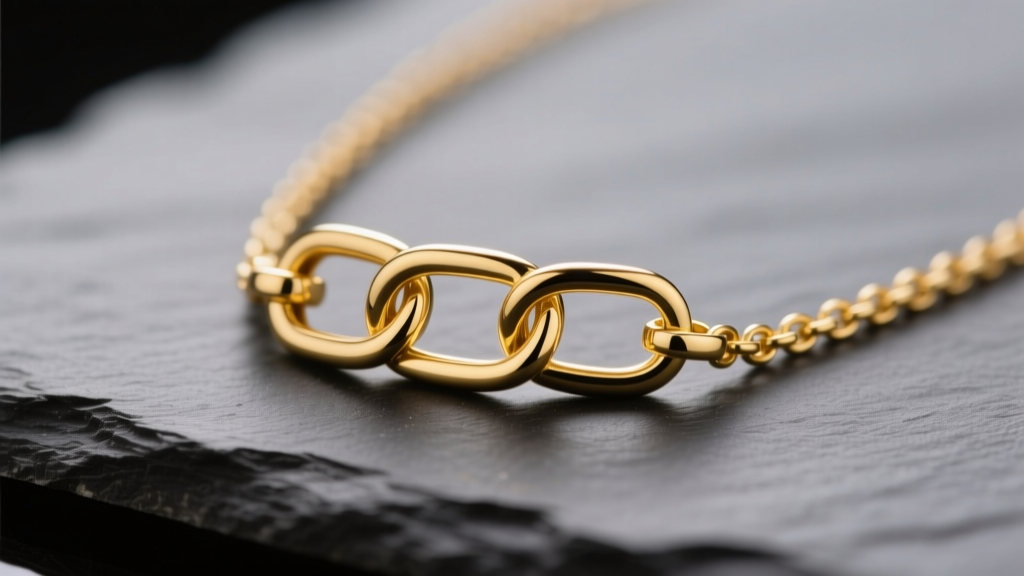
The Metallurgy and Anatomy of the Paperclip Link
The 14k gold paperclip necklace has transcended fleeting trend status to become a foundational staple in modern jewelry wardrobes. However, beneath the minimalist, elongated aesthetic lies a complex matrix of metallurgical and structural variables that dictate the chain's longevity, drape, and tensile strength. As a jewelry technical specialist, I evaluate these pieces not just by their visual appeal, but by their structural integrity. Standard 14k yellow gold is an alloy composed of 58.5% pure gold, typically blended with 25% silver and 16.5% copper. According to the Gemological Institute of America (GIA), this specific copper-to-silver ratio is critical; the copper provides the necessary tensile strength and work-hardening capabilities required for the elongated links of a paperclip chain to resist warping under their own weight and external tension.
The defining characteristic of the paperclip chain is its link aspect ratio, typically ranging from 3:1 to 4:1 (width to length). This elongated geometry creates a larger surface area for light reflection but introduces structural vulnerabilities at the link seams. In premium manufacturing, these seams are closed via automated laser welding. Unlike traditional torch soldering, which can anneal (soften) the surrounding work-hardened wire, laser welding creates a localized, high-heat fusion that maintains the wire's structural rigidity. Unsoldered or poorly soldered paperclip links will inevitably pull apart at the seam under just 2 to 4 pounds of tensile force.
Solid Drawn Wire vs. Electroformed Hollow Core
When sourcing a 14k gold paperclip necklace, the most critical technical distinction is whether the links are constructed from solid drawn wire or an electroformed hollow core. Solid wire chains are manufactured by extruding gold alloy through a series of progressively smaller draw plates, aligning the metal's crystalline structure and maximizing its yield strength. A solid 14-gauge paperclip chain can withstand upward of 40 pounds of tensile force before yielding.
Conversely, hollow paperclip chains are created through electroforming, where gold is deposited over a wax or resin mandrel. While this technique produces voluminous, lightweight links that mimic the look of heavy solid gold, the structural compromise is severe. The gold shell is often less than 0.15mm thick. These hollow links are highly susceptible to denting from minor impacts and cannot be repaired using standard laser or torch soldering, as the heat will either melt the internal resin core or cause the thin gold shell to collapse. For everyday wear, a solid core is the only technically sound investment.
Gauge, Weight, and Tensile Strength Matrix
Selecting the correct gauge (wire thickness) is essential for balancing visual impact with structural durability. The American Wire Gauge (AWG) system is inversely proportional to thickness; a lower number indicates a thicker wire. Below is a technical matrix detailing the specifications for standard solid 14k gold paperclip chains.
| Gauge (AWG) | Wire Diameter (mm) | Link Dimensions (mm) | Weight per 18" (g) | Tensile Yield (lbf) |
|---|---|---|---|---|
| 18 | 1.02 | 4.0 x 12.0 | 8.2 | 12-15 |
| 16 | 1.29 | 5.0 x 15.0 | 14.5 | 22-28 |
| 14 | 1.63 | 6.5 x 19.0 | 26.1 | 40-45 |
| 12 | 2.05 | 8.0 x 24.0 | 42.3 | 65-75 |
For a standalone piece that can support a moderate pendant (2-4 grams), a 16-gauge chain offers the optimal balance of durability and elegance. If the necklace is intended for heavy layering or supporting pendants exceeding 5 grams, upgrading to a 14-gauge wire is technically mandatory to prevent long-term metal fatigue and link stretching.
Clasp Mechanics: Preventing the Weakest Link Failure
A chain is only as strong as its clasp, and the paperclip necklace presents unique clasp-integration challenges. The standard 5mm spring ring clasp, commonly used on delicate chains, is a catastrophic failure point for paperclip chains 16-gauge and thicker. The internal spring mechanism in a standard spring ring lacks the tension to securely hold the thick, rigid wire of a paperclip link, often resulting in the link slipping out of the clasp jaw during wear.
For 16-gauge and 14-gauge paperclip chains, a 12mm to 15mm lobster clasp is the minimum acceptable hardware. The lobster clasp features a heavier internal spring and a wider jaw aperture, ensuring the thick paperclip link seats fully at the base of the clasp rather than resting on the tip. An even more robust solution, increasingly popular in high-end 2026 designs, is the integrated paperclip toggle. In this configuration, the final link of the chain is slightly elongated and acts as the toggle bar, passing through a reinforced jump ring on the opposite end. This eliminates mechanical spring failures entirely, relying instead on the tensile strength of the solid gold links.

Layering Physics: Friction and Nesting Prevention
Layering paperclip necklaces requires an understanding of friction coefficients and geometric nesting. The flat, elongated surfaces of the paperclip link create high friction against similar flat surfaces. If you layer two paperclip chains of varying lengths, the links will inevitably align, nest inside one another, and tangle into a rigid, knot-like mass that is difficult to separate without damaging the seams.
To engineer a successful layering stack, you must introduce chains with contrasting geometries and low-friction profiles. The optimal technical pairing for a 16-gauge paperclip chain is a 1.2mm to 1.5mm box chain or a smooth, tightly woven rope chain. The flat planes of the box chain or the cylindrical ridges of the rope chain prevent the paperclip links from nesting, allowing the chains to glide past one another dynamically. Furthermore, maintain a minimum length differential of 2.5 inches between layers to ensure the pendants or terminal links do not collide and cause abrasive wear on the gold alloy.
Ultrasonic Cleaning and Maintenance Protocols
Maintaining the high-polish finish of a 14k gold paperclip chain requires specific cleaning protocols. While ultrasonic cleaners are highly effective at removing sebum and environmental grime from the intricate seams of laser-welded links, they pose a severe threat to certain chain types. As noted by jewelry manufacturing experts at Ganoksin, the microscopic cavitation bubbles generated by ultrasonic frequencies can easily collapse the thin walls of hollow electroformed chains or shake loose poorly soldered seams.
If your chain is verified as solid drawn wire with laser-welded seams, a standard 3-minute cycle in a heated ultrasonic cleaner with a mild ammonia-based jewelry solution is safe and highly recommended. However, for routine maintenance, a soft-bristled baby toothbrush dipped in warm water and a drop of pH-neutral dish soap is sufficient to clean the interior of the rectangular links without risking structural fatigue. Always dry the chain thoroughly with a microfiber cloth, ensuring no moisture is trapped in the link seams, which can accelerate the oxidation of the copper alloy over time.


