14k Gold Sun Necklace: Metallurgy, Construction, and Buying Guide
Discover the technical details behind a 14k gold sun necklace. We analyze alloy compositions, casting methods, chain gauges, and enamel durability.

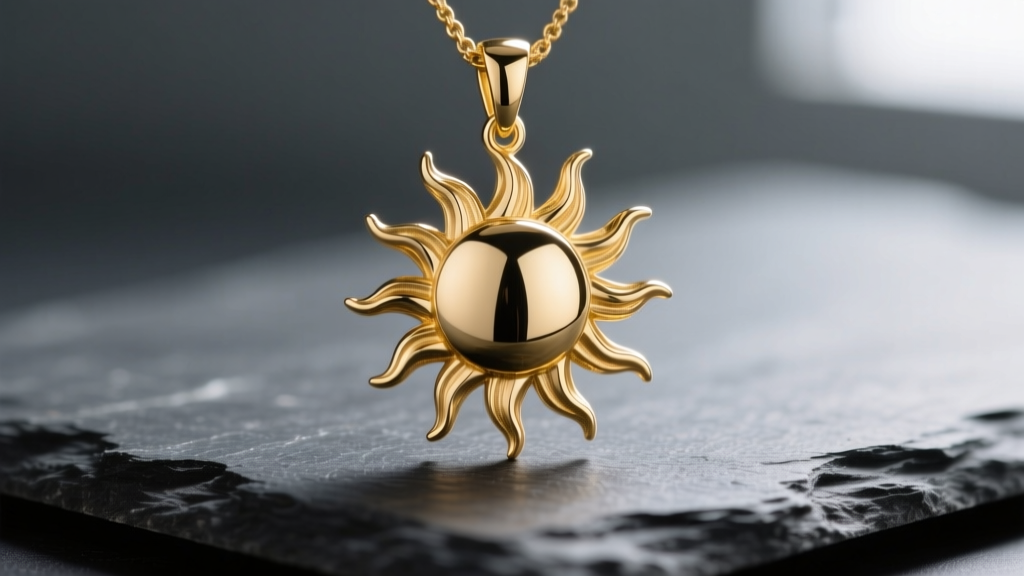
When evaluating a 14k gold sun necklace, consumers and collectors often focus solely on the aesthetic appeal of the sunburst motif. However, as a structural piece of fine jewelry, the technical specifications of the alloy, the manufacturing method of the pendant, and the tensile strength of the accompanying chain dictate its longevity and wearability. A sun pendant, characterized by its protruding rays and often intricate central detailing, presents unique engineering challenges compared to simpler geometric pendants. This expert deep dive explores the metallurgy, construction techniques, and mechanical requirements necessary to select or design a high-quality 14k gold sun necklace that will endure for generations.
The Metallurgy of 14k Gold: Why 58.5% Purity Matters for Pendants
To understand the durability of a 14k gold sun necklace, one must first examine the metallurgical properties of the alloy. Pure 24k gold is exceptionally soft, registering a mere 25 on the Vickers hardness scale. This makes it entirely unsuitable for the delicate, protruding rays of a sun pendant, which would easily bend, warp, or snap under minor mechanical stress.
According to the Gemological Institute of America (GIA), 14k gold consists of 58.3% (or 58.5% depending on regional hallmarking standards) pure gold, with the remaining 41.5% comprised of a master alloy. This specific ratio elevates the Vickers hardness to approximately 130-150 HV, providing the necessary rigidity to maintain the sharp lines of sunburst rays while retaining enough malleability for intricate casting and polishing.
Yellow, Rose, and White: Alloy Compositions and Wear Patterns
The visual and physical characteristics of your sun necklace depend heavily on the master alloy used:
- 14k Yellow Gold: Typically alloyed with a balanced mix of copper and silver. It offers the best overall balance of tarnish resistance and structural integrity. The warm hue naturally complements the solar motif.
- 14k Rose Gold: Achieved by increasing the copper content (often up to 20% or more of the total alloy). While visually striking, the higher copper content makes the metal slightly more prone to oxidation and requires more frequent polishing to maintain the high-shine finish on the sun's rays.
- 14k White Gold: Alloyed with nickel, palladium, or manganese, and plated with rhodium. For a sun pendant, white gold presents a specific wear issue: the rhodium plating will inevitably wear off the high-friction edges of the protruding rays first, revealing the slightly yellowish underlying alloy. Palladium-based white gold alloys are preferred over nickel-based ones to prevent contact dermatitis, though they are more expensive and harder to cast.
Sun Pendant Construction: Casting vs. Die Striking
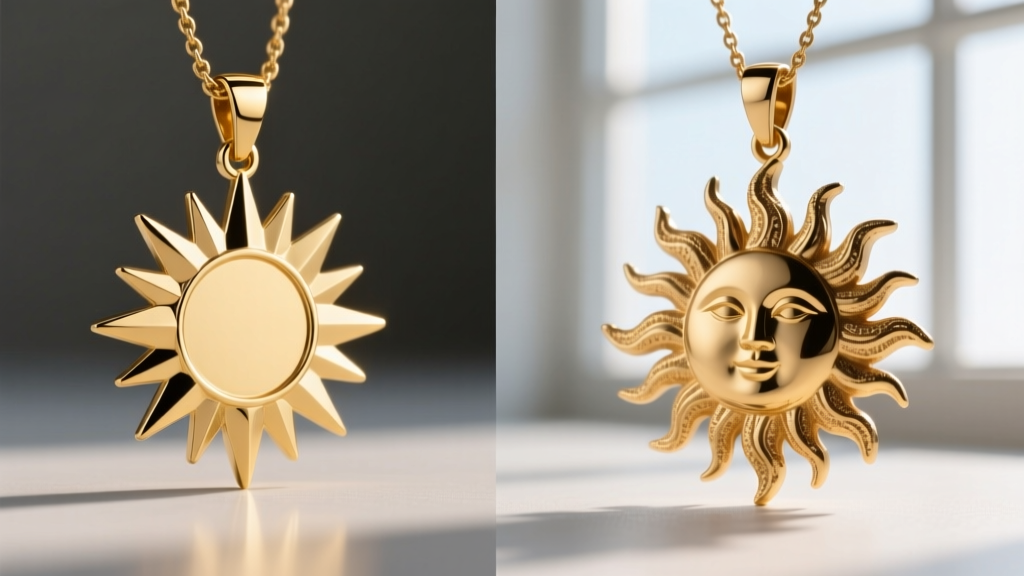
The manufacturing technique used to create the sun pendant fundamentally alters its weight, detail resolution, and structural density. There are two primary methods utilized in fine jewelry production for this specific motif.
Lost-Wax Casting for 3D Sun Faces
If the sun necklace features a three-dimensional face, granulation, or deep undercuts in the rays, it is almost certainly produced via lost-wax casting. This method involves injecting wax into a rubber mold, investing it in plaster, burning out the wax, and pouring molten 14k gold into the cavity. Cast gold is slightly more porous and softer than work-hardened gold. To mitigate this, expert jewelers will heavily polish and burnish the cast rays to compress the surface molecules, increasing surface hardness and creating a mirror finish that resists micro-scratches.
Die Striking for Flat Sunbursts
For flat, geometric sunburst designs, die striking is the superior technical choice. This process uses immense hydraulic pressure to stamp a sheet of 14k gold between two hardened steel dies. The extreme pressure aligns the metal's grain structure and work-hardens the gold, making a die-struck sun pendant up to 30% harder and denser than a cast equivalent. While it limits the design to flat or low-relief profiles, a die-struck sunburst is virtually impervious to bending and requires less metal, resulting in a lighter, more durable everyday pendant.
Enamel and Gemstone Inlays: Technical Failure Points
Many high-end 14k gold sun necklaces incorporate color to represent the sun's core or the sky behind the rays. The technical execution of this color is critical to the piece's lifespan.
Vitreous Enamel: This is the only acceptable standard for heirloom-quality jewelry. Vitreous enamel is essentially powdered glass that is fired in a kiln at temperatures exceeding 1400°F. It fuses chemically with the 14k gold, creating a bond that will not degrade, yellow, or peel over time. However, because glass is brittle, a vitreous enamel sun pendant must not be dropped on hard surfaces, as the thermal shock and impact can cause the enamel to shatter.
Cold Epoxy Enamel: Often found in lower-tier or mass-produced sun necklaces, cold epoxy is essentially a colored resin. While it is impact-resistant and will not shatter, epoxy degrades under UV light exposure, inevitably yellowing and shrinking away from the gold bezel walls within three to five years of daily wear.
Chain Pairing: Gauge, Tensile Strength, and Clasp Mechanics
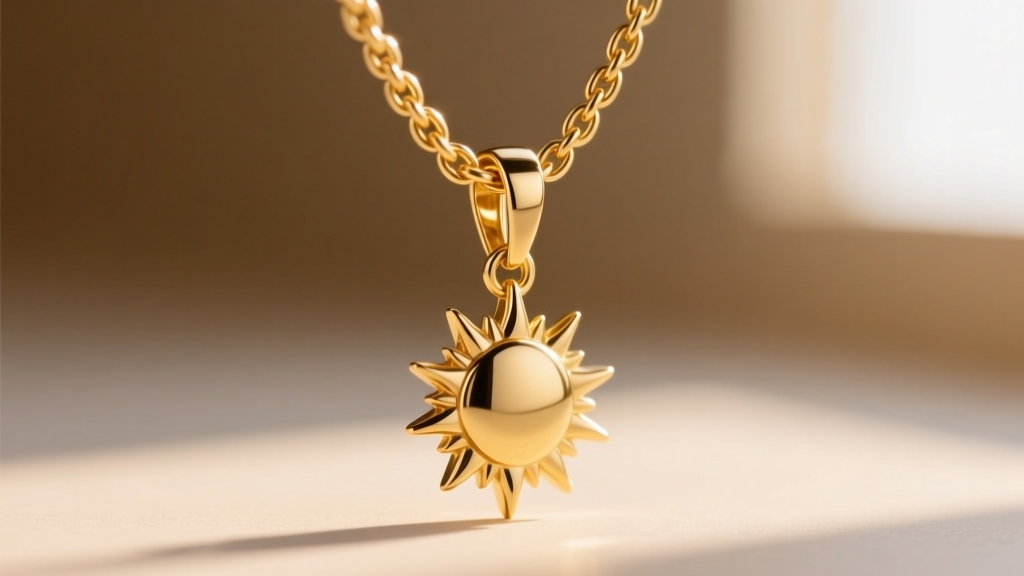
A common failure point in sun necklaces is the chain snapping or the bail (the loop connecting the pendant to the chain) wearing through. Sun pendants are typically front-heavy and feature intricate bails that can act like a saw against softer or thinner chains. The Federal Trade Commission (FTC) Jewelry Guides mandate accurate karat marking, but do not regulate chain tensile strength, leaving it to the buyer to verify mechanical compatibility.
When pairing a chain with a 14k gold sun pendant, you must calculate the pendant's weight and select a chain with a tensile strength rating that exceeds it by a minimum factor of four to account for dynamic shock loads (e.g., the necklace catching on clothing).
| Chain Type | Recommended Gauge (mm) | Approx. Tensile Strength | Best For Pendant Weight | Bail Friction Resistance |
|---|---|---|---|---|
| Cable Chain | 1.2 - 1.5 | 15 - 25 lbs | Under 5g (Lightweight sunbursts) | Moderate |
| Wheat Chain | 1.5 - 2.0 | 30 - 45 lbs | 5g - 15g (Standard cast sun faces) | High (Excellent) |
| Rope Chain | 1.8 - 2.5 | 40 - 60 lbs | Over 15g (Heavy, gem-set suns) | Low (Prone to catching) |
| Box Chain | 1.2 - 1.8 | 20 - 35 lbs | Under 8g (Flat die-struck suns) | Moderate |
Note: Always avoid hollow-core rope or herringbone chains for sun pendants. The protruding rays will easily dent hollow tubing, and the bail will rapidly wear through the thin outer gold shell.
Pricing Tiers and Authenticity Verification
In the 2026 market, the pricing of a solid 14k gold sun necklace is directly tethered to the spot price of gold, plus a manufacturing premium. A standard solid 14k gold sun pendant weighing between 6 and 10 grams should retail between $450 and $850, depending on the complexity of the casting and the presence of vitreous enamel or gemstones.
Beware of deceptive terminology. Terms like "14k gold-plated," "14k vermeil," and "14k gold-filled" refer to a microscopic layer of 14k gold over a base metal core (usually brass or sterling silver). While vermeil is acceptable for fashion jewelry, the friction from the sun pendant's bail will wear through the gold plating on the chain within months, exposing the base metal to sweat and causing rapid oxidation and skin discoloration. Always look for the "14k" or "585" stamp on both the pendant bail and the chain clasp.
Maintenance and Chemical Exposure Risks
The most severe threat to a 14k gold sun necklace is not physical impact, but chemical exposure—specifically to chlorine. When 14k gold is exposed to chlorinated water (in swimming pools or hot tubs), the chlorine reacts with the copper and silver in the master alloy. This causes a metallurgical phenomenon known as stress corrosion cracking.
The delicate tips of the sun's rays, which harbor microscopic casting stresses, are the first to succumb to this chemical attack, often snapping off cleanly without warning. To preserve the structural integrity of your necklace, it must be removed before swimming. For routine cleaning, an ultrasonic cleaner is safe for plain 14k gold sun pendants, but if the piece features vitreous enamel or fracture-filled gemstones in the center of the sun, it must be cleaned manually with a soft brush, warm water, and a mild, non-detergent soap to avoid thermal shock or chemical stripping.


